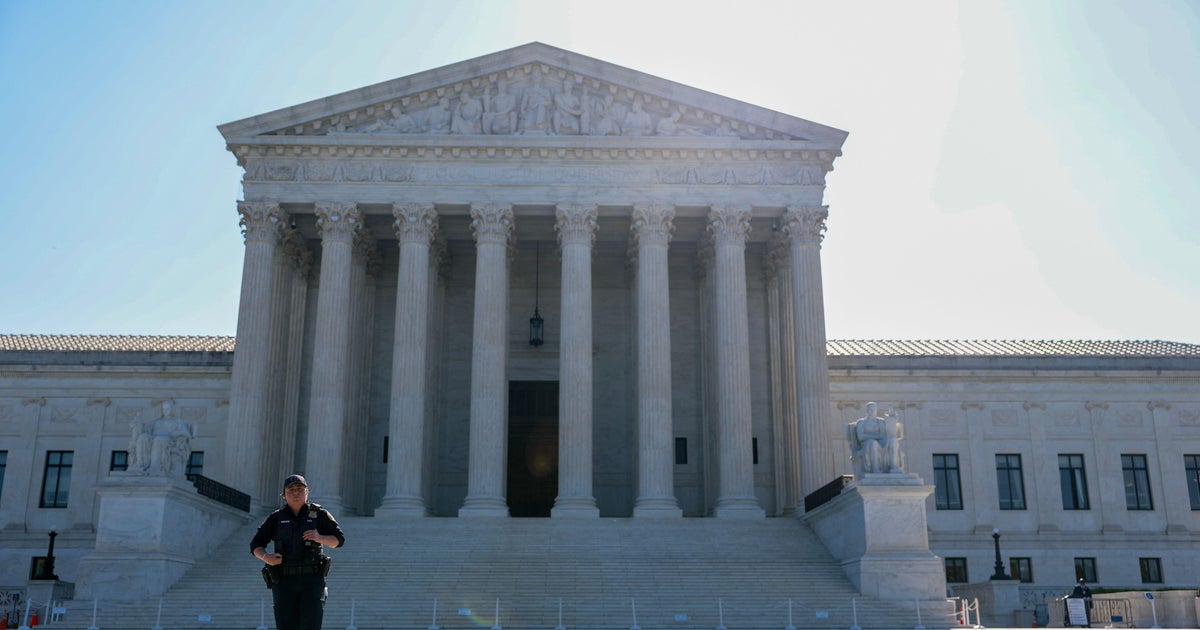
Washington — The Supreme Court on Wednesday is weighing the Trump administration’s efforts to rescind temporary deportation protections for more than 6,000 Syrian and 350,000 Haitian immigrants.
President Trump and his administration have moved to end the relief, known as Temporary Protected Status, for 1 million immigrants from 13 countries since the start of the president’s second term. The push to revoke TPS is just one aspect of Mr. Trump’s immigration agenda, a pillar of which is mass deportations.
The cases before the court, known as Mullin v. Doe and Trump v. Miot, stem from then-Secretary of Homeland Security Kristi Noem’s decisions to end TPS for thousands of Syrians and Haitians. In both cases, Noem determined that after consulting with other agencies and reviewing conditions in the two countries, they no longer met the criteria for TPS.
Syria’s designation was set to end last November and Haiti’s in February. Immigrants from the two countries had roughly 60 days from Noem’s announcement to when their deportation protections would expire.
But TPS holders from Syria and Haiti filed two lawsuits challenging the administration’s terminations as unlawful, and judges in New York and Washington, D.C., agreed to postpone the effective dates. After appeals courts declined to put the lower court decisions on hold, the Trump administration sought emergency relief from the Supreme Court.
The high court said last month that it would consider the government’s efforts to roll back the protections for Syrians and Haitians, but it left the programs for the two countries in place while it considers the case.
Last year, the Supreme Court twice allowed DHS to revoke protections for hundreds of thousands of migrants from Venezuela, putting them at risk of arrest and removal.
Enacted by Congress in 1990, the TPS program gives the homeland security secretary the power to provide temporary, country-specific relief to foreign nationals who cannot safely return to their home countries because of war, natural disaster or other “extraordinary and temporary conditions.”
Relief is limited to 18 months, but the secretary can provide extensions if he determines that a country is not safe for immigrants to return to.
A key question before the Supreme Court is whether courts can even review the claim that the secretary violated federal law when she moved to end TPS for Syria and Haiti.
The Trump administration has interpreted the TPS statute broadly to bar judicial review of the ultimate decision to designate, terminate or extend the relief program, as well as the steps and analysis taken by the secretary in the lead-up to a determination.
Solicitor General D. John Sauer argued in court filings that the lower courts substituted “their own views for those of the Executive as to procedures, country conditions, and foreign-policy objectives.” He rejected claims that Noem failed to consult with the appropriate agencies, namely the State Department, before concluding that Haiti and Syria were safe for immigrants to return to.
That consultation requirement, he said, “does not invite district courts to sit in judgment of when agencies have communicated enough. All the statute requires is that DHS solicit and receive other agencies’ views; Congress left the Executive Branch to resolve how that process happens and how much detail other agencies provide.”
Sauer also rejected the lower court’s finding that the Trump administration’s decision to end TPS for Haiti rested on racial animus, calling it a “legal and factual nonstarter.”
The plaintiffs, though, argued that the homeland security secretary failed to engage in adequate consultation with the State Department, violating the TPS statute’s requirement for interagency discussions on the conditions in countries whose nationals are shielded from deportation.
They noted that the State Department has issued Level 4 travel advisories for both Syria and Haiti, warning Americans against traveling there because of kidnapping, terrorist activity and unrest. The plaintiffs’ lawyers said those advisories highlight the inconsistencies with Noem’s TPS determinations that the countries are safe.
Lawyers for both the Haitian and Syrian immigrants warned that if the Supreme Court finds that courts have no role to play, it would shield from scrutiny the secretary’s actions regarding TPS.
The plaintiffs take a more narrow view of the TPS law and argue that it bars judicial review only of the secretary’s determination as to the safety of a country, and whether the protections should therefore be ended or extended. Courts, however, can scrutinize the process taken to reach that conclusion and whether the secretary applied the criteria laid out in the law, they said.
The TPS holders also cited public statements from the secretary and Mr. Trump, which they said demonstrate that Noem moved to end TPS to help the president achieve his goal of rolling back the deportation programs, regardless of whether a country was safe to return to.
Syria was first designated for TPS in 2012 by the Obama administration, which cited “extraordinary and temporary conditions” stemming from former Syrian President Bashar al-Assad’s crackdown on anti-government protests.
Haiti, meanwhile, was designated for TPS for the first time by the Obama administration in 2010 because of a devastating earthquake, which affected roughly one-third of Haiti’s population of 9 million people. The Biden administration extended TPS for Haiti several times because of economic, health and political crises in the wake of the assassination of its president in 2021.