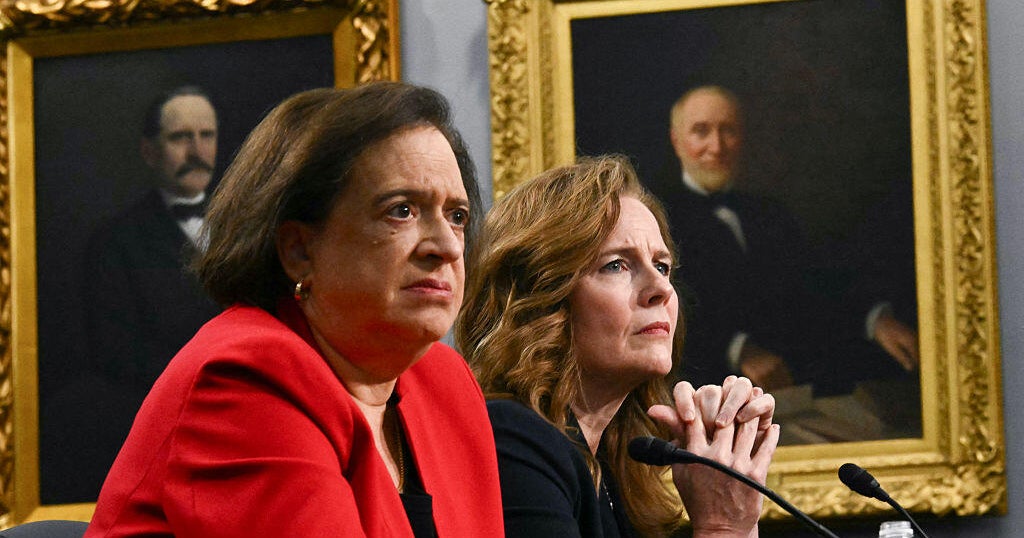
Washington — Supreme Court Justices Elena Kagan and Amy Coney Barrett urged Congress on Tuesday to provide additional funding to enhance protection for the justices as they face a rise in threats, with Kagan warning that the “threats have come very close” for some members of the high court.
Kagan and Barrett made a rare appearance before a House subcommittee to testify about the Supreme Court’s budget request for the next fiscal year, which begins Oct. 1. The pair will also appear before a Senate panel later Tuesday, just weeks after the Supreme Court finished handing down decisions to wrap its latest term.
The Supreme Court is seeking more than $228 million from congressional appropriators, an increase of more than $20 million. Part of the court’s funding request includes an additional $14.6 million to expand security for the justices provided by the Supreme Court Police, which would allow for an additional six agents per member of the court, according to budget documents. The money would also be used for travel when the justices are outside of the Washington, D.C., region.
Each justice is currently assigned between four and eight officers as part of their security details, Barrett said, but that may increase if a member of the court is facing a particular threat or is participating in more public events.
Kagan told lawmakers that the recent increases in the court’s budget have been “almost entirely” for security expenses, since the Supreme Court’s in-house police force took over residential security for the justices from the U.S. Marshals Service.
“For some of us, those threats have come very close, and all of us live with the knowledge that they may again materialize,” she said. “But, as the chief justice has said, all members of the court continue to do their jobs as they believe legally right, adjudicating cases without fear or favor.”
Kent NISHIMURA /AFP via Getty Images
The Supreme Court Police is anticipating a 38% increase in threats for 2026, Kagan said. For federal judges, there was a 57% rise in “security incidents of significant concern” in fiscal year 2025, according to the Marshals Service. As of July 1, there have been 370 threats to judges this fiscal year, and the Marshals have conducted 512 investigations, according to agency data. In the last fiscal year, there were 564 total threats to judges, the Marshals Service said.
Sitting judges and members of the Supreme Court have been facing a barrage of threats in recent years. A CBS News analysis found there were 126 prosecutions from 2025 that stemmed from threatening communications and 12 of those cases arose from menacing messages directed at judges.
Following the May 2022 leak of a draft Supreme Court opinion overturning Roe v. Wade, protesters descended outside the homes of several conservative justices, including Barrett’s. That June, an individual from California was arrested outside of Justice Brett Kavanaugh’s Maryland residence with a handgun, knife and tools.
Prosecutors said the defendant aimed to kill three members of the Supreme Court and had researched their home addresses. The individual, who was arrested as Nicholas Roske but now goes by Sophie Roske, pleaded guilty in April 2025 to attempting to kill or kidnap a Supreme Court justice and was sentenced to more than eight years in prison.
Barrett separately told House members about being given a bulletproof vest following the leak of the decision reversing Roe v. Wade and having to answer questions from her then-12-year-old son about it.
“I didn’t expect that performing this service was going to put me in the position of explaining to my children what a bulletproof vest was and why I had to wear one,” she said.
The justice also said that she was the victim of a “swatting” incident roughly six weeks ago. Her teenage son opened the door to their home and saw police cars on the street responding to a false report of gunshots and “raised voices,” Barrett said.
The Supreme Court Police, who were stationed outside her house, met with local police and explained it was a “false alarm,” she said.
“Federal judges across the country, throughout the judiciary, including the Supreme Court, continue to do their jobs without fear or favor, but the threat level is really high,” she said.
Several judges, including Barrett, have also been the victims of “pizza doxxing,” where they’ve received anonymous pizza deliveries to their homes, she said. The pizzas are sent in the name of Daniel Anderl, the 20-year-old son of U.S. District Judge Esther Salas who was shot and killed at their New Jersey home by a disgruntled lawyer.
“The message on these deliveries being sent in his name is clear,” Barrett said, telling lawmakers they’re “designed to intimidate and harass us.”
Kent NISHIMURA /AFP via Getty Images 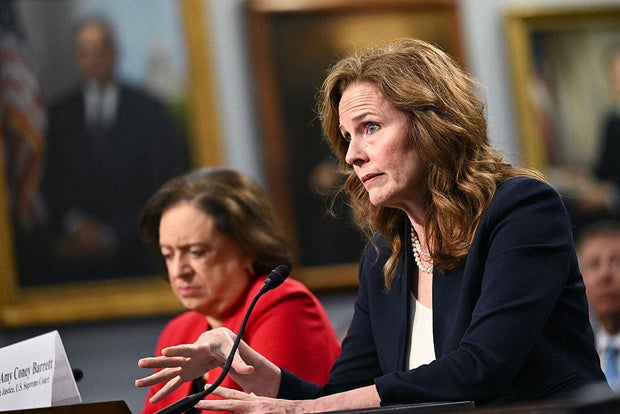
Lawmakers appeared ready to provide the resources for the Supreme Court to beef up its security.
Judicial officers “must be able to do their jobs without fear for their safety or their family’s safety,” said Rep. David Joyce, an Ohio Republican who chairs the House subcommittee.
Rep. Steny Hoyer of Maryland, the top Democrat on the panel, said, “With a deeply divided country and increasingly violent rhetoric being directed at judges, Congress must provide sufficient funding to ensure the safety of all judicial personnel.”
Beyond protection at the justices’ houses, the Supreme Court is also seeking $6.5 million for a facility to screen visitors to the high court outside of the building, similar to the Visitor Center at the U.S. Capitol. Roughly $2.3 million would go to cybersecurity, according to budget documents.
While the justices were on Capitol Hill to testify about the court’s requested operating budget, Kagan and Barrett fielded questions about the Supreme Court’s code of conduct, which it adopted in 2023, as well as the court’s caseload and requests for temporary relief made on its interim docket, also known as the emergency or “shadow” docket.
The high court has faced scrutiny for its handling of cases on its shadow docket, largely as it faced a slew of requests from the Trump administration last year to enforce the president’s second-term policies, and lower courts indicated they were struggling with how to apply the Supreme Court’s orders.
But Kagan said in the past year or so, the Supreme Court has “gotten more experienced” in handling those requests and providing a more thorough explanation of its decisions.
“We better recognize that at least sometimes, there is a need for additional information, and we have issued opinions and sometimes majority and dissenting opinions accordingly,” she told lawmakers.
Kagan noted that the Supreme Court has “tried to do better in important cases” by soliciting additional briefs and holding oral arguments, such as in the recent dispute over Mr. Trump’s attempt to fire Lisa Cook from the Federal Reserve’s Board of Governors. The Supreme Court heard arguments in the case and ruled last month that Cook can continue in her post while her lawsuit challenging her attempted removal moves forward.
Asked by Rep. Mark Pocan, a Democrat from Wisconsin, about the shadow docket, Kagan suggested the increase in emergency requests may be because some parties have had success in securing relief while their case proceeds.
“People see that there is at least a potential for us to grant relief, and so why not file a petition,” she said.
Congressional testimony by the justices used to be a common occurrence. Justices appeared before House and Senate panels at least once every year from 1960 through 2011, according to a 2023 report from the Congressional Research Service. But their participation has waned in recent years.
Members of the Supreme Court — Kagan and Justice Samuel Alito — last answered questions from the House in 2019 in a hearing that focused on the court’s budget request. And sitting justices — Justices Stephen Breyer and the late Justice Antonin Scalia — last testified at a Senate hearing in 2011.
While Chief Justice John Roberts was asked to testify on Capitol Hill about ethics rules governing the high court in 2023, he declined to do so. Roberts told Sen. Dick Durbin, an Illinois Democrat who chaired the Senate Judiciary Committee at the time, that testimony by the chief justice is “exceedingly rare” and cited “separation of powers concerns and the importance of preserving judicial independence.”