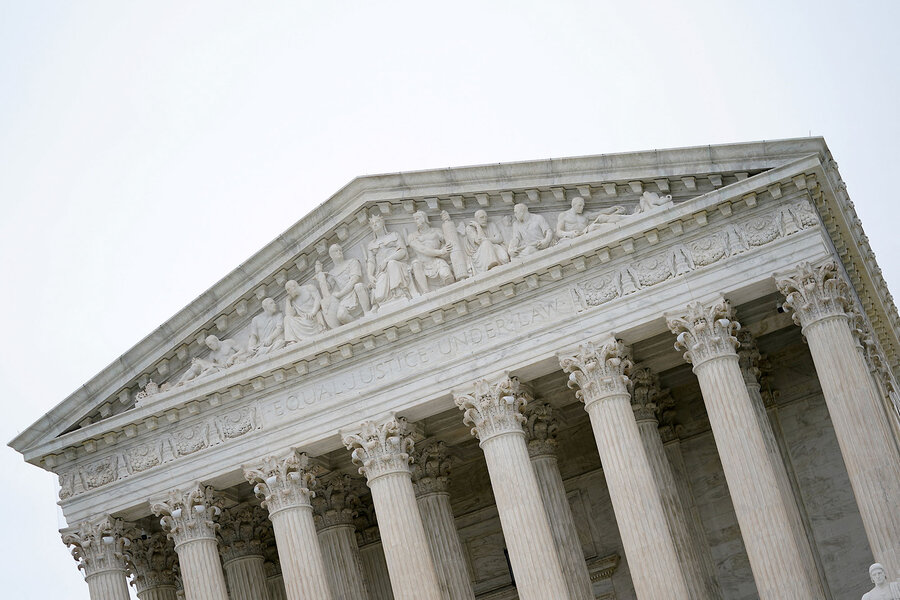
In a landmark ruling Wednesday, the U.S. Supreme Court held that a Louisiana congressional map – drawn to protect the electoral clout of Black voters in the state – is itself an unconstitutional racial gerrymander.
The case, Louisiana v. Callais, concerned a map creating two majority-minority voting districts in a state where about one-third of the population is Black, and in a country where voting behavior often tracks closely with race.
The decision continues a decadelong trend of the high court reinterpreting a 1965 civil rights law enacted to protect minority voting rights. It could set off another wave of partisan redistricting, with potentially decisive consequences for which party controls Congress in the coming midterm elections and in years to come.
Why We Wrote This
In a major voting rights case, the Supreme Court struck down Louisiana’s congressional map, calling it an unconstitutional race-based gerrymander. This continues a decadelong trend of the high court reinterpreting the 1965 Voting Rights Act.
The ruling broke 6-3 along the court’s ideological divide. The majority opinion didn’t strike down the law at issue – Section 2 of the Voting Rights Act – but it did craft an updated framework through which courts must now evaluate race-based challenges to proposed voting maps.
These updates “eviscerate” Section 2, Justice Elena Kagan wrote in a dissent joined by her two liberal colleagues. But the majority contended that its ruling corrects a recurring flaw with modern redistricting – and, more broadly, modern American society – that reinforces racial segregation. The majority opinion, penned by Justice Samuel Alito, contends that efforts to address racial discrimination through the Voting Rights Act have sometimes perpetuated discrimination instead. It’s a familiar concern for the court, which three years ago – in another 6-3 decision along ideological lines – struck down affirmative action policies at colleges and universities.
“Unfortunately, lower courts have sometimes applied this Court’s [Section 2] precedents in a way that forces States to engage in the very race-based discrimination that the Constitution forbids,” wrote Justice Samuel Alito in the majority opinion for Callais.
“But,” he added, “allowing race to play any part in government decisionmaking represents a departure from the constitutional rule that applies in almost every other context.”
Legal experts differed in their immediate responses to Wednesday’s ruling and its significance, largely mirroring the splits among the justices.
The ruling was “long overdue” and “makes it clear that the government can’t treat citizens differently based on their race,” says Zack Smith, senior legal fellow and manager of the Supreme Court Appellate Advocacy Program at the conservative Heritage Foundation.
“The court did not overturn Section 2 of the Voting Rights Act; they simply said that the way certain lower courts had been interpreting and applying it was incorrect,” he added.
The ruling wasn’t simply a narrow one, says Kareem Crayton, a vice president at the left-leaning Brennan Center for Justice, but one that broadly undermines the Voting Rights Act.
“It purported to keep the provision in question in place, but effectively prevented any practical usage of the act to actually get at the object of the framers, which is to end racial discrimination,” he says.
As a result of the ruling, Louisiana will need to redraw its congressional map. That may face new legal challenges, as well as a time crunch; early voting for Louisiana’s primary starts Saturday.
Addressing a “long-unresolved question”
Wednesday’s decision is a landmark development in a long-running dispute dating back to the 2020 Census. After every decennial census, state legislatures traditionally redraw their congressional maps to account for population changes.
When Louisiana redrew its congressional map, the state legislature adopted a six-district map in 2022, with one majority-Black district, in a state where about one-third of the adult population was Black.
A group of Black voters challenged the new map in federal court, alleging that it violated Section 2 of the Voting Rights Act, which bars any voting practice or procedure that “results in a denial or abridgement of the right of any citizen…to vote on account of race or color.” Lower courts agreed with that argument and ordered Louisiana to draw a new map.
In 2024 the legislature drew a new map, this one featuring a second majority-Black district. This map also faced legal challenge, this time from a group of “non-African American” voters who alleged that it had unconstitutionally sorted voters by race.
The case over the second map reached the Supreme Court last term, and the justices heard oral arguments in March 2025. In a rare turn of events, the court did not issue a decision, instead scheduling a second round of arguments for October 2025 after the court’s summer recess.
The case teed up for the court what Justice Alito described as a “long-unresolved question.”
“The Constitution almost never permits [discrimination] on the basis of race,” he wrote. Supreme Court precedents have identified a “very short list of compelling interests” that can justify flouting the Constitution in this way, he added. Should Section 2 be added to that list?
“For over 30 years, the Court has simply assumed for the sake of argument that the answer is yes,” wrote Justice Alito.
With its ruling in Callais, the high court has turned that answer from a “yes” to a “yes, if.”
How Section 2 can now be used
Section 2 must be reconciled with the 15th Amendment of the Constitution’s prohibition on intentional racial discrimination, the Supreme Court majority held. This would mean the provision “does not intrude on States’ prerogative to draw districts based on nonracial factors, including to achieve partisan advantage,” wrote Justice Alito.
As a result, he continued, a Section 2 challenge can succeed “only when the evidence supports a strong inference that the State intentionally drew its districts to afford minority voters less opportunity because of their race.”
The Voting Rights Act provision does still have legal force – though Justice Kagan, in dissent, argued otherwise – the majority explained. The court had outlined how plaintiffs can prove racial “vote dilution” cases under Section 2 in the 1986 case Thornburg v. Gingles. The Callais decision “only update[s] the [Gingles] framework” to align with, among other things, “important developments” over the past four decades.
Among those developments, Justice Alito wrote: “vast social social change has occurred throughout the country and particularly in the South, which have made great strides in ending entrenched racial discrimination” from the Jim Crow era.
In a one-paragraph concurring opinion, Justice Clarence Thomas – joined by Justice Neil Gorsuch – said the Callais ruling has been overdue.
With its original Gingles framework, “the Court led legislatures and courts to ‘systematically divid[e] the country into electoral districts along racial lines,’” wrote Justice Thomas, quoting his own concurrence in a case from 1994.
“Today’s decision should largely put an end to this ‘disastrous misadventure’ in voting-rights jurisprudence,” he added.
“In general, the government cannot treat citizens differently based on race, and unfortunately, I think in a lot of areas of the law, there’s been this idea that there can be such a thing as good discrimination,” says Mr. Smith of Heritage. “What the Roberts court has done well, in particular, is say that no, there is no such thing as good discrimination.”
A dilution of voting power?
In a lengthy dissent, Justice Kagan – joined by Justices Sonia Sotomayor and Ketanji Brown Jackson – blasted the majority for a decision she warned could lead to the widespread disenfranchisement of minority voters.
“Under the Court’s new view of Section 2, a State can, without legal consequence, systematically dilute minority citizens’ voting power,” wrote Justice Kagan.
The majority opinion downplayed the significance of its holding, she added, describing Justice Alito’s opinion as “understated, even antiseptic.”
“The majority claims only to be ‘updat[ing]’ our Section 2 law, as though through a few technical tweaks,” she continued. “But in fact, those ‘updates’ eviscerate the law.”
This decision will “reverberate for a very long time,” says Lindsey Langholz, vice president of policy and program at the American Constitution Society, a progressive legal organization.
“It is the final piece in the Roberts’ courts attack on the Voting Rights Act,” she says. “Section 2 was one of the very few meaningful provisions left, and they’ve now essentially rendered it powerless.”
Tracking Supreme Court precedent on the Voting Rights Act
The Callais ruling in many ways echoes the court’s 2013 decision in Shelby County v. Holder. In that case, the court held that Section 4 of the Voting Rights Act was unconstitutional. That decision effectively ended the law’s “preclearance” requirement, in which certain jurisdictions with a history of discrimination needed to have any proposed changes to voting procedures cleared by the Justice Department or a federal judge in Washington, D.C. before they could go into effect.
The Shelby County ruling left Section 2 as the primary statute through which to challenge allegedly discriminatory voting laws. In a 2021 decision, the high court limited when challenges under that provision could be brought. A year later, the justices actually dismissed a challenge to Section 2 from the state of Alabama over an allegedly racially gerrymandered voting map. (During this period, the court also ruled that partisan gerrymandering claims are not reviewable by federal courts.)
Alabama had argued that the Gingles Section 2 framework conflicted, to an unconstitutional degree, with the 15th Amendment, Justice Kagan noted in her Callais dissent. “We stomped on that objection,” she added.
Exactly what effects the Callais ruling will have on redistricting are unclear, but the Shelby County case may be instructive. That decision led to a surge in states enacting stricter voting laws, according to the nonpartisan League of Women Voters. A decrease in Black voter turnout, relative to white voters, has also been documented in a 2024 study in the Journal of Public Economics.
As in Callais, the Shelby County court pointed to positive social change since the civil rights era as a reason the Voting Rights Act provision was no longer needed. (“Things have changed dramatically” in the South, Chief Justice John Roberts wrote in that majority opinion.)
The Callais majority “summons the slogan of Shelby County” when it comes to citing increases in Black voter registration and Black elected officials, Justice Kagan wrote.
“No doubt that is so, in large measure because of the Voting Rights Act. But it is a separate question whether those gains will endure once the Act’s protections are gone,” she added.