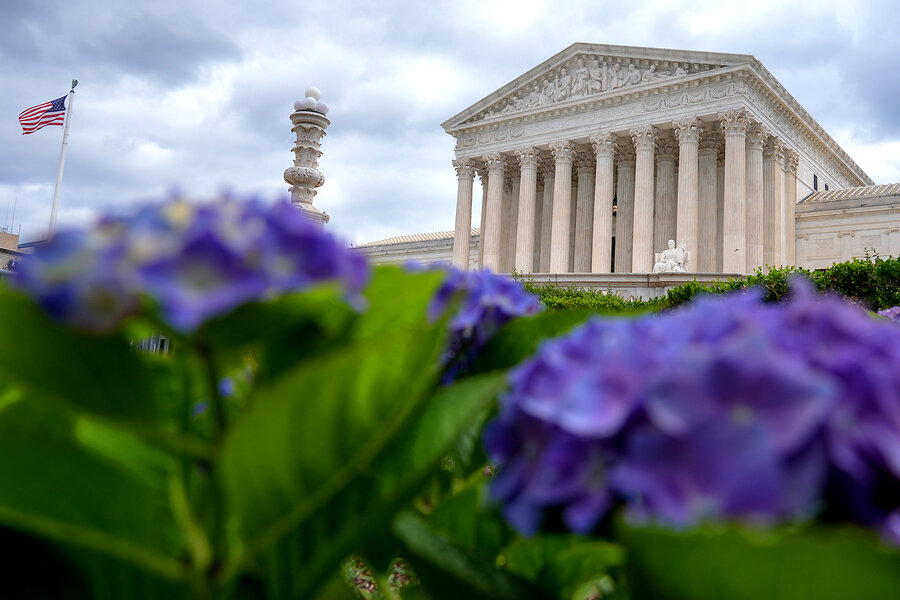
The U.S. government can’t take away a Texas man’s right to own a gun, even though he uses marijuana, the Supreme Court held Thursday, in a unanimous decision that narrows a provision of a federal gun control law.
The case, United States v. Hemani, offered the justices a chance to further explain how courts should apply the “history and tradition” test for restrictions on gun ownership that the high court created in a landmark gun rights decision in 2022. Since that ruling, lower courts have seen a flood of cases testing the new standard.
The U.S government argued it could prosecute Ali Hemani based on the Gun Control Act of 1968, which prohibits gun possession by individuals who are “an unlawful user of or addicted to any controlled substance.”
Why We Wrote This
A unanimous Supreme Court sided with a marijuana user whom the U.S. government had arrested for gun possession. The case offered the court’s latest insights on how to apply its “history and tradition” test to gun regulation.
To meet the Supreme Court’s “history and tradition” test for gun laws, government lawyers argued that the 20th-century law was analogous to “habitual drunkard laws” in place around the nation’s founding.
Justice Neil Gorsuch, writing the majority opinion for the 9-0 court, rejected the government’s arguments in favor of Mr. Hemani. (Several justices wrote concurring opinions explaining differences in their reasoning.)
“The government’s analogy fails under every measure it asks us to consider: The historical laws on which it relies targeted different kinds of people, did so for different reasons, and operated in different ways,” he wrote.
“Whatever one thinks of … developments [like marijuana acceptance], the federal government has not just tolerated them; it helped fuel them,” Justice Gorsuch noted. “All of which leaves it awkwardly positioned to suggest that the millions of Americans who now regularly use marijuana are categorically and unusually dangerous.”
The Department of Justice indicted Mr. Hemani, a dual citizen of the U.S. and Pakistan, in 2022, six months after government agents searched the house that he and his parents lived in on suspicion of terrorism-related activities. Mr. Hemani cooperated with investigators, gave them his gun, and said he used marijuana “about every other day.” Six months later, Mr. Hemani was charged on a single count for possession of a gun while being an unlawful drug user.
Mr. Hemani appealed his conviction, claiming that his Second Amendment rights were violated. He wasn’t charged with any other crimes or accused of using the gun while intoxicated.
The case also drew interest because Hunter Biden was convicted under the same law and subsequently pardoned by his father, President Joe Biden. In Thursday’s opinion, the Supreme Court said its decision did not take up the legality of the section of the Gun Control Act that bans people addicted to drugs from owning guns, which Mr. Biden was prosecuted under.
Justice Gorsuch notes the ruling is a narrow one that doesn’t address scenarios such as whether the government can disarm people convicted of a felony or bring charges if there’s evidence of intoxication when a gun is carried or wielded.
Justices Ketanji Brown Jackson and Sonia Sotomayor, in a concurring opinion, said they agreed with the outcome of the case, in light of previous Supreme Court decisions like the 2022 case, New York State Rifle & Pistol Association v. Bruen. However, they argued that the “history and tradition” test introduced by Bruen is “unworkable” and courts should instead go back to the test they previously applied.
The Hemani case likely won’t give much guidance to lower courts, in part because it leaves an unresolved tension from Bruen about how to rule on modern social issues by searching for analogies from the nation’s past, says Andrew Willinger, a constitutional law professor at Georgia State University College of Law.
“You see the same division with the Jackson concurrence and the majority, this ongoing debate about whether … the Bruen test makes sense,” Mr. Willinger says.
Perhaps underscoring that tension, United States v. Hemani inspired several odd alliances.
The National Rifle Association and cannabis legalization groups, which are often seen as ideological opposites, cheered the ruling together. On the other side, liberal-leaning gun control groups like Everytown sided with the Trump administration’s view.
The Supreme Court is expected to decide another Second Amendment case, over restrictions on where an individual can carry a firearm, by early July.
Staff writer Henry Gass contributed reporting.