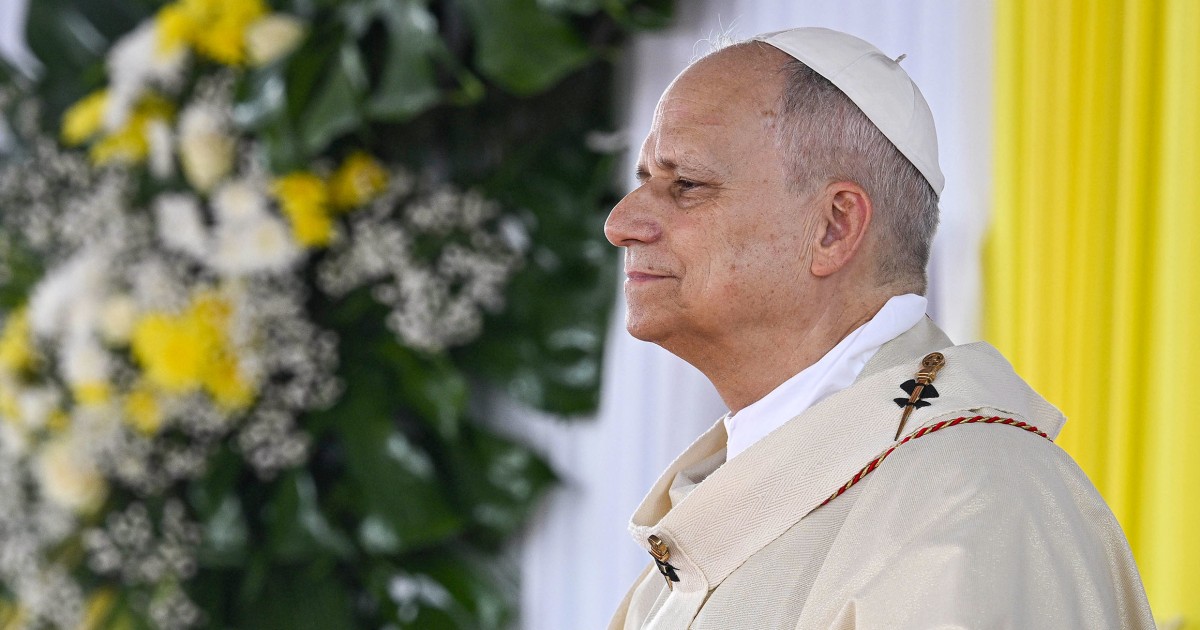
Pope Leo XIV’s sweeping warning about the dangers of artificial intelligence drew a largely muted response across the American technology world, though a handful of leaders quickly embraced the Vatican’s push for stronger government oversight while others blasted it as a threat to innovation.
Subscribe to read this story ad-free
Get unlimited access to ad-free articles and exclusive content.

In a roughly 42,300-word encyclical published Monday, Leo called for more regulation of the private companies powering the AI boom, stronger protections for workers facing economic disruption, and measures to protect people from fake AI-generated information. He also criticized “the growing ease with which autonomous weapons systems can be deployed.”
“Humanity — in all its grandeur and woundedness — must never be replaced or surpassed. We can embrace the technological progress that alleviates suffering and unlocks new possibilities, provided that we do not abandon the very essence of our humanity, namely the capacity for relationship and love,” the pontiff wrote in “Magnifica Humanitas,” or Magnificent Humanity.
Silicon Valley’s most high-profile AI executives — including Sam Altman, Elon Musk and Mark Zuckerberg — did not immediately express public opinions on Leo’s encyclical, his first since he was elected head of the Catholic Church. Amazon, Anthropic, Google, Meta, Microsoft, Nvidia, OpenAI and xAI did not immediately respond to requests for comment Tuesday.
Notably, Anthropic’s top executives have for years advocated for more robust guardrails on the technology, and at least one of the company’s key figures hailed Leo’s message. Christopher Olah, a co-founder of the firm, appeared alongside Leo during the presentation of the encyclical and gave remarks welcoming “moral voices” attempting to guide his industry.
“We need more of the world — religious communities, civil society, scholars, governments, and indeed all people of good will — to do what His Holiness has done here: to take this seriously, to look closely, and to push events in a better direction,” Olah said, according to a transcript of his remarks published online. “We need informed critics who will tell the labs when we are failing.”
Yoshua Bengio, a professor and leading AI researcher who is frequently described as one of the “godfathers” of the technology, expressed support for a major theme of Leo’s proclamation: the importance of AI serving all people and “the common good.”
“I agree with this sentiment by @Pontifex,” Bengio posted on X, using the pontiff’s account name. “The Vatican and other global institutions can and must play a role in the global dialogue on AI to raise public awareness and mobilize society for the challenges ahead.”
Will Jones, the head of faith outreach efforts at the Future of Life Institute, a nonprofit organization focused on avoiding extreme risks from transformative technologies, said Leo’s message “exemplifies the moral leadership so needed in an age when a handful of technology corporations race to replace humans in work, relationships and decision-making.”
“Magnifica Humanitas can serve as a rallying cry for the world to reassert unashamedly the primacy of humanity, in all its flawed glory, over our tools,” Jones said in a statement Monday.
Leo’s warning about powerful technological tools becoming concentrated “in the hands of a few” appeared to find a receptive audience in Twitter co-founder Jack Dorsey, who responded to an excerpt of the pope’s missive with a one-word post: “yes.”
Vice President JD Vance, a practicing Catholic who once worked at the Silicon Valley venture capital firm Mithril Capital, told NBC News in a phone interview Tuesday that he had scanned “bits and pieces” and summaries of the pope’s message.
“What I read of it sounds very profound, and the sort of thing that you would expect and hope from a leader of the church,” Vance said in part.
But not all technology industry figureheads agreed with Leo’s policy prescriptions.
David Sacks, a prolific venture capitalist and the White House’s former AI and crypto czar, pushed back on the Vatican’s appeal for more aggressive government regulation of private firms, which have largely avoided stringent rules under the second Trump administration.
“The Pope rightly warns that AI must serve human dignity, not become a tool of domination or exclusion. But if we hand governments sweeping power over AI development in the name of safety, how do we prevent it from being used to censor, surveil, and control citizens — as Orwell foretold in 1984,” Sacks wrote on X, referring to George Orwell’s allegorical novel.
“Who will guard the guardians?” Sacks added in Latin and English.
Eddy Lazzarin, a general partner at the influential venture firm Andreessen Horowitz, found the encyclical “light on the theology of artificial intelligence, and thick in reiterating Catholic social doctrine.”
“The encyclical feels defensive,” Lazzarin wrote on X. “It protects human dignity by saying intelligence was never the point, without really explaining what that means — or explaining what it means for us when intelligence is no longer uniquely human.”
Pedro Domingos, a leading AI researcher and an emeritus computer science professor at the University of Washington, reacted with a pointed quip on X: “The Pope is infallible, and on AI he’s infallibly wrong.” In a subsequent email to NBC News, Domingos said he believed the pope’s message was premised on “a series of ignorant and wrong-headed things about AI.”
Leo, for example, cautioned that “AI will concentrate power,” Domingos said, “when in fact it will spread it more widely than ever, just like the Internet before it.”
The Vatican’s attempt to sound the alarm on AI comes as the rapidly evolving technology faces mounting resistance across the U.S. In a national NBC News survey released in March, a majority of voters — 57% — said they believe the risks of AI outweigh its benefits, compared with 34% who said the opposite; a plurality of voters viewed AI negatively.