

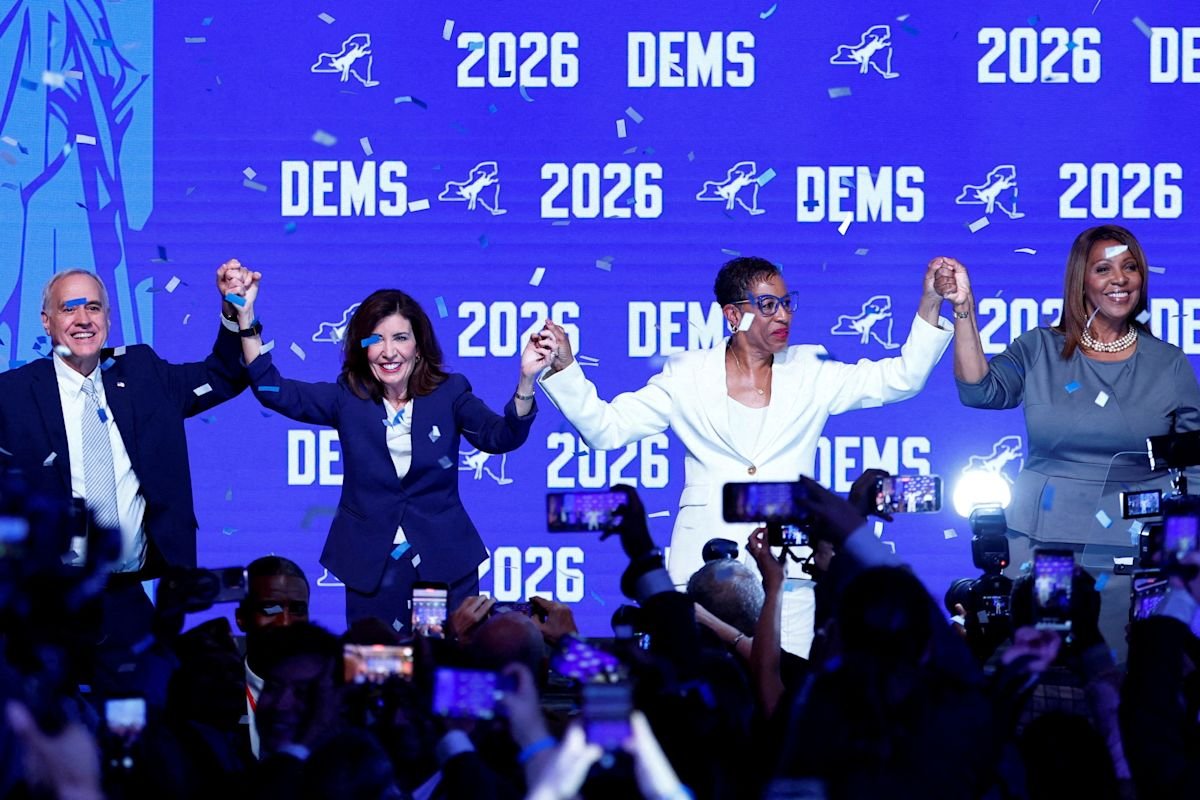
A blue wave is here, and Gen Z is responding the way they know best: with memes.
From “Blexas” to “Bliowa,” young people are turning this week’s Nov. 3 midterms into a viral moment. The election flipped the House and Senate, and Democrats also pulled off several down-ballot races in a defeat over President Donald Trump and Republicans. It’s something the internet is calling the “blueification” of states.
“Blexas, Blichigan, Bliowa, Blaine, Blorth Carolina, Blouth Caroline, Blansas… Blhat’s going on?” TikToker Cassie Willson joked in a video with more than 109,000 likes.
Videos at Tuesday night watch parties and bar celebrations got in on the excitement with hashtags like #Blexas and #bluewave.
Other videos paired election results with cinematic edits set to Halsey’s song “Colors” over the well-known lyric, “Everything is blue.” “SHE’S FROM BLEXAS I CAN TELL BY THE WAY HE’S LIBBING ROUND THE ROOM!” user joseph.maxfield wrote in another, parodying Ella Langley’s “Choosin’ Texas.”
Mike Wagner, director of UW-Madison’s School of Journalism and Mass Communication, says these posts are a way for young people to politically participate and signal being part of a movement.
“It amplifies the power because people are sharing memes or puns related to the election result in ways that are fun for them, but also give them a little way to let off some steam after the two years that they’ve had, and identify other people who are in their community,” Wagner says.
Not all Gen Zers, of course, are happy with how the night went, and the generation isn’t suddenly optimistic about politics as a whole. About half of voters under 30 said they were angry about the direction of the country, according to the AP Voter Poll. But data suggests young voters have swung sharply toward Democrats after making significant gains for President Donald Trump in 2024.
More: On the anniversary of Charlie Kirk’s death, many Gen Zers are sharing odd posts. Here’s why
‘It actually is rooted in how overwhelming and negative the last couple years have been’
In Wisconsin, where David Crowley’s election as the state’s first Black governor made history, Wagner says “there’s a lot of optimism around campus today.” He’s seen posts about the “Brew wave” – a reference to the Milwaukee Brewers’ recent world series win.
At the start of his 250-person lecture Wednesday, he estimated that about 230 students raised their hands when he asked how many had stayed up to watch election results the night before.
After class, Wagner was walking down a hill when he heard one student turn to another and exclaim, “Mississippi, can you believe it?” (As of Thursday morning, the race is still too close to call.)
That reaction reflects how unexpected some of these results felt, he says.
“When you see Blexas or Blississippi, these are places that were not on the electoral college map for Democrats, and now they are, and so part of it is also an expression of what’s possible in the political future,” Wagner says.
Emma Mont, a Gen Z communications assistant who previously ran the social media account Organizer Memes, says these are states many in her generation didn’t expect to see flip for the next decade, or possibly ever.
“For it to happen, sooner than we expected, all at once in a sort of a tsunami, it sort of felt like we don’t even have words for what this is,” Mont says.
The celebratory posts don’t reflect how all young voters feel about the election, or erase the political polarization among Gen Z. Though many are lighthearted on the surface, for young Democrats, Wagner says these memes reflect a deeper response.
“It actually is rooted in how overwhelming and negative the last couple years have been for many younger Democrats,” Wagner says. “Now there’s some joy to be found, and it’s kind of a release.”
Meeting young people where they’re at
The memes and banter also reflect a changing information ecosystem and an effort by politicians to meet young people where they are online as both parties seek to make inroads with Gen Z.
Pew Research Center finds that 76% of young adults ages 18 to 29 say they get news from social media, and 70% of young adults say they get news because they happen to come across it, compared with 30% who seek it out.
“We’ve been saying for a long time that it’s the largest growing voter bloc, and so Gen Z’s attention is … imperative for success,” Mont says. “Meeting them where they are and sort of signaling on the platforms they’re on, that this is a win.”
The “blueficiation” trend follows an increase in politicians and their supporters using internet culture to support their cause in the past decade. In 2024, edits of Kamala Harris superimposed to Charli XCX’s “Brat” took over corners of the internet. Trump’s YMCA dance inspired remakes on TikTok, and edits of Zohran Mamdani and Curtis Sliwa trended in the lead-up to the New York City mayoral election.
For young people, the memes are a way to turn individual political excitement into a collective experience with their age group.
“It’s a way of saying, ‘Hey, I’m here and I’m feeling excited and I’m glad we’re part of the same team,'” Wagner says.
Rachel Hale’s role covering Youth Mental Health at USA TODAY is supported by a partnership with Pivotal and Journalism Funding Partners. Funders do not provide editorial input. Reach her at rhale@usatoday.com and @rachelleighhale on X.
This article originally appeared on USA TODAY: The ‘blueification’ of state names is taking over TikTok. What does it mean?



Leave a Reply