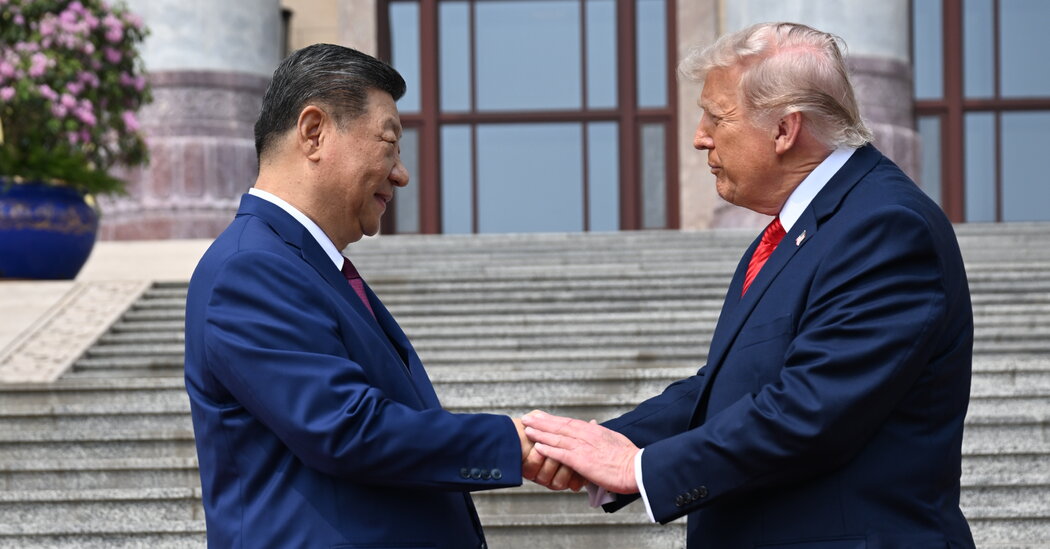
They shook hands. They took a long walk. One man touched the other’s arm, then he did it again. They later shook hands some more.
For two leaders at odds on many fronts — Taiwan, trade, rare earth resources, among others — Thursday’s meeting between President Trump and Xi Jinping, China’s leader, suggested they wanted the rivalry to be more friendly than not.
The body language stood in stark contrast to Mr. Trump’s harsh criticism of China at home, and to many of his meetings with longtime U.S. allies. The scene was far from tense or combative, as it was when Mr. Trump hosted Ukraine’s president in the Oval Office. Gone was the gruff distance that Mr. Trump kept from Germany’s former chancellor or NATO leaders.
Nor did it include one of Mr. Trump’s inscrutable handshakes, as when he kept Japan’s prime minister in his vise for 19 very long seconds.
Instead, experts said, the body language suggested Mr. Trump and Mr. Xi were each striking a conciliatory pose, each in their own style and reflecting their countries’ complicated relationship. Since the Trump administration’s aggressive trade moves against China last year, and Beijing’s countermeasures, the two countries have adopted a tentative truce.
“If you look at the statements in the run-up to the summit, Trump gives off a bit of a thirsty vibe toward Xi Jinping that he’s really keen to make friends,” said Melanie Hart, the senior director of the Atlantic Council’s Global China Hub. “His words indicated that he is hoping that Xi will like him as a person, and that they will develop some kind of rapport that will lead to special treatment and deals. And you see that same thing in their body language as well.”
Walking toward a longer truce
From the moment that Mr. Trump met Mr. Xi on Thursday, the interaction was warmer and more relaxed than past meetings. They smiled, chatted and stayed close physically, walking down a long red carpet together around the Temple of Heaven, the Ming dynasty complex not far from the Forbidden City.
“It was noteworthy that Xi appeared not to let Trump do the ‘power pull’ move, whereby Trump pulls the foreign leader’s hand closer to Trump,” said Lyle Morris, a senior fellow at the Asia Society Policy Institute.
He added that “Trump gave Xi a few warm ‘taps’ of Xi’s hand with his left hand, a signal that Trump showed extra friendliness.”
Each leader shook hands with other officials, too. Present on the American side were a group of business executives whom Mr. Trump said he had brought to show “respect” for China while seeking market access. Mr. Xi did not bring an equivalent group.
A contrast in styles
As Mr. Trump and Mr. Xi progressed through their walk, accompanied by a military band, a group of children stood waiting with flowers and U.S. and Chinese flags. Once the leaders got close enough, the children began hopping up and down, waving the flowers and flags and cheering.
Mr. Trump smiled and clapped for the children, while Mr. Xi gave a few short waves.
That too, reflected each leader’s contrasting style, experts said. While Mr. Trump looked around, smiling and gesturing at his surroundings, Mr. Xi stayed more stoic, sometimes looking directly at cameras that hovered nearby.
“Trump’s more casual, showmanship style was on full display, whereas Xi’s body language and remarks were a bit more scripted and reserved, which is Xi’s style,” Mr. Morris said. (The children returned to silence in orderly rows after the leaders passed.)
On reaching the end of their long walk, Mr. Trump paused before a grand staircase to chat some more, touching Mr. Xi’s arm twice before they ascended.
When they met last year in South Korea, the leaders shook hands tensely, with Mr. Trump talking and Mr. Xi staying largely quiet. Ahead of that meeting, the United States and China were in the depths of a trade standoff, and just minutes before he arrived in South Korea, Mr. Trump had announced he would restart nuclear weapons testing.
In contrast to that stiff scene, on Thursday Mr. Trump called Mr. Xi “a great leader” and warmly spoke about how the United States and China had “worked it out” whenever they had “difficulties.” During a toast at a televised state banquet, Mr. Trump promised “a fantastic future together.”
He added, “It’s an honor to be with you, it’s an honor to be your friend, and the relationship between China and the U.S.A. is going to be better than ever before.”
Mr. Xi’s remarks were far more reserved, and it was he who seemed to set boundaries on the relationship. “The U.S. must handle the Taiwan issue with utmost caution,” he said, citing the dangerous rivalries of ancient history to warn against escalation today.
And Mr. Xi described a more plain vision of U.S.-Chinese amity. “The common interests between China and the United States outweigh their differences,” he said, adding, “stability in China-U.S. relations is a boon to the world.”
Each country’s version of what the delegations actually spoke about also differed enormously.
“The two readouts, when read side-by-side, describe almost two different meetings,” Ryan Hass, a Brookings scholar on China, wrote on social media. While the Americans emphasized Chinese investment, purchases of U.S. oil and stopping fentanyl, Beijing’s readout discussed Taiwan and how U.S. and Chinese officials could improve “strategic stability.”
“Both leaders think that they can get something from the other if they play this right,” Ms. Hart said. “The interesting thing is those things are wildly different.”