
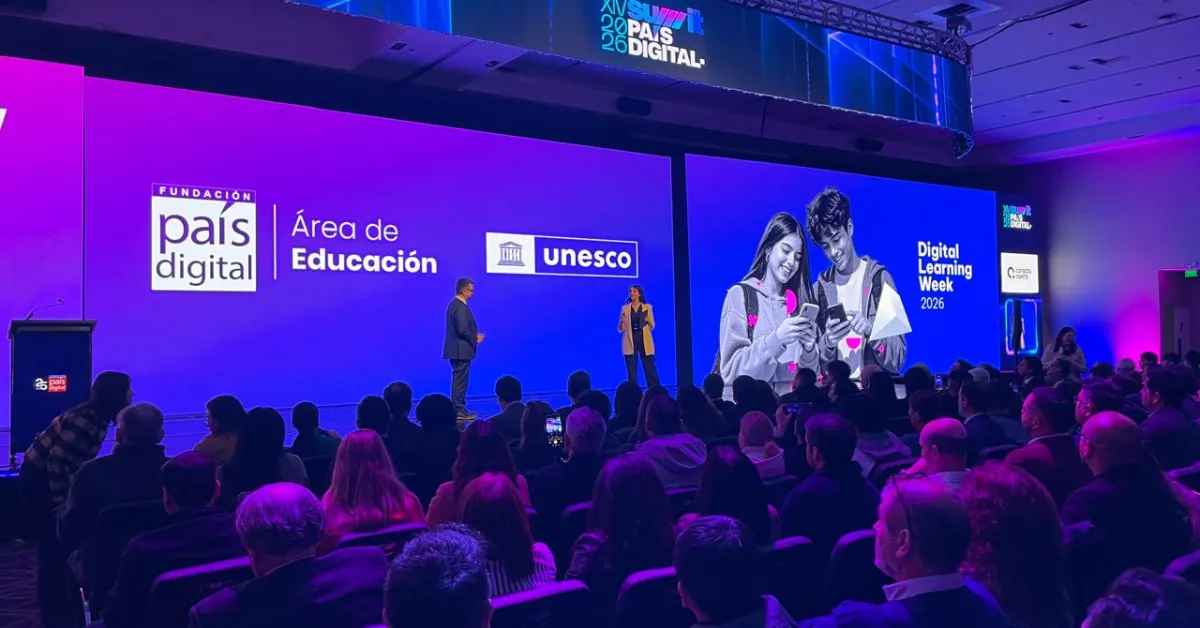
Teachers, technical and vocational education and training, and education management: keys to the future
The second day continued with specialized dialogue sessions addressing some of the main opportunities and tensions surrounding the use of AI in education in Latin America and the Caribbean.
The session “TVET governance in the age of AI: needs and strategies for Latin America and the Caribbean” brought together UNESCO specialists and representatives of technical and vocational education and training institutions to discuss governance and adaptation challenges in the face of technological and labour-market transformations. Ramón Iriarte (UNESCO Paris) highlighted the role of Centres of Excellence as spaces for innovation and collaboration, while Amparo Naranjo (UNESCO Santiago) and Alejandra Ortiz (UNESCO Mexico) presented progress on the regional model and its pilot implementation in Mexico. Francisco Norberto Varela Cruz (CONALEP) and Elliot Gama Ramírez (DGETI) shared experiences of strengthening links between technical education and the productive sector. Finally, Soledad Patiño Villalba (UNESCO Paris) presented the Global Skills Academy initiative, aimed at strengthening digital skills for the future of work.
In this context, a closed meeting of focal points of the Regional Alliance for Educational Transformation and Innovation (ARTIE) was held, with representatives from 15 countries in Latin America and the Caribbean. The meeting provided an opportunity to share progress within the network, exchange experiences and strengthen regional coordination to promote joint educational transformation and innovation initiatives.
The session “New frontiers for teaching practice: teaching and learning with AI” brought together Darío Riquelme (University of Chile), Alejandra Meza (Red EdTech) and Pablo Donoso (Matific), who explored the opportunities and challenges of integrating artificial intelligence into teaching and learning processes. Riquelme highlighted the importance of strengthening institutional governance and reviewing assessment strategies; Meza shared experiences of using AI to foster students’ creativity and experimentation; and Donoso examined its potential to develop mathematical reasoning, critical thinking and personalized learning. The discussion emphasized the fundamental role of teachers and the pedagogical decisions that guide the use of these technologies.
Finally, the programme on 7 October concluded with the round table “From data to decision-making: AI in curriculum management”, which brought together Nicole Faure and Jaime Balladares (researchers from the FONIDE project) and Karla Cantuarias (Fundación Kodea). Faure and Balladares presented preliminary findings on the use of AI in teaching practice, highlighting opportunities to reduce administrative workload, improve planning and personalize learning, as well as challenges related to access gaps, professional autonomy, and ethical and pedagogical guidance. Cantuarias, for her part, shared progress on “Future Teachers in AI”, an initiative aimed at incorporating artificial intelligence competencies into initial teacher education through collaboration with universities.








Leave a Reply