

Artificial intelligence represents intriguing challenges in higher education. Professors are teaching and providing guidance on technology that is changing so fast that often their students are the true experts. Concurrently, educators are expected to help the next generation embrace those high-tech skills while maintaining the ability to think critically.
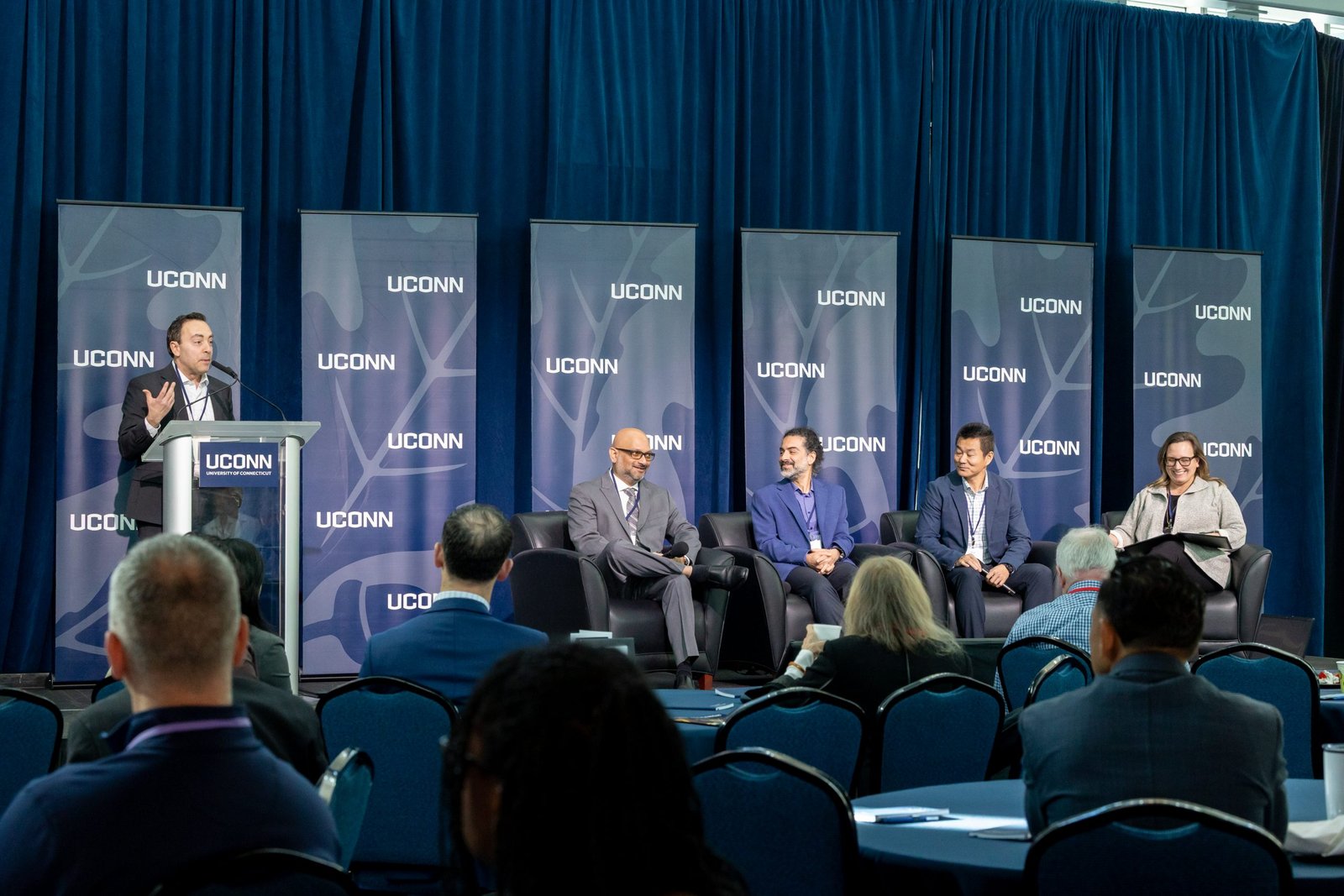
UConn faculty members wrestled with those topics and more during a panel on Thursday, Nov. 19, during the third annual Economic Impact forum. Held at Pratt & Whitney Stadium at Rentschler Field in East Hartford, the event focused on AI and how UConn and the state can adapt and collaborate to maximize Connecticut’s potential for growth.
The forum aligned with an important mission for UConn. Headed by Provost Pamir Alpay, the University launched its “AI for ImpaCT” initiative in June, focused on advancing artificial intelligence best practices across education, research, innovation, public engagement, and workforce development.
As part of the effort, operations and information management Prof. David Bergman, the associate dean for faculty and research, was appointed the provost’s special advisor on artificial intelligence. He now chairs an AI Council comprised of faculty, staff, and student stakeholders.
Bergman moderated the panel discussion at the forum, which also featured faculty members from the College of Liberal Arts and Sciences, College of Engineering, and School of Law. Echoing earlier remarks from UConn President Radenka Maric, Bergman emphasized that views on intelligence continue to evolve. Years ago, it was all about high IQ, then more recently emotional quotient. Now, Bergman said, a third “q” must be considered: AQ, standing for “agility” or “adaptability” quotient. He attributed the term to author Liz Tran.
“You have to move very quickly, be agile with technology, agile with ideas, and agile with learning, and I think that would be the one thing I encourage our faculty to instill in our students,” Bergman said.
The session offered a glimpse into how professors are building curriculum and establishing guidelines around responsible AI use. Those considerations extend outside of the classroom as faculty consider how to best prepare their students for careers that will require them to learn new technology at breakneck pace and apply it to all fields of study and work.
“In our discussions, we’ve certainly been focusing on AI, but we’ve also been thinking more broadly about technological developments because AI technology and quantum technology,” said Molly Land, Catherine Roraback Professor of Law, associate dean for academic affairs. “They’re developing so quickly that we want to make sure that our graduates are not only ready to enter the workforce, ready to use these technologies, but also have the capacity to be able to keep up as technology develops as they move forward in their careers.”
Professor-in-residence of mathematics Amit Savkar focused on what students are perceiving in their teachers. While faculty members are experts in their disciplines, AI is presenting ethical questions they’ve never faced before. Educators must be open-minded and willing to listen and learn along with their students.
“If we, who are supposedly subject matter experts or otherwise in industry and education, are struggling to figure out the questions of ethics, of the questions of fluency and AI literacy, you can imagine the kind of uncertainty that our students are facing today,” Savkar said.
Civil and environmental engineering Prof. Arash Zaghi offered the prospect of AI as a tool for fixing pressing issues in society. At UConn Waterbury, students are engaged in several AI-related programs that expand skillsets and align with the AI for ImpaCT initiative. As a designated Minority-Serving-Institution, those skills are key for overcoming achievement and poverty gaps.
“We talk about drug discovery, renewable energy, and solving some of the crises, but we don’t talk much about AI’s potential to close some of the major socioeconomic gaps that we have across this country and the world,” said Arash. “I see this tool as an equalizer. I see that as the unique opportunity that fell on our lap, honestly, in the past few years, and if we don’t frame it correctly, if we don’t align ourselves in the right way, we are going to let it further expand those gaps rather than closing it.”
As much as AI can produce data and be an important research tool, there is no substitute for the skills that machines cannot replicate. The panelists agreed that those are what should be reinforced in the classroom.
“We need to teach students critical thinking skills,” said statistics Prof. Kun Chen. “That’s the most important thing in the age of AI. AI can help us to master some technical stuff really quickly, but critical thinking is still the most important.”














Leave a Reply