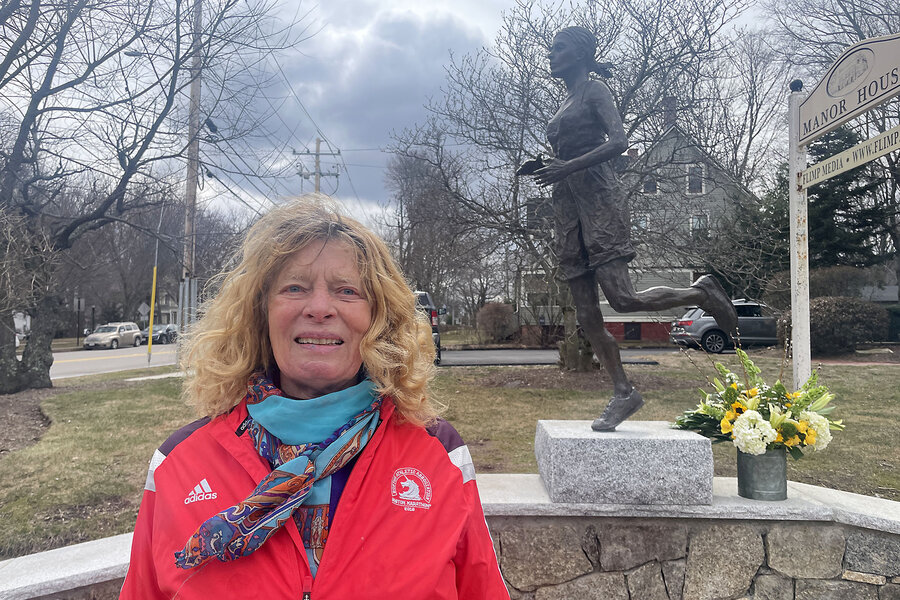
Above the colorful sea of 30,000 runners who will check their watches and bounce from foot to foot to soothe last-minute jitters at the start of the Boston Marathon April 20 will be a new stationary figure, standing as a tribute to those who came before.
“The Girl Who Ran” depicts Roberta “Bobbi” Gibb – the first woman to complete the marathon in 1966 – cast in bronze and captured midstride, eyes focused straight ahead. Ms. Gibb, an accomplished artist, is also the sculptor of the life-size monument. Sixty years ago, 100 yards from this spot, she hid in a forsythia bush, her long hair tucked beneath a hooded sweatshirt. She waited, coiled like a spring, to leap into a race not open to women.
Times have clearly changed. On Monday, when the runners line up for the 130th Boston Marathon, women will make up nearly half of the competitors. Ms. Gibb’s statue may represent a moment of her personal history, but to the artist, it embodies much more. “I also want it to be for not just women, but men and women, because much as women were locked into a stereotype … so were men. We were segregated,” she says in a phone interview from her home on the North Shore of Massachusetts.
Why We Wrote This
When Bobbi Gibb sprang out of the bushes and into the Boston Marathon, she proved women could run 26.2 miles. A new sculpture she crafted at the race start marks her legacy.
A recent ribbon-cutting ceremony at “The Girl Who Ran” marked the culmination of a nearly decade-long fundraising effort by Boston Marathon winners and private donors. The effort was coordinated by the 26.2 Foundation, a nonprofit dedicated to advancing the sport.
“The Girl Who Ran” is not only the first Boston Marathon-related statue to represent a real woman, but it is also a rarity among public works of art. Most monuments that portray female figures are allegorical, such as the Statue of Liberty, says Sierra Rooney, an associate professor of art history at the University of Wisconsin-La Crosse. Her research shows there are around 400 monuments honoring real women in the United States, about 8% of all monuments. Dr. Rooney is particularly struck by “The Girl Who Ran” because it depicts a living person, created by the athlete herself.
“It is about the physical strength of a female body. And that’s quite unusual in the landscape of public monuments,” says Dr. Rooney. “The cultural conception of what it means to be a hero has so long been bounded by sort of masculine ideals of being a politician, being a statesman, being an explorer, these professions that historically have excluded women.”
The number of public works honoring women is slowly increasing. There are about 16 statues of women in sport in the U.S., most installed in the past decade, says Dr. Rooney, who is assembling a database of public monuments. The first statue of a woman athlete that she knows of is one of Joan Benoit Samuelson, the winner of the first women’s Olympic Marathon in 1984, installed in 1986 in Cape Elizabeth, Maine.
Ms. Benoit Samuelson is also a two-time Boston Marathon champion and a donor behind “The Girl Who Ran.” The Olympian has her own running statuette sculpted by Ms. Gibb, one of her cherished possessions, presented to her at the 1984 Olympic trials. Ms. Gibb had created one for each of the top three American finishers.
“When you think of women and Boston, clearly Bobbi should be the one who’s recognized,” says Ms. Benoit Samuelson in a phone interview. “[Her statue] should be at the start because she really started women’s marathoning here in the United States. That is her place in history and in time.”
“Prove this misconception about women wrong”
For Ms. Gibb, who grew up outside Boston running in the woods for the joy of movement and to commune with nature, the vision of watching the marathon runners as a college student in 1964 took her breath away.
“I had never actually seen a group of human beings running like that together, and I felt very moved by it,” she says. “I knew I wanted to be part of it.”
Over the next two years, she gradually increased her distances. She ran between her family’s home in Winchester and Tufts University, where she was a student, and the Museum of Fine Arts, where she was taking art classes, wearing sturdy leather nurses’ shoes and a swimsuit under shorts as her training gear. In the snowy winter months, she layered on long underwear and wore a pair of boys’ buckle galoshes over layers of wool socks.
A marriage and a move to San Diego, California, did not deter her quest. She wrote to the Boston Marathon organizers to request entry. They refused. Women were “not physiologically capable” of running 26.2 miles, their reply stated, and they couldn’t risk giving her a number. The Amateur Athletic Union sanctioned the competition as men-only. She crumpled the letter and threw it across the floor. In that moment, the tranquility she felt while running was joined by something else: rage.
“I took off out the door, and I ran 20 miles north to Delmar Beach. I was so upset,” says Ms. Gibb. She fell asleep on the beach, and when she awoke, she knew she had to run the upcoming marathon. It was no longer just an endurance race. It was an opportunity.
“If I can prove this misconception about women wrong … then it’s going to throw into question all the other false beliefs about women that have been used literally for centuries to keep women from really manifesting their potential,” she recalls thinking at the time. So, she boarded a bus and traveled four days back to Boston, arriving the evening before the race.
Her mother, a housewife who disapproved of her daughter’s free-spirited ways, finally agreed to drop young Bobbi off at the start line the next morning. That’s where Ms. Gibb hid in the bushes, wearing a pair of her brother’s Bermuda shorts, her swimsuit, a hooded sweatshirt, and a brand-new pair of boys’ running shoes.
After the fastest runners had passed, Ms. Gibb joined the 500 men churning toward Boston. It wasn’t long before she could hear the runners behind her saying, “Is that a girl?” So she turned and smiled.
“I said, ‘I’m afraid if they see I’m a woman they’ll throw me out,’” Ms. Gibb recalls. “And the guys around me said, ‘We won’t let them throw you out. It’s a free road.’ They were on my side. We had a great time.”
A local radio station also spotted Ms. Gibb on the course and broadcast her progress, clipping along at a sub-three-hour pace until blisters from her new shoes slowed her down. By the time she crossed the finish line in 3 hours, 21 minutes, and 40 seconds – faster than two-thirds of the field that day – the governor of Massachusetts was waiting to shake her hand.
Ms. Gibb returned in 1967 to run again, without official sanction. Her finish was overshadowed by the second woman to cross the finish line that year, nearly an hour behind her. Katherine Switzer had obtained an official number by disguising her gender as “K. Switzer” on her application. When an official spotted Ms. Switzer on the course, he tried to tear off her bib to prevent the race from losing its accreditation. A photojournalist caught the scene, and the series of photos has since become part of the iconic history of women running in the Boston Marathon.
Ms. Gibb was also the first woman to cross in 1968, followed by two other women runners, but by then the media frenzy had moved on from the first few trailblazers. The Boston Marathon officially opened to women in 1972. At the 100th anniversary in 1996, the Boston Athletic Association awarded Ms. Gibb with a medal that listed her three first-place finishes and included her name in the winner’s ring on the Boston Marathon Monument.

Kendra Nordin Beato/The Christian Science Monitor
Now “The Girl Who Ran” bookends the course, honoring Ms. Gibb and those who followed, and inspiring those yet to line up to run 26.2 miles to Boston, such as Joy Donohue, a Hopkinton resident. Ms. Donahue will join 14,000 other women at the start of her 10th Boston Marathon this year.
“I train in the area, and I plan to touch Bobbi’s shoes every time I run by so they eventually turn shiny and bright,” says Ms. Donahue, who came to the ribbon-cutting ceremony.
Ms. Gibb is quick to say that although she was the only woman running down Boylston Street to the finish that day in 1966, she was hardly alone in her efforts to break barriers.
The statue of a young woman wearing a swimsuit and Bermuda shorts “symbolizes all the pioneer women in running, but also the way women have fought for and attained equal or almost equal rights, civil and human rights, around the world,” says Ms. Gibb. “My run in 1966 was like a match lighting the fire. And that’s exactly what I wanted to happen.”