
There’s an epidemic weighing heavily on all of us today: distrust of the internet. From the launch of Sora to Nano Banana Pro, it has become increasingly difficult for people to distinguish between false narratives and reality on our screens. It’s a scary thought, that we can no longer fully trust what we see, hear, or read online without second-guessing its authenticity.
Our environment isn’t helping: as more AI companies roll out updates and release new generative AI models, the average user struggles to keep pace. The constant evolution means that yesterday’s detection tactics become obsolete almost overnight.
- Deepfakes are more convincing
- AI-generated music sounds indistinguishable from real people
- Even photos of everyday moments could be entirely fabricated
This erosion of trust changes how we interact with online content, forcing us to approach everything with skepticism.
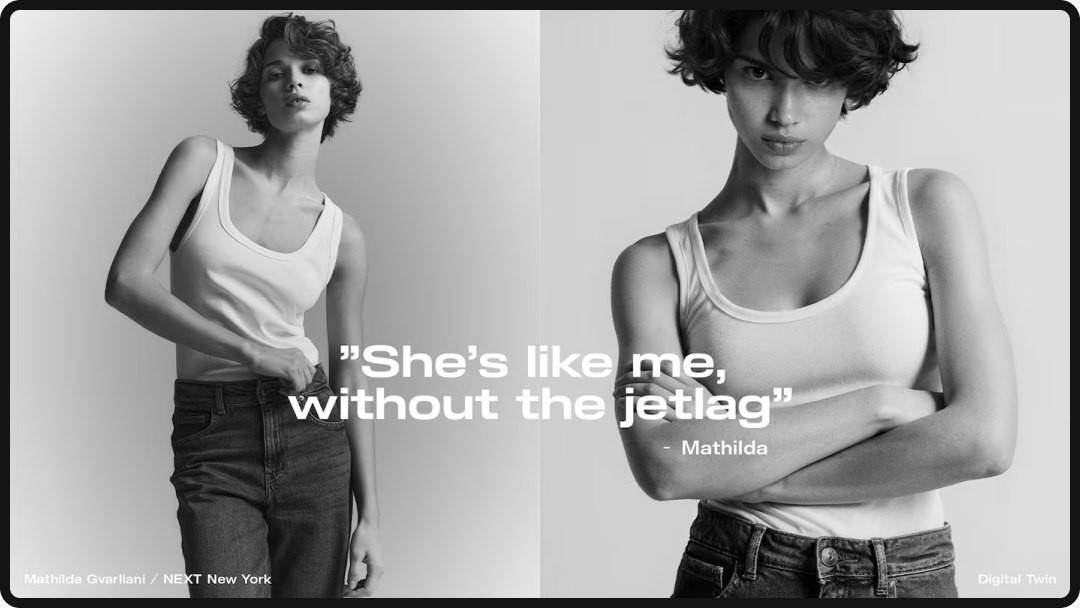
Some subscribe to the philosophy, “if you can’t beat ’em, join ’em,” and that’s exactly what brands have started to do. Fashion retailers like H&M and Mango deployed AI models, calling them “digital twins,” claiming they wanted to be innovative and tap into “cutting-edge” technology to improve their brands.
Then there are trending TikTok artists with songs like “I Run” that captivated users, only for them to discover it was AI music all along.
A common theme threads through every “innovation”: people don’t want AI shoved down their throats. More importantly, people want the freedom to choose whether to consume AI content.
AI filters, AI watermarks, and detection tools are still in development, but for now, society is drowning in AI slop and desperately searching for an escape (and the fatigue is seriously setting in). Following the growing trend of consumer activism, many are going so far as to stop supporting companies that indulge in generative AI altogether.
As we entered the new year, we came up with a list of predictions for organic social in 2026, but one in particular is highly topical already: human creativity becoming a flex. That’s exactly what we’re seeing.
What Is Anti-AI Marketing?
Anti-AI marketing is a strategic positioning approach where brands publicly distance themselves from generative AI, emphasizing human creativity, craftsmanship, and authenticity in their work.
Rather than adopting AI tools for efficiency or cost-cutting, these brands intentionally keep real people at the center of their creative process (whether it be ads, social content, design, or product development). Anti-AI marketing is a value-driven stance brands use to differentiate themselves in an increasingly saturated market.
But why are we seeing this rise now?
The backlash stems from consumer frustration:
- People are exhausted by the flood of generic, AI content that’s constantly cluttering their feeds.
- They’re concerned about job displacement in creative industries and crave authenticity during a time when nothing feels real anymore.
- They feel like AI has been forced upon them without their consent (this is perhaps the most important factor); it’s woven into products, services, and experiences they never asked to be “improved” by algorithms.
Take last Christmas, for example: people started to notice that the prints on the wrapping paper they were buying were AI-generated, pointing out inconsistencies in the print design. Guided by their frustration, they went so far as to make their own custom wrapping paper. It’s clear that even the simplest products are now being mass-produced with AI, and the people who wanted none of it took matters into their own hands, opting for handmade, custom designs instead.
Many consumers are in the same boat as the anti-AI Christmas crew, and they’re doing the exact same thing to their brand loyalties: replacing pro-AI brands with more ethical ones that don’t participate in using AI for their own benefit.
What Happens When Brands Take a Stance on AI?
2025 was the year that AI truly entered mainstream social conversation. One moment that sent shockwaves through the internet was Duolingo’s announcement that it would become an “AI-first company.” The backlash was almost immediate, resulting in a mass unfollowing, drops in viewership, and app uninstalls.
While the announcement didn’t explicitly focus on generative AI, the damage was done regardless. Fans who loved Duolingo for its unhinged, organic, relatable personality (me included) suddenly thought of the green owl as artificial and fake.
The brand’s carefully crafted persona, built over the years, risked ruining their reputation almost overnight.
The main reason for the shift we’re seeing goes something like this: there’s a loaded connotation attached to the word “AI.” When people hear brands using it, many immediately assume no real person participated in the work and that the brand wholeheartedly chose efficiency over craft. And in response, they turn their backs, even on their favorite brands.
Taking a stance on AI isn’t just about clarifying your positioning. Consumers increasingly demand transparency from the brands they know and love (and the ones they don’t), so taking a stance is a way to protect your brand reputation. Today’s audiences want to know who made their content, how it was created, and whether real people were involved in the process. They’re asking questions brands used to avoid and are looking hard to find the answers, whether they’re explicitly stated or not.
And trust me when I say this, there will be a select few who go down deep rabbit holes to find those answers.
This pressure for transparency stems from a change in consumer expectations. People aren’t taking vague responses or deflection for an answer. They want honesty, even if it’s uncomfortable. So when AI enters the conversation, silence reads as complicity, and considering how little people trust the internet, neutrality isn’t safe.
Your customers will decide your position for you, and they rarely give you the benefit of the doubt (so it’s better to be safe than sorry).
And unfortunately, it’s difficult for brands to claim the middle ground. It’s almost impossible for them to have a neutral take on AI, considering how two-sided the conversation around AI use is. According to the Pew Research Center, about 52% of Americans are more concerned than excited about AI use in day-to-day life. While some Americans are unsure why or how AI is used, the majority see it as black and white. AI is good for its efficiency and drives innovation, or AI is bad because it reduces human critical thinking skills, causes job displacement, has negative environmental effects, etc.
Without a clear stance, trust remains uncertain, and people will typically be the ones jumping to conclusions for your brand, whether you like it or not. Some have even gone so far as to accuse VFX work of being AI. Take A$AP Rocky’s “Helicopter” music video – fans accused his video of being AI-generated, only to find out it was made using the Gaussian Splatting method: a photorealistic 3D rendering technique. It’s becoming harder to tell the difference between VFX and AI-generated content, and with no clear labels in place, accusations such as this can ruin one’s reputation, leaving others cautious and wary.
The Rise of Anti-AI Stunts & Other Market Shifts
Enter the rise of anti-AI stunts: a direct response to people’s demand for proof of human creativity and original taste. Anti-AI stunts are a form of this stance-taking and have become one of the most visible tactics in this movement, gaining rapid popularity towards the end of 2025 and into 2026.
But why are they necessary? Because in an environment where nothing feels real anymore, these declarations serve as a seal of authenticity, guaranteeing that a real person did the work. They’ve become the only reliable way for consumers to distinguish between handcrafted content and machine-generated content.
Take Aerie’s 2025 campaign, for example. The brand photographed real women in Aerie clothing, but with labels on each image, explicitly stating, “No retouching. No AI. 100% Aerie real.” It’s simple, direct, and impossible to miss. Aerie didn’t use AI models or retouching tools, so they loudly declared it, showing they aren’t trying to be “perfect.” It’s also important to note that this campaign dropped in October of last year, and it’s still pinned to the top of their IG feed as of the writing of this article.
Multiple publications released at the end of 2025 predicted that anti-AI positioning would be more prominent in 2026 (ourselves included), but we saw the signs months earlier.
In 2025, there was backlash at Cannes Lions when the marketing agency DM9 had its “Creative Data Lions Grand Prix” award revoked after it was revealed they had used AI to alter their campaign without disclosing it. The industry’s reaction was unforgiving; not just because AI was used, but because they weren’t up front about it.
The lack of transparency violated an unspoken rule with audiences and prompted Cannes Lions to implement additional measures to prevent a similar situation in the future.
Then came The Brutalist, a film that used AI to alter an actor’s voice to sound more Hungarian. Critics argued that the filmmakers could have cast a real Hungarian actor or someone who accurately embodied the accent. Instead, they chose the path of least resistance, raising uncomfortable questions about labor ethics in Hollywood.
If directors can simply modify actors’ voices, appearances, and accents with AI, what happens to the rising talent who actually possess those qualities? The film went on to win an Oscar, receiving both praise and significant backlash (which happens to be a perfect encapsulation of where we are culturally with AI).
With no major AI regulations in place at that time, those moments painted a clear picture of what was to come, which we are now seeing. Consumers are paying attention to how content is made, who made it, and whether brands are being honest about their process. Transparency is the new currency, and people aren’t settling for less.
5 Examples of Anti-AI Marketing
Now that we’ve more than established the importance of taking a stance on AI, let’s review how brands are getting creative about how they communicate their “human-first approach.” From bold public declarations to subtle design choices, these tactics all serve the same purpose: building trust through transparency.
Here are some of the most effective anti-AI marketing strategies that I’ve noticed over the past few months.
1. BTS (Behind-the-Scenes) Content
One of the most effective anti-AI tactics is to pull back the curtain and show audiences exactly how the magic happens. Behind-the-scenes content has transformed from a nice-to-have bonus into a necessity, serving as proof of human craftsmanship and creative labor.
From clips of artists doing the work themselves (whether it be sewing, cooking, molding, etc.), BTS content shows that people are willing to get their hands dirty and provides proof of concept from start to finished product.
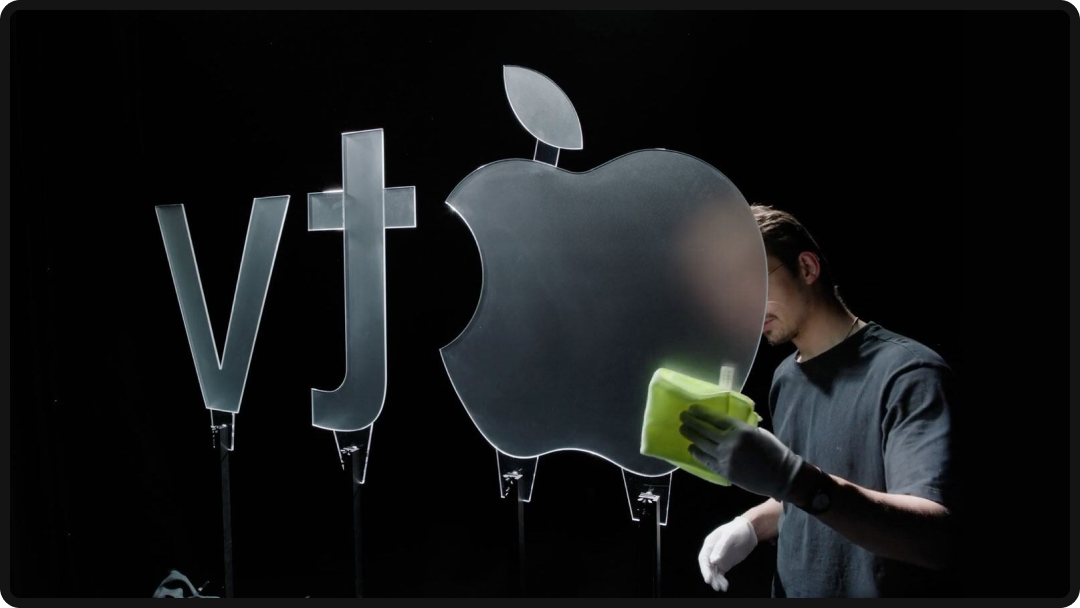
Apple, for one, does a tremendous job at BTS content. They unveiled a new Apple TV logo last year, alongside which came a BTS video that revealed the graphic wasn’t created using CGI, but with real glass. The glass was filmed under different lighting conditions, and multiple versions were created to reflect light in different ways.
The team knew they wanted to use practical events from the get-go, and seeing how this logo was made stands out as a stark contrast to the slop-ification of the internet today.
Then there was Apple’s Christmas ad, “A Critter Carol,” shot on an iPhone 17 Pro. The ad featured different woodland creatures singing and using an iPhone. The twist? The ad was made using real puppets. Puppeteers in full blue suits moved these critters around, and by showing how tedious it was to bring the vision to life with team work, Apple emphasized the skill and labor involved in this process.
There’s an extra level of AI vs. anti-AI irony here: just weeks earlier, Coca-Cola had released an animal-focused ad of their own, their version being an AI-generated Christmas ad. So when Apple dropped “A Critter Carol,” while they never explicitly called out Coca-Cola, the contrast was that much harder to ignore.
Why It Works: BTS content like this breaks the fourth wall, satisfying the audience’s curiosity about the creative process while also serving as verification that real people (puppeteers, directors, cinematographers, designers) were involved in bringing the vision to life. Showing your work is proof of craftsmanship and positions your brand as transparent.
2. Tagging & Crediting
Whether it be in the form of captions, LinkedIn shoutouts, end-of-video credits, artist tags, or anything in between, these credits aren’t nice-to-have extras anymore. They’re essential proof that real people made your content. In creative work like animation, illustration, or design, audiences now actively demand that credit be given where credit is due.
And if it’s missing? People automatically assume AI was involved (womp womp). This shift represents a change in how we evaluate content. Have some brands always tagged the designers and animators involved with their campaigns? Yes, but doing it now is more intentional and valuable. The presence of credits demonstrates human creativity, while their absence raises suspicion.
Take GAP’s collaboration with Sandy Liang. When the brand released an animated video promoting its new Sandy Liang line, it prominently credited the animator, producer, and sound designer. Even the VP of Head Creative at GAP reposted the animation, adding multiple tags to credit everyone who participated. The response was overwhelmingly positive; not just because the animation was good, but because GAP made it clear a real person designed it, which contrasts sharply with the state of the internet as we know it.
When you highlight the creatives behind your content, you’re signaling something deeper about your brand. You’re showing that you have the discernment to recognize excellence and the resources to invest in real talent. It positions your brand as one that chooses quality over convenience.
To illustrate the other side of this equation, let’s look at Coca-Cola again. Recently, they flaunted how they used fewer people to work on their 2025 Christmas ad. Fewer ad dollars spent, fewer employees who did the work, and for what result? This ad received more backlash than the one they made in 2024.
Viewers can see how tasteful brands are when they work with a team of real people, whether that be directors, animators, illustrators, or photographers, rather than typing prompts into a text box and claiming that process to be as tedious as the work that’s on a typical designer’s plate. And when you credit those collaborators publicly, you’re demonstrating that your brand values craft and the partnership you had with that creative who makes great work unforgettable.
So if you want to make it clear your craft is as true as a handwritten letter, tag your creatives where possible.
3. Adding AI Disclaimers
The most powerful statements can also be the simplest ones. I’ve started seeing brands drop cut-to-the-chase disclaimers about not using AI. A simple statement like this quickly and immediately confirms that what people consumed was real and not a facade. Brands are basically giving audiences a heads-up before they turn into skeptics.
In the end credits of Pluribus, a single line appeared after listing the cast and crew: “This show was made by humans.” One thing that caught my eye was how intentional the placement was, coming right after crediting the real people who worked on it, the label reinforced what the credits already implied.

This anti-AI marketing tactic matters particularly in the film and television industry, where questions about AI use in writing, editing, and voice effects have become unavoidable (just like in the aforementioned The Brutalist scenario).
Writers are working twice as hard to maintain the status and quality of their work amid fears of getting canceled if any bit of a film looks like AI had something to do with it. However, what makes these labels effective is their directness.
As I mentioned earlier, people aren’t taking vague responses for an answer. They want transparency without having to ask for it, and AI disclaimers solve just that.
4. Taking the Direct Approach
While some brands are avoiding the AI conversation entirely, others are calling it out loud and proud, using it as the perfect contrast to make their own point even stronger.
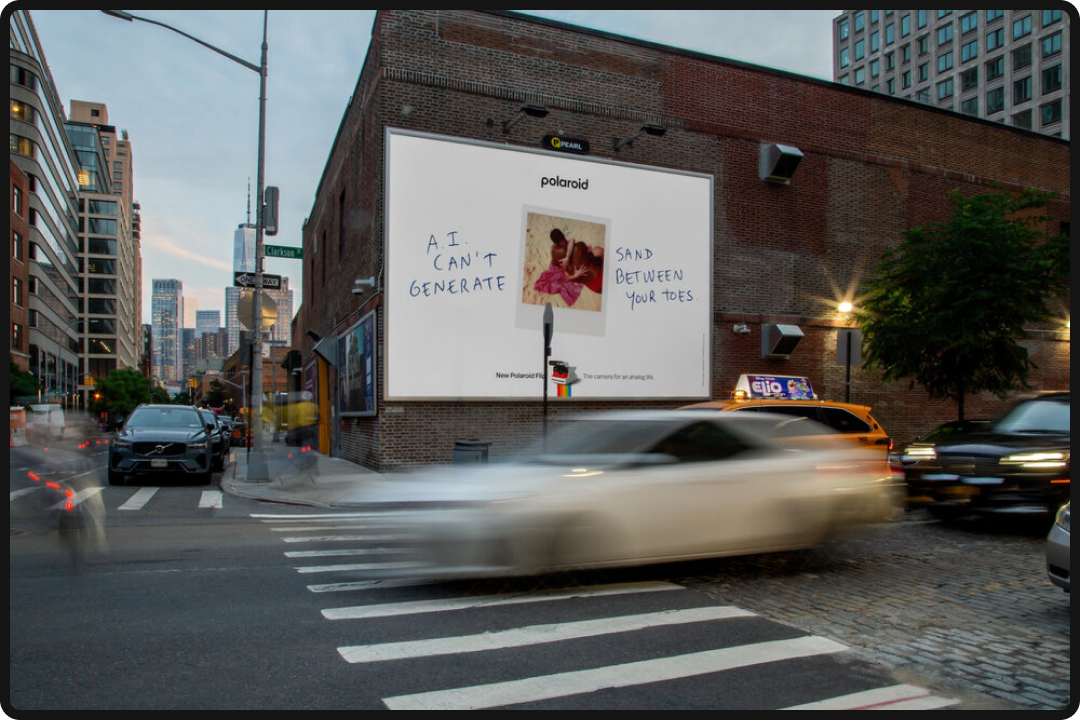
Polaroid launched a pro-analog campaign in 2025 that went straight for AI’s throat. One ad said, “AI can’t generate sand between your toes;” messaging that tells you exactly how it is. Since 2022, over 15 billion AI images have been created using text-to-image AI tools, some of them even mimicking camera-style photography that makes you do a double-take to confirm if it was generated or shot by a real person.
You could literally type “generate an image of a beach in the style of a Polaroid picture” and get something that looks like what someone using a Polaroid camera would capture. But AI-generated images can’t evoke the kind of emotions a real photograph would, and Polaroid is trying to convey that message by calling it out for what it is (or isn’t).
Polaroid was not only defending the concept of analog photography, but also the irreplaceable value of capturing moments out of real experiences.
And then there’s Chipotle, which not only called out AI marketing directly, but also called out a specific brand that’s been using AI. Let’s discuss.
The Super Bowl is arguably one of the only times of the year when marketers come together to lock in and watch the ads, only to then develop a list of the good and the bad, and then talk about it online the next day (we even made some predictions and reviews of our own).
Well, as a marketer myself, I’m guilty as charged, so here are my two cents: SVEDKA was on my “bad ads” list, and it seems like I was far from the only one who thought so. But right after SVEDKA aired the first-ever fully AI-generated Super Bowl ad, Chipotle posted a text-to-claim offer on social with a message that said they’re the “realest” 30 seconds of the game.
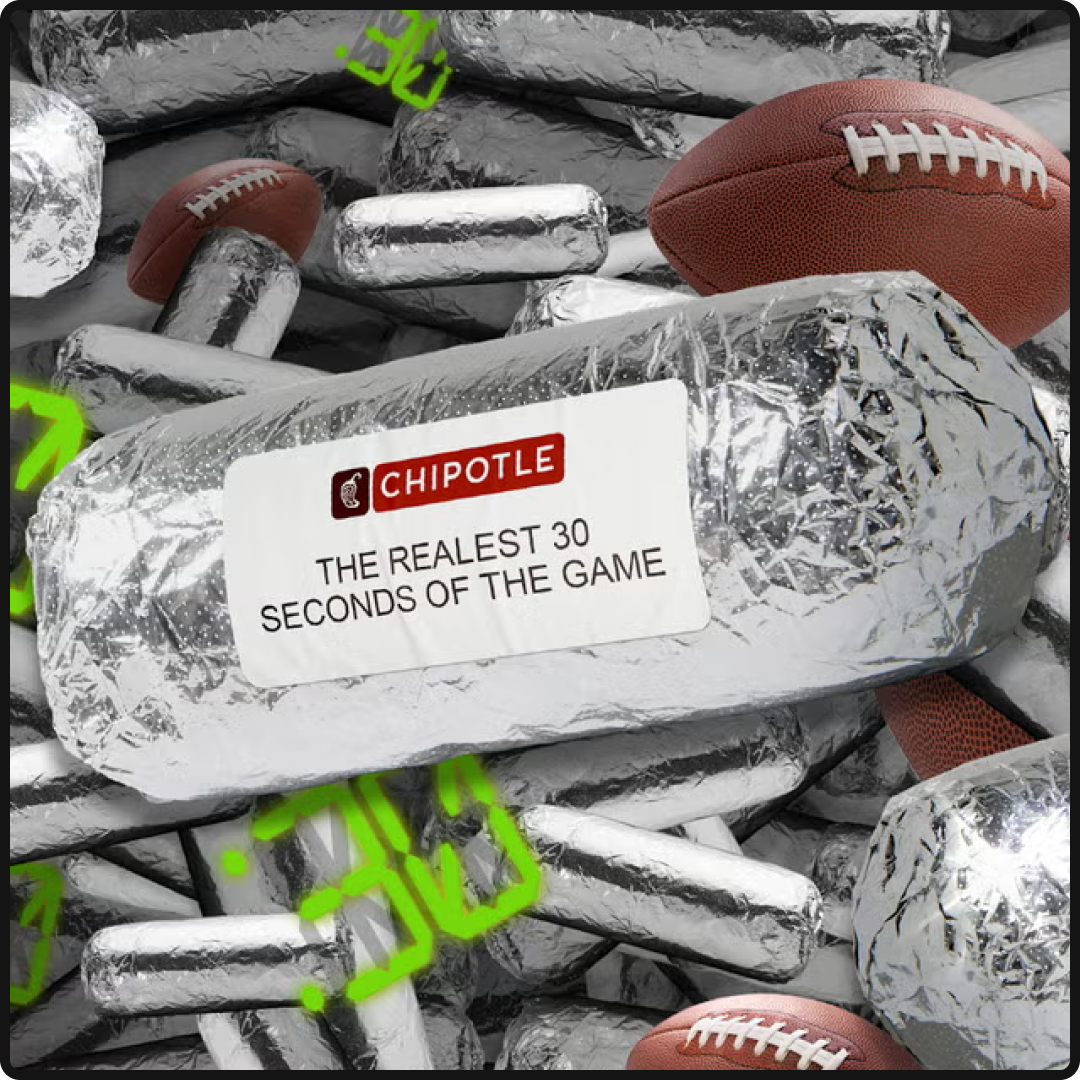
While people were still processing (and roasting) SVEDKA’s AI commercial, Chipotle slid in to position themselves as taking the opposite stance. They didn’t even need to mention AI explicitly; it was the context that did all of the work for them. Let’s also keep in mind the fact that Chipotle didn’t even need a Super Bowl ad to get their message across (they instead leveraged another ad’s immediate infamy; talk about saving money, right Coca-Cola?).
Chipotle hijacked the cultural moment around AI backlash and turned it into proof of their own values. Another brand stumbles with AI? Chipotle is there to remind you that they’re committed to real food, made by real people. What makes this direct approach so effective is that these brands show up as proactive, not defensive. They’re out here drawing the line first and that’s bold.
5. Using Visual Storytelling
The best kind of anti-AI approach brands can take is the one where their work speaks for itself. You know that feeling when you come across a piece of content that’s so good visually, you end up stalking the account responsible and before you know it, you’re spamming links to your team’s Slack channel? That’s the kind of content where there’s no question whether a human made it or not.
This is because visual storytelling evokes emotions and feelings that AI just can’t replicate because of their nuance. The quality of the camera work, the editing style, the color grading, the angle a video or picture was shot in; it all feels intentional in a way that makes you feel so certain that whoever was responsible for the creative direction worked hard.
Ffern is a perfect example of this. They’re an artisan perfume brand based in the UK that releases limited-edition fragrances tied to the seasons. Each perfume has its own story woven into every bottle. It’s designed to evoke a specific emotion because the scent reflects each season, like this year’s winter 2026 scent: Oakmoss and violet leaf capture dark winter waves, with timut pepper sparkling like moonlight on the sea’s surface.
Ffern is meticulous about capturing raw, in-the-moment shots that make every frame feel peaceful and deeply sensory. There’s one post in particular, called “Come Inside The Lighthouse Keeper’s Cottage,” with a caption that urges viewers to keep their sound on. Each slide goes through different kinds of sounds you’d hear in this cottage: the sound of a fireplace crackling, water dripping in a bucket from a wet coat, and the sound of a candle burning with ocean waves crashing in the background.
Their craft naturally reflects their admiration and appreciation for human creativity and artistry. Nothing explicitly mentions AI, but their content leaves no room for skepticism. The emotions you feel while watching their content make it crystal clear that real people conceived these ideas and brought this vision to life.
How to Identify Fake Anti-AI Marketing
With all the hype around anti-AI marketing, every brand has tried to get in on it (some more successfully than others, obviously). There have even been brands that made an “anti-AI statement” while still using generative AI. And spoiler alert: that does not work. It completely contradicts what being anti-AI stands for, but what does it really mean to be anti-AI?
Take Equinox’s “Question Everything Buy Yourself” campaign. The concept made sense at first: use AI-generated people as a contrast to real people with real bodies, driving home the message that your body is more authentic than anything you see online. The intention was to celebrate realness by juxtaposing it against the fake.
So if the messaging was there, why were people so disturbed? Comments called it weird, unsettling, and extremely off brand considering Equinox falls into the category of luxury. Videos of babies surfing and a guy’s face exploding for New Years threw viewers off completely. People pointed out that using AI to make a point about authenticity completely waters down the brand’s credibility. If you’re trying to champion real bodies and real people, why are you creating fake ones to begin with? The cognitive dissonance was hard to ignore.

Then there’s the Almond Breeze commercial featuring the Jonas Brothers. In the ad, directors pitch various concepts using generative AI (like showing the Jonas Brothers in space) before landing on a “real” idea. While most viewers were distracted by Joe Jonas (as was I), a few commenters expressed their distaste. The brand had the budget to feature the Jonas Brothers, so why lean on AI for hypothetical concepts at all? It felt lazy and contradictory.
So, what actually defines anti-AI?
Being anti-AI on a larger scale means protesting against the use of AI in any way, shape, or form from job ethics, environmental issues, security and safety concerns, and its effects on society.
Brands can’t claim to be anti-AI while still using it for their own benefit. In other words, anti-AI doesn’t mean “make fun of how silly it is to use AI by using AI”; it means don’t use AI. Real anti-AI tactics mean brands choose not to use AI in any creative process or in a way that impacts the people that work at their company.
When brands use AI (even if it’s to speak against it) they’re still investing money into that content, making the entire concept counterproductive. They’re still profiting from AI, and that completely undermines any anti-AI stance they’re trying to project.
Does anti-AI mean not using AI at all? If you’re putting budget toward AI-generated content and monetizing it, you’re not anti-AI. You’re pro-AI with better branding and audiences can tell the difference. People don’t want brands to use AI as a creative shortcut and still claim moral high ground on authenticity; they lose credibility that way.
The anti-AI movement isn’t about being performative and tapping into a trending conversation to be #relevant. Being anti-AI is a definitive choice and an intentional one that shows your audience you’re choosing human creativity over efficiency and convenience, even when it’s harder and more expensive. If you’re going to take a stance, commit to it.
The Future of Anti-AI Marketing
It’s still the beginning of 2026 and we’re still going to see more and more brands join the AI conversation (whether they land on the pro or anti side). For brands trying to navigate this cultural conversation and figuring out if they should be next to participate, here are some things to remember before doing so:
- Trust is fragile: User trust is more fragile than ever, especially on the internet. One contradiction between what you say and what you do, and your reputation takes a hit that’s hard to recover from. Everyone who’s chronically online has developed a finely tuned BS detector. Audiences magnify and nitpick the tiniest inconsistencies and they will call you out. And those callouts don’t just disappear; it’ll be something people attach to your brand when they think about you.
- Consistency is everything: One “I’m anti-AI” statement isn’t enough. You can’t declare your stance once and then go silent (or worse, contradict yourself three months later with an AI-generated campaign). Participating in anti-AI marketing is an ongoing commitment that needs to show up consistently across everything you do. Continue proving to your customers that your brand hasn’t changed, show up in ways that reinforce your values, whether that’s through BTS content, crediting creators, using anti-AI labels, or just producing work so undeniably human that no one could question it.
- The stakes are only getting higher: As AI technology advances and becomes even more accessible, the pressure on brands to take clear positions will intensify. Sitting on the fence won’t be an option.The brands that thrive in this environment will be the ones who clearly show that they value human creativity, compensate artists fairly, are transparent about their process, and respect their audience enough to tell them the truth.
The rise of anti-AI marketing is a response to the change in how people evaluate content due to internet distrust. Whether you’re leaning into AI or pushing back against it, the expectation is the same: be honest, be consistent, and respect the people you’re trying to reach. Because at the end of the day, your audience is not only watching what you say, but watching what you do.