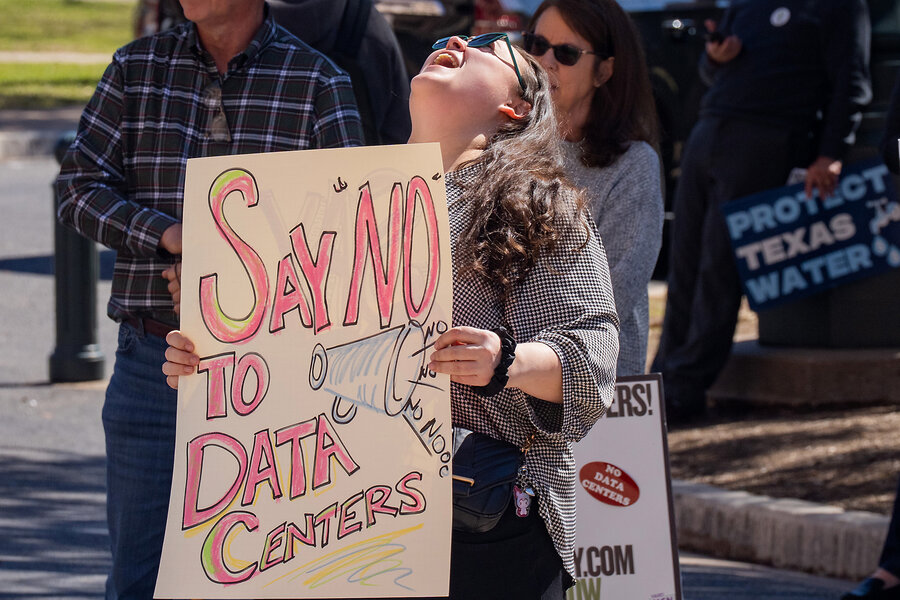
Many Americans are not happy about AI.
In some places, people are filling community meetings to resist data-center construction. The Department of Homeland Security warns of a rise in anti-technology extremism. Public polling indicates that U.S. citizens increasingly believe artificial intelligence will take their jobs, raise electricity prices, and dilute the value of art, all while offering little in return.
But in countries such as China and South Korea, where AI is also expanding rapidly, a majority of people view it as a positive tool that will spur economic growth.
Why We Wrote This
Artificial intelligence is viewed with less optimism in the U.S. than in other countries. The reason for that could be related to messaging around the rapidly advancing technology: In America, the focus is on potential job loss; elsewhere, AI is pitched as an economic boon.
It’s a striking disparity that reflects a wider trend. AI is playing an ever-bigger role in people’s daily lives, and it is being used in government and business operations. As AI usage grows, chasms are emerging between how different parts of the world perceive and react to this transformative technology.
The United States is a clear global leader in AI, outpacing other countries in the construction of data centers, which provide the physical infrastructure – and which use massive amounts of energy – to run this technology. It also leads in private investment into AI.
But at the same time, average Americans are more resistant to AI than people in almost any other part of the world. Experts say the way AI is developed and rolled out in the U.S. highlights its possibility to do harm over the benefits it might provide.
“The U.S. has committed up-front to leading in this [AI] space, but the public has been left behind,” says Sha Sajadieh, who leads the AI Index at the Stanford Institute for Human-Centered Artificial Intelligence.
About 3 in 10 Americans trust their government to regulate AI, the lowest score out of 35 countries surveyed by Ms. Sajadieh’s institute in 2026. In multiple polls, the U.S. ranks at or near the bottom in its AI optimism – a feeling that the technology will do more good than harm – compared with other countries. In Asian countries such as China, Indonesia, and Thailand, between 75% and 85% see AI’s benefits as outweighing its drawbacks.
“When you look at China, the number of people who are nervous is around 40%,” says Ms. Sajadieh. “And in the U.S., that’s the amount of people who are actually excited.”
Experts link the disparities in part with how different governments approach the rollout of AI.
AI as a tangible benefit
Ranjit Singh, the director of Data & Society’s AI on the Ground program, says the way countries approach AI and the messaging they use can make a big difference in public perception.
In the U.S., he says that, apart from the need to stay competitive with China, neither the government nor AI companies have made a clear case for why AI is a positive thing for most people or why it’s worth the cost of the massive resources being invested in it.
In fact, tech executives have openly predicted that AI advancement will lead to widespread job loss.
“There is no positive vision of AI that has been offered in the U.S. as a way to anchor what people’s relationship to this technology should be,” says Dr. Singh.
By contrast, he says many other countries have approached AI with a more intentional vision and have sought to connect AI development with a problem their country needs to solve.
In Saudi Arabia and the United Arab Emirates, for example, AI is presented as an economic tool to help those countries diversify an oil-dependent economy and thus drive growth. They are using AI to help build up new industries, including tech and tourism, as well as attract investment from other countries. In Japan, AI robots are viewed as a way to help people care for elderly relatives in a country with an aging population.
For some developing countries, AI development represents a chance to “leapfrog” or catch up with the rest of the world. For example, India aims to become a global “AI garage” by creating AI tools that other countries will want to use.
The differing narrative is “why some people are willing to place more trust or be more optimistic about an AI future than in the U.S.,” says Dr. Singh.
AI development in the U.S. tends to be focused on achieving theoretical milestones like artificial general intelligence, defined as machines or software that replicate human intelligence.
Baobao Zhang, an associate professor at Syracuse University who studies public and elite opinion toward AI, says the goals are completely different in countries such as China. In those places, the focus is more about using AI to tangibly improve people’s lives in areas such as healthcare, education, and science. For example, China is a global leader in trials for AI healthcare use and in testing self-driving cars.
In the U.S., she says, “It just seems more that [consumers are] being burdened with the risks and potential harms.”
Where AI fosters mistrust
Views on AI can differ depending on its application. For example, public polling shows that people around the world, including Americans, are generally excited about AI’s potential to support healthcare, spur scientific innovation, and perform convenient tasks such as forecasting the weather.
But Americans balk at a number of other applications that they fear will make society worse, not better. Large majorities believe that AI will decrease the number of available job opportunities by automating tasks normally done by humans. Scams and misinformation are also a concern reflected in American public opinion, as is the belief that AI will make people worse at thinking creatively and forming meaningful relationships.
People in the U.S. feel like they don’t have a choice when it comes to Al, says Dr. Zhang.
She cites her university students as an example. In a pinched labor market, she says they tell her they feel compelled to use AI to more easily apply for hundreds of job positions.
But at the same time, AI feels like a growing threat to those students’ work prospects – it might be used to interview them, screen their applications, or even automate the jobs they hope to land. The apprehension is strong enough that several college commencement speakers this spring were booed when they mentioned AI.
“Right now, it feels like for a lot of people, they don’t have much say and control over how AI is being used,” Dr. Zhang adds. “It is either forced upon them … or they feel like they have to acquiesce to it in order to keep their job.”