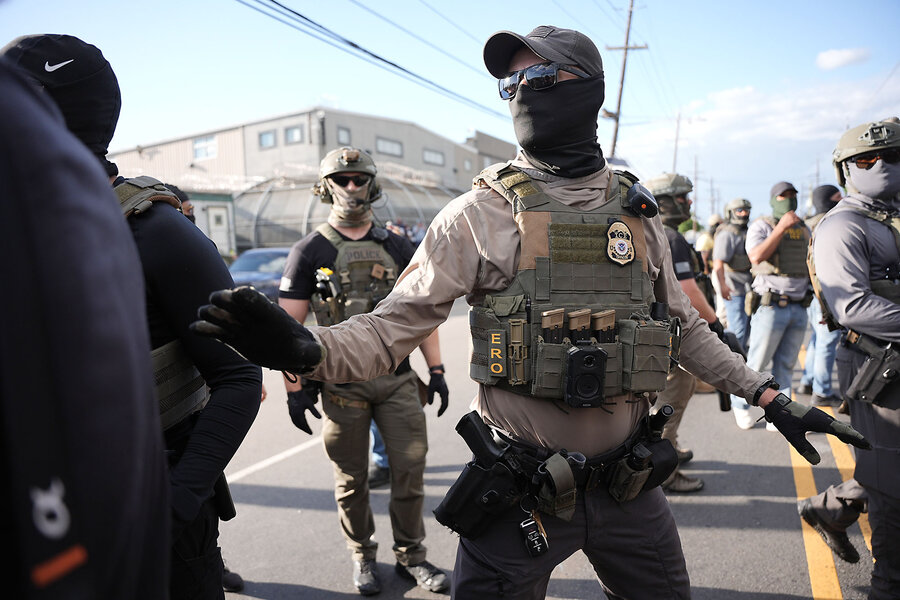
In the immigration debate, consensus is rare. Yet the Trump administration and its critics have come close on the need to outfit officers with body cameras.
Immigration and Customs Enforcement officers fatally shot two immigrant drivers this month, in Texas and Maine. The Department of Homeland Security claimed its ICE officers acted defensively, but hadn’t been issued body cameras. While more than half of ICE field offices have that gear, said DHS, the rest will catch up by September.
Federal officials and ICE critics see body cameras as a way to hold each other accountable on the street. Yet while it helps with context, video alone can’t tell the full story. Expanded use of body cameras has also raised red flags around surveillance – and potentially selective release of official footage to shape narratives of events.
Why We Wrote This
Two recent killings of immigrants by Immigration and Customs Enforcement officers have raised questions about whether the shootings were justified. Officers wearing body cameras would add a piece of evidence to contested encounters.
Recent shootings, filmed by bystanders, came as ICE ramped up arrests to record levels under the second Trump term – averaging more than 1,470 daily for the first couple of weeks of July. As vehicle stops persist at the urging of President Donald Trump, officers might encounter more protesters and others whom the government accuses of impeding operations.
After officers killed two U.S. citizens in January during Minnesota immigration protests, DHS promised more body cameras. Now, the Trump administration blames disruptions to purchases and deployment on government shutdowns that froze DHS funding as Democratic lawmakers pressed for reforms. Another Democrat, President Joe Biden, launched a body camera pilot five years ago.
That administration was on a path to nationwide deployment over a few years, but “faster would’ve required more resources,” says Scott Shuchart, former assistant director for regulatory affairs and policy at ICE during the Biden administration. Beyond the cameras, costs related to training and data storage added up.
“The speed of rollout was really dictated by the appropriation,” says Mr. Shuchart. At the time, “ICE was profoundly resource-constrained.” That’s no longer the case.
In April, Congress gave DHS $20 million to outfit body cameras for personnel enforcing immigration law – after the agency scored billions more in funds last year. The administration’s proposed DHS budget for this fiscal year had called for funding cuts to the camera program.
Pro-enforcement support
As officers across the country get trained and gear up, ICE now requires at least one body camera for each arrest team.
DHS didn’t respond to requests for comment, including to confirm ICE’s latest body camera policy. A directive from February 2025 requires ICE officers to activate the tool during actions such as arrests, executions of warrants, and deployments to federal facilities. Undercover efforts, including surveillance, are exceptions.
Some former officials support the rollout.
“For the most part, we wanted bodycams,” says Scott Mechkowski, an ICE deputy field office director during the first Trump term. Especially to document difficult deportations when immigrants would fight back, he says.

Steven Garcia/NurPhoto/AP/File
In the absence of agencywide body cameras, he recalls how ICE officers occasionally recorded their own enforcement actions as proof – in case things went south.
“Do I think that all the federal agencies by now should have had body-worn cameras on their person when they were conducting arrests? Yes,” says Mark Morgan, who led Customs and Border Protection and ICE during the first Trump term. Yet due to divisive immigration politics, Mr. Morgan laments that DHS officers face more scrutiny for shootings than other federal agents.
For example, he notes, agents working with the Justice Department shot 223 people – and more than half died – between 2018 and 2022, according to an NBC News analysis. Those shootings, often of people wanted for crimes, appeared to garner less notice than recent killings by ICE, he says.
The Justice Department directed its law enforcement agencies to develop body camera policies in 2021. One agency, the Bureau of Alcohol, Tobacco, Firearms and Explosives, has a public map showing that nearly all field divisions have phased in cameras. Another, the U.S. Marshals Service, reports equipping all deputies as of last year.
Background from Biden’s term
Several U.S. police departments began using body cameras in the early 2010s. Yet as acting director of ICE in 2013 and 2014, John Sandweg says he doesn’t recall significant discussion of body cameras at ICE at the time.
For one, the Obama administration often pursued less overt enforcement. That meant picking up immigrants already in custody in prisons or jails, and assisting removals at the border, he says.
“Over the last year and a half, we’re seeing ICE engage in a lot more activity that is more akin to a patrol officer,” such as at traffic stops, says Mr. Sandweg. “That’s where the bodycam is essential.”
In 2021, responding to a mandate from Congress, ICE announced a body camera pilot program. Two years later, a Rand study, though limited in scope, found “no critical issues” with plans to expand.
“In the ICE conversation, one of the significant issues … has been the question, What exactly was the danger that officers encountered?” says Chuck Wexler, executive director of the Police Executive Research Forum, a Washington-based think tank. “Body-worn cameras can answer that question.”
Caveats
While more cameras could enhance accountability, research underscores limits. Whether law enforcement body cameras reduce use of force overall is inconclusive, analysts found. Other research suggests body camera footage can accentuate racial bias by the viewer against people with dark complexions.
Privacy and evidence experts point to other potential downsides. Think expanded surveillance and cherry-picked releases of video by ICE.
A former DHS attorney, Spencer Reynolds, says he worries about footage fed into the department’s “massive surveillance infrastructure.”
DHS preserves large amounts of video and images. Those are combined with “massive DNA repositories, social media monitoring, vehicle trackers – and tons and tons of intelligence to target immigrants and build dossiers on protesters,” says Mr. Reynolds, senior counsel at the NAACP Legal Defense Fund.
The February 2025 policy prohibits “live” body camera recordings for facial recognition systems. But a footnote says facial recognition searches are allowed with still images culled from the cameras.
Observers also raise concerns around selective or manipulated releases of official video. There must be clear policy guiding public access to footage, says Sandra Ristovska, founding director of the Visual Evidence Lab at the University of Colorado Boulder.
More broadly, she says, society has placed “too much faith in video,” which can reveal reality as easily as conceal it. Video is just one tool.
Fair immigration enforcement is a social question, she says. “Not one that we can solve with technology alone.”