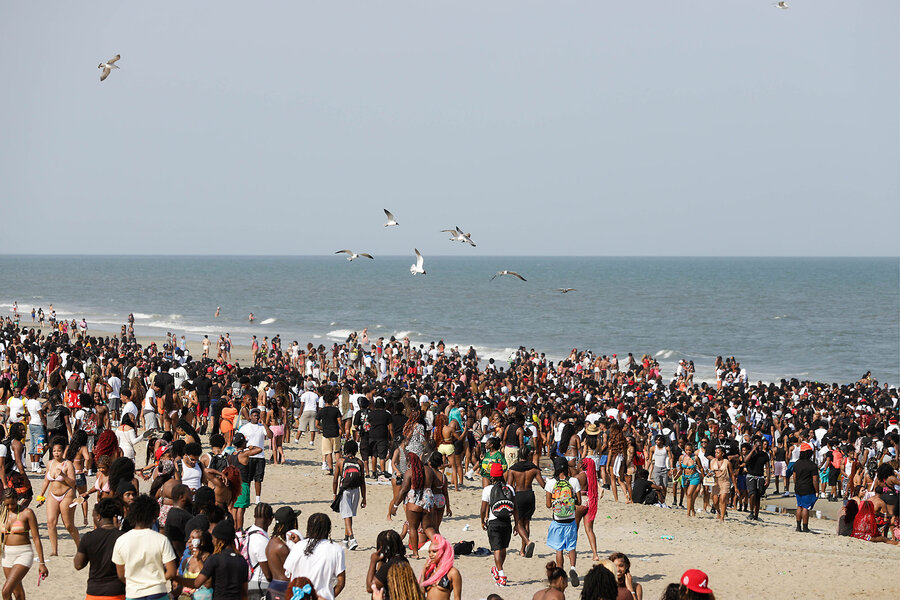
For Cabriel Lewis, it was an “epic” teen takeover.
When he was just 15, he joined tens of thousands of other teenagers to rush onto tiny Tybee Island, Georgia, a barrier island beach town with only one causeway road on and off. They were trying to take part in “Orange Crush,” a controversial, annual spring break beach bash here. Gridlock ensued, people were injured, ambulances got stuck, and mayhem ruled deep into the night.
“It was a lot of fun,” says Mr. Lewis, now 18. “But I also feel lucky to have gotten off the island alive.”
Why We Wrote This
A rise in “teen takeovers” is highlighting young people’s need for safe spaces and connection. It is also prompting a shift from reactive policing to proactive engagement, including more teen-focused, supervised “third spaces” in communities.
Unruly teen gatherings have long been an integral part of American culture (think “West Side Story,” or Halloween egg fights). But driven by social media organizing and the potential for viral fame, a new wave of teen “takeovers” is presenting big problems – and opportunities – for communities across the U.S.
This past weekend alone, groups of rowdy teens descended takeover-style on Six Flags St. Louis and at Katy Mills Mall just outside of Houston, requiring police to disperse the crowds. Another planned “takeover” in nearby Tomball, Texas, was halted by a Harris County constable before it could begin.
With such takeovers becoming more frequent, authorities from Alameda Beach, California, to the Navy Yard neighborhood of Washington, D.C., say they are concerned about a restive summer. On Tuesday, the D.C. Council voted to extend the police chief’s authority to enforce an 8 p.m. youth curfew zone through 2028, adding enforcement guardrails. D.C. Mayor Muriel Bowser has also pledged to expand youth programming. The measure might not take effect until late summer.
Like the often artistic “flash mobs,” in which a group rushes in, performs an unexpected act (like the 4,000-person silent disco in London’s Victoria Station in 2006, or the five-minute frozen pose by some 200 people in New York’s Grand Central Station in 2009), modern “teen takeovers” tend to be social-media-driven gatherings that happen fast, with kids disappearing into crowds when police arrive. That makes it difficult for authorities to hold the youthful participants accountable for any property damage – including dented car roofs from stomping on them or other unruly behavior.
Not all mobs or takeovers are problematic. With May 2 being billed as “International Line Dance Flashmob Day,” hundreds of peaceful flash mobs gathered this past weekend at city landmarks, parks, and malls on every continent except Antarctica, including roughly 50 in Canada alone.
But questions are being raised about how communities can tweak responses to the often unruly teen takeovers, rather than just punishing errant teens or their parents. City leaders also acknowledge they can do better. After all, they say, hanging out, taking on risky adventures, and prioritizing peers’ attention over possible consequences are deemed normal behavior for teens trying to establish independence.
“This is the kind of thing we, as teenagers, have always done,” says Jennifer Breheny Wallace, a fellow at the Center for Parent and Teen Communication at the Children’s Hospital of Philadelphia, referring to the youth gatherings in malls and parking lots.
“This need to matter”
But times are different, these leaders note, and some teens talk about a sense of irrelevance, whether related to changing media norms, invasive, high-stakes technology, or a polarized political environment – a tricky mix for young people.

Patrik Jonsson/The Christian Science Monitor
“When we are made to feel like we don’t matter, we can either withdraw or act out in extremes,” says Ms. Wallace. Teen takeovers “are a collective assertion of this need to matter.”
Here on Tybee Island, a teen takeover on the beach pier in early April ended when gunfire erupted. The teens fled and the police chased, but no one was arrested and no bullet casings were found. The TV show “Inside Edition” even asked Mayor Brian West for a comment.
“I think [the producers] were expecting this shocked, unprepared small town mayor who was horrified by all of this,” says Mr. West, who, years ago, became the legal guardian to three teenagers who had nowhere else to go. “They didn’t get that. I said, ‘Look, we do this every year. It’s a big deal, but we know how to handle it.’” (Interestingly, he says, the interview never made it to air.)
While Mayor West said his goal was to end Orange Crush, citing safety risks, drug and gun concerns, and traffic gridlock, he refocused on creating safe spaces for teens to gather, even as they push boundaries. That revamped gathering, held this year, is now rebranded as “Crush Reloaded.”
Other cities and towns are learning on the job.
The first work is keeping the peace. In Orlando, last week, 30 sheriff’s deputies were called in to control a throng of more than 1,000 teenagers, some fighting, who had descended on the parking lot of an amusement park. Takeovers in Chicago, Washington, D.C., Detroit, and Atlanta have led to arrests, fights, gunshots, and youth running wild through the streets.
Discipline and accountability
In search of solutions, several cities, including Washington and Detroit, have vowed to strictly enforce curfews. Private businesses such as Six Flags have instituted new chaperone policies. Following the chaos at ICON Park in Orlando, the city implemented a chaperone policy requiring park guests under age 17 to be accompanied by an adult 21 or older.
Other communities are demanding consequences for parents and other responsible adults. In North Carolina, authorities said they plan to file charges against adults who, they claim, recently stood by as teens engaged in a “planned fight” in April that devolved into gunfire that left two teenagers dead.
“You are responsible for knowing where your children are, at all times,” Detroit City Council member Angela Whitfield-Calloway told a local TV station after mayhem broke out during another such teen takeover there last month. “I know where my four were. You know where yours are? Why should we make exceptions? It’s not funny. It is a very serious matter, and … parents are going to be held accountable.”
But focusing solely on either curfews or parental accountability can fall short, according to research by Charlotte Gill, a criminology professor at George Mason University, who has found that crime sometimes increases during curfews.

Patrik Jonsson/The Christian Science Monitor
Former Chicago police officer Louis Martinez, now an associate professor of criminal justice at Oakton College in Des Plaines, Illinois, agrees. The call, he says, is to address a mix of needs around discipline, respect, and meaningful relationships in families, schools, neighborhoods, and communities.
“Most of us experienced [teen years] as a tough time in life. We should be reminded of that. We need some patience,” says Mr. Martinez.
A “balanced” communal response
Many communities, in fact, are moving to balance their response.
In Detroit, city leaders created a youth advisory board and vowed to sponsor midnight basketball leagues. Recreational center hours would also be expanded. The city has a new website that will list existing activities in one place, including nighttime gathering spots.
Other communities have countered the teen gatherings with “adult takeovers” that gather near the impromptu teen events to discourage troublemaking.
“Have fun,” 2nd District Council member Marquinn McDonald said to teens at a news conference in Chicago announcing one such event. “Come out, kick it, do your thing, but do not destroy.”
That communal embrace is critical, experts say, as surveys show that 3 in 5 young adults report feeling a lack of “meaning or purpose” in the last month. Half said they “lack direction” in their lives.
For his part, Tybee Island’s Mr. Lewis attended Crush Reloaded, which took place two weeks after the “teen takeover” where shots were fired. The “Crush” fest featured 30,000 young people, raunchy lyrics from a stage, scant swimwear, and glimpses of underage drinking.
“The vibe was good,” says Mr. Lewis, waiting on a friend as the party wound down. “We just really want to have fun and push boundaries, but we also want to feel safe. And I’ve felt safe today.”
Other teens say reactions to such gatherings depend heavily on perceptions, which can fall along racial lines.
“I think people often try to demonize Black and brown youth specifically and try to make them seem like they’re doing something mischievous when really they’re just trying to have fun,” teenager Nahema Konate told a youth forum sponsored by the Black Swan Academy in Washington, D.C., in April.
When asked what adults should keep in mind, another teen, Samir Scroggins, said, “I want them to think about how they can make us better, maybe give us advice.”
Tybee Island had dealt with non-permitted gatherings for years. But the 2023 event that Mr. Lewis attended became a turning point. Since then, the city has worked with a new promoter to obtain proper permits for the gathering.
The collaboration, officials say, has resulted in less violence and fewer resident complaints.
At the April 18 event, though stronger security measures were in place, police did not actively intervene. Instead, they quietly kept watch over the tens of thousands of Orange Crush partiers from the pier. A city council member, Tony Ploughe, walked the tide line, picking up trash left on the sand by the crowds.
Islanders have also started joining in the festivities with corner “watch parties.” Next year, officials say, they hope to have a resident “golf cart brigade” to shuttle teens from distant parking lots to the beach party.
The focus is on ensuring the teens have safe yet fun things to do while on the island, says Mayor West.
“We were all there at one point, at that stage in life where we had to go wild and we didn’t know where the edges were,” he adds. “Somebody had to stand at the edges and say, ‘This is too far.’ … That’s what I hope we can do.”