
Here’s a truth bomb: the search landscape is not what it was two years ago (or even one year ago, if you were a little slow to the game, no offense). Not even close. AI Overviews have solidified their positions at the top of Google SERPs. ChatGPT and Perplexity are actively routing purchase decisions. ChatGPT even has ads now.
And the development of these platforms is not for naught. It’s a response to a change in user behavior: your customers are increasingly getting their answers from LLMs before they even consider clicking a link.
Visibility is the new rankings (aka, if your brand’s not there when a user asks about something in your category, you’ve got a visibility problem that your traditional SEO stack is not going to fix). Now, here’s the next piece of the puzzle:
Shifting user behavior → shifting platforms → shifting measurement tools.
In plain English, this is where AI search optimization tools come in. And before you scroll through this list thinking it’s just another collection of “AI tools” glued together with a coat of GPT paint, let me reassure you: I’ve done my homework:
- Some of these tools are purpose-built for the GEO (Generative Engine Optimization) era.
- Others are legacy platforms that have meaningfully evolved.
- A couple are workhorses that have earned their place, even if they don’t have “AI” plastered across the homepage.
Below, I’ve ranked and reviewed nine tools that are worth your time (and your budget) in 2026 and beyond.
What Is AI Search Optimization & How Does It Work?
Before we skip to the good part, let’s chat a little. AI search optimization is the practice of making your content visible, credible, and citable inside AI answers, not just your standard SERPs.
Here’s the distinction that matters:
- Traditional SEO gets you ranked on a SERP.
- AI search optimization (sometimes called GEO, AEO, LLMO, or, for some reason, AISEO, depending on who you ask) gets your brand cited inside AI responses from ChatGPT, Perplexity, Google AI Overviews, Gemini, or Claude.
Those are different games with overlapping, but not identical, rules.
How does it work? I could write a monologue about this (and I have, several times over), but I’ll keep it short. At its core, AI systems like LLMs pull from sources they find credible, authoritative, and well-structured. They favor:
- Authoritative content with clear factual claims backed by evidence
- Strong H-E-E-A-T signals (helpfulness, experience, expertise, authoritativeness, trustworthiness)
- Structured data and schema markup
- Content that answers specific questions directly (think follow-up queries)
- AI PR in the form of third-party mentions, citations, and brand presence across the web
AI search optimization tools help you monitor where you stand, identify gaps, fix crawlability issues for AI bots, and optimize content to get surfaced and cited in those AI answers. Some tools do one of these things well. The best ones do several 😉
Here are ten tools that have genuinely earned a spot on this list, ordered for your convenience from most GEO-native to most SEO-established.
|
Goodie |
|
|
Custom pricing; contact for a quote |
|
Semrush One |
|
|
AI Visibility Toolkit: $99/mo per domain. Semrush One bundles start at $199/mo. |
|
RankScale |
|
|
Essentials: $20/mo ($17/mo annually); Enterprise: $780/mo |
|
Surfer SEO |
|
|
Starter: $119/mo (or $99/mo annually); Pro and Peace of Mind plans available |
|
AirOps |
|
|
Pricing not publicly listed and requires a sales conversation |
|
MarketMuse |
|
|
Free tier available; Paid plan pricing not publicly listed (contact for pricing) |
|
Scalenut |
|
|
Starter: $59/mo ($30/mo annually); Plus: $89/mo; Professional: $199/mo |
|
Clearscope |
|
|
Essentials: $129/mo; Business: $399/mo; Enterprise: custom |
|
Rankability |
|
|
Core: $199/mo ($1,990/yr); Agency: $799/mo ($7,990/yr) |
1. Goodie: Best for End-to-End GEO + AEO Visibility
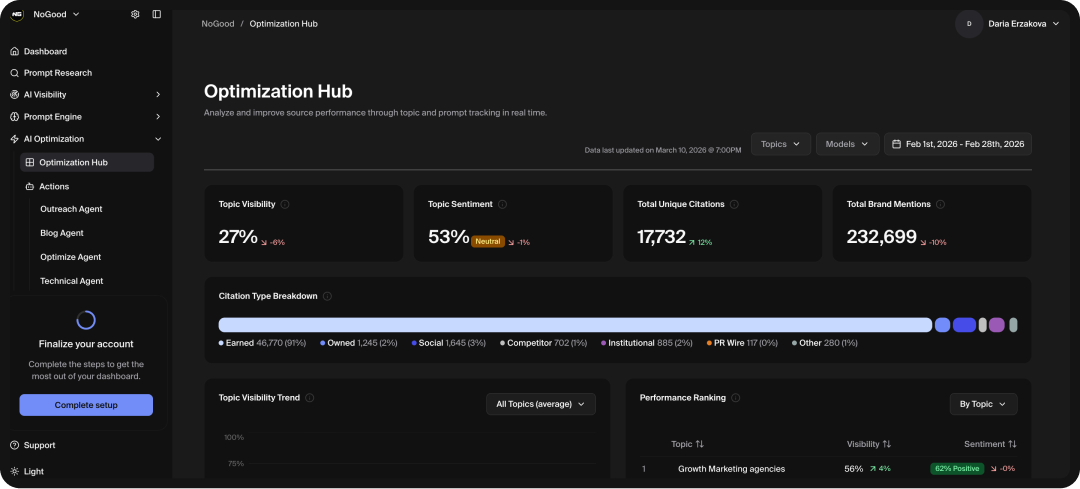
If there’s one tool on this list that was built from the ground up for the AI search era, it’s Goodie. And yes, I’m aware that that sounded like marketing copy… but hear me out.
Goodie’s platform covers the full loop:
- Monitor your brand visibility across AI engines (ChatGPT, Gemini, Perplexity, Claude, DeepSeek, and 6 others; that’s 11 total)
- Understand how LLMs perceive your brand narratively, identify content gaps, and optimize content using their AEO Content Writer
- Trace AI search performance all the way back to leads and revenue
That attribution layer (connecting AI visibility to actual funnel impact) is something that most tools in this space haven’t even attempted yet.
The platform works with GA4, Looker, and HubSpot, which means it actually plugs into your existing marketing stack rather than living in a silo. And for enterprise teams, they’re SOC 2 compliant with approval workflows built in.
Case studies worth noting:
- Dermalogica saw a 127% increase in AI conversions using the platform.
- SteelSeries became the most retrieved gaming brand across ChatGPT, Gemini, and Perplexity, with AI search conversions tripling in six months.
Overall, Goodie is best for brands serious about GEO and AEO strategy, enterprise content teams, and anyone who wants to measure AI visibility the same way they measure organic.
Pricing: Goodie pricing is custom; reach out to their team for a quote or demo.
2. Semrush One: Best for All-in-One SEO + AI Visibility
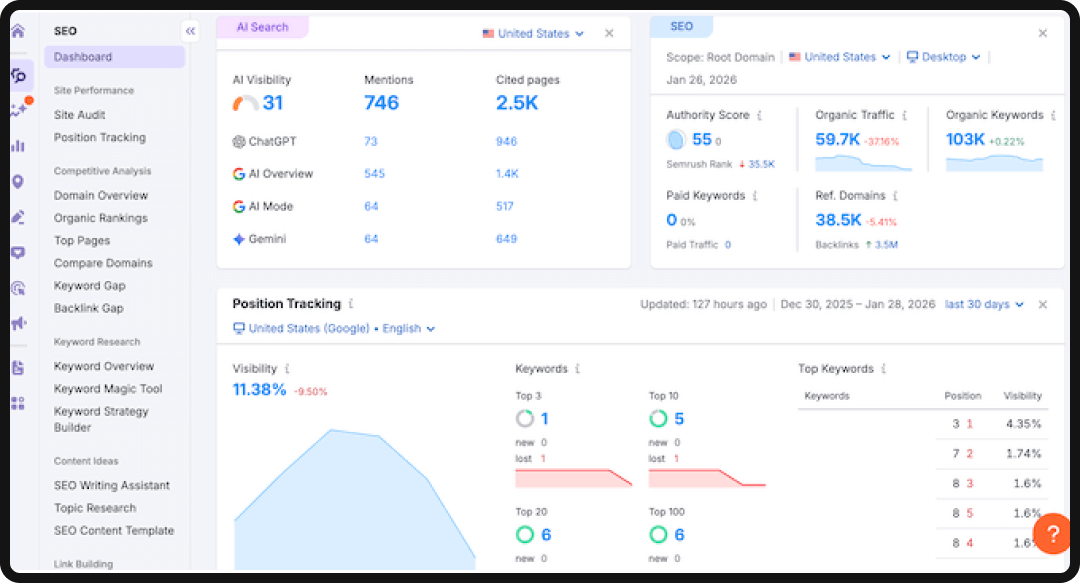
Semrush dropped something interesting in October 2025: Semrush One, a bundle combining their legendary SEO toolkit with a brand-new AI Visibility Toolkit. For teams that already live inside Semrush (been there), this is a meaningful upgrade.
The AI Visibility Toolkit tracks how your brand appears across Google AI Overviews, AI Mode, ChatGPT, Perplexity, and Gemini. You get prompt tracking, competitive benchmarking, sentiment analysis, and a visibility score, and it’s all in the same interface you already use for keyword research and site audits. That unified workflow is the real sell here.
The honest caveats:
- Regional coverage is currently limited to six markets (US, UK, Canada, Australia, India, Spain), which may frustrate global brands.
- If you’re managing multiple client domains at an agency, the per-domain pricing adds up fast.
But if you’re a mid-sized brand or agency already paying for Semrush and want to layer in AI visibility tracking without adopting a whole new platform, Semrush One is the most frictionless way to do it.
To summarize: teams already using Semrush who want SEO and AI visibility under one roof, this one’s for you.
Pricing: The Base AI Visibility Toolkit plan starts at $99 per month per domain. There’s also an option to add the toolkit onto existing Semrush plans.
3. RankScale: Best for Granular AI Citation Analysis
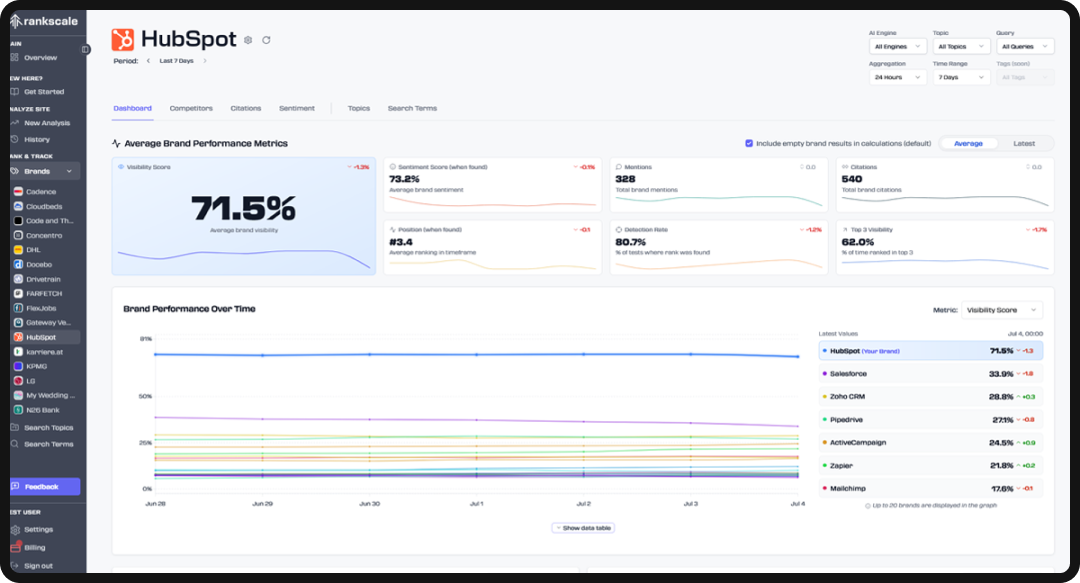
RankScale is the kind of tool that SEOs of the technical persuasion are going to love immediately. Built specifically for AI search visibility tracking, it recreates real prompts across ChatGPT, Perplexity, Gemini, Claude, and AI Overviews, captures exactly what those engines return, and includes which sources get cited.
What sets it apart from other GEO monitoring tools is the depth of its citation analysis. RankScale stores full snapshots: the generated answer, the mention position, and the source domains cited. Over time, this would build a database of how your content earned or lost citations across AI engines. Their competitive benchmarking is built around apples-to-apples comparisons (same prompt, same engine, same timestamp), so the data is actually meaningful.
It’s not the most beginner-friendly tool in this roundup (in fact, it’s earned the label “pretty technical” from its own users), but for agencies managing multiple brands who need visibility data to show their clients, the depth might be worth the learning curve. Founder Mathias Ptacek is known for shipping new features multiple times a week based on community feedback (mad respect).
RankScale is best leveraged by SEO agencies and technical marketers who want deep citation data and competitor benchmarking across AI engines.
Pricing starts at $20 per month when billed monthly, or $17 billed yearly for the Essentials plan (though the Enterprise plan for larger agencies shoots up to $780 per month).
4. Surfer SEO: Best for Content Optimization + AI Visibility Tracking
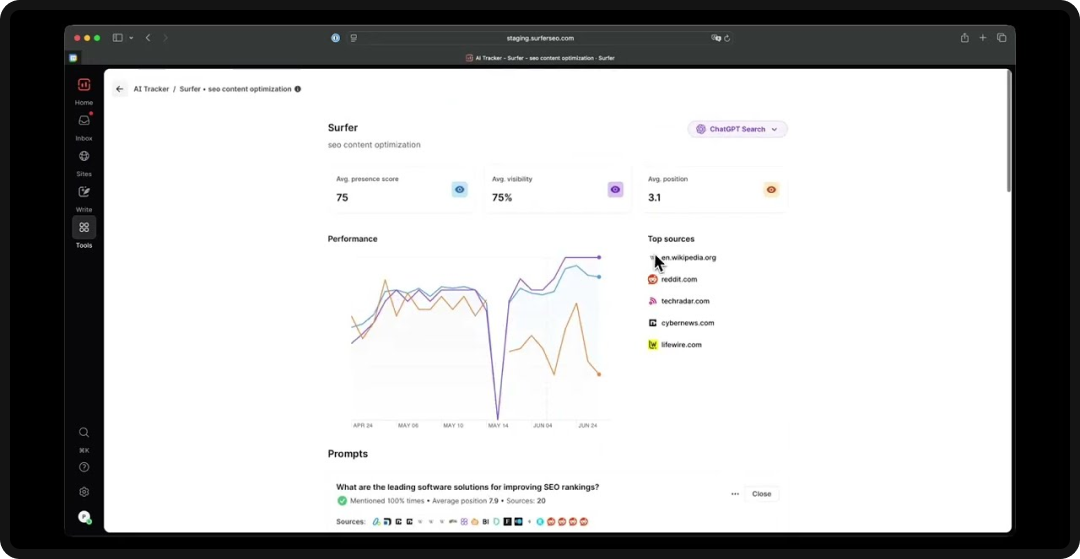
Surfer has been a content team staple for years (I know the tool well myself), and in 2025, they made their GEO pivot official. Their AI Tracker, launched mid-2025, monitors brand presence across ChatGPT, AI Overviews, and Perplexity. Their Facts feature is designed to help content get cited by AI (based on their own data, pages with Surfer Facts are 25% more likely to show up in AI answers).
But as we all know, you can take the tool out of the content, but you can’t take the content out of the tool (is that anything?)
What I mean to say is, the real strength of Surfer is still in the content editor: real-time NLP-keyword scoring, entity coverage, internal link suggestions, and a publishing readiness check. For teams that are looking for a writing tool that also has AI search optimization built in, Surfer has matured into a solid jack-of-all-trades.
A note that I’d be remiss not to mention: Surfer was acquired by Positive Group in late 2025 (just something to keep an eye on in terms of product direction and pricing trajectory).
As for pricing, the Starter plan goes for $119 per month billed monthly (or $99 per month for annual payments). There’s also a Pro plan and a Peace of Mind plan (such a clever way to say “Enterprise” or “more than you could ever need”).
5. AirOps: Best for Content Operations at Scale
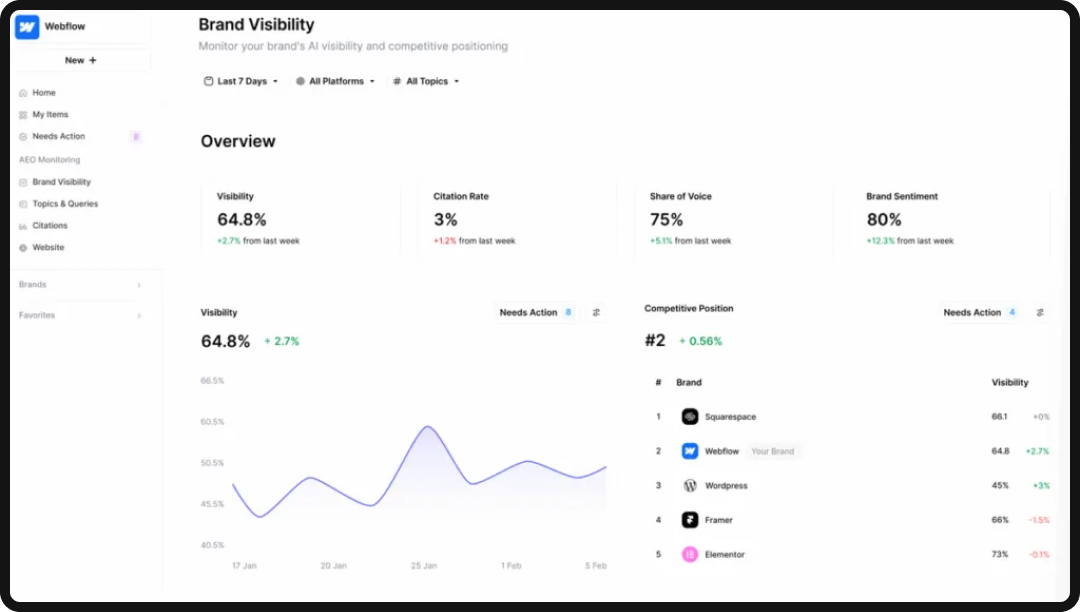
AirOps doesn’t position itself as a GEO tracker, and that’s fine; it’s doing something different. It’s a no-code content operations platform that helps teams build repeatable workflows for research, briefing, writing, optimization, and CMS publishing. Think Zapier, but built specifically for content teams who want to ship at scale without sacrificing brand voice or quality.
You may be asking, Daria, where’s the AI part? Well, their Answer Engine Diagnostic evaluates content readiness for AI search: checking freshness signals, authority cues, schema markup, and snippet extractability. It might not tell you whether you’re showing up in AI results, but it will tell you whether your content is set up to be cited. For teams refreshing hundreds of old blog posts (again, been there) or building programmatic content at scale, the Grid view is legit impressive.
AirOps raised a $15.5M Series A in 2024 and has since built integrations with Semrush, WordPress, Webflow, Shopify, Contentful, and Strapi. One client, Deepgram, grew organic traffic 20x using AirOps content workflows. Be prepared for a learning curve, though; this is a workflow builder, not a point-and-click interface.
In short, AirOps is a great solution for content operations teams managing high volumes of content who need repeatable, brand-consistent systems.
You know what comes next: pricing. There are three plans and a free trial for the two lower tiers (the highest tier requires a sales conversation). I’m sad to report that pricing isn’t public other than that, and there’s no time frame listed on the free trial. Curious.
6. MarketMuse: Best for Content Strategy & Topical Authority
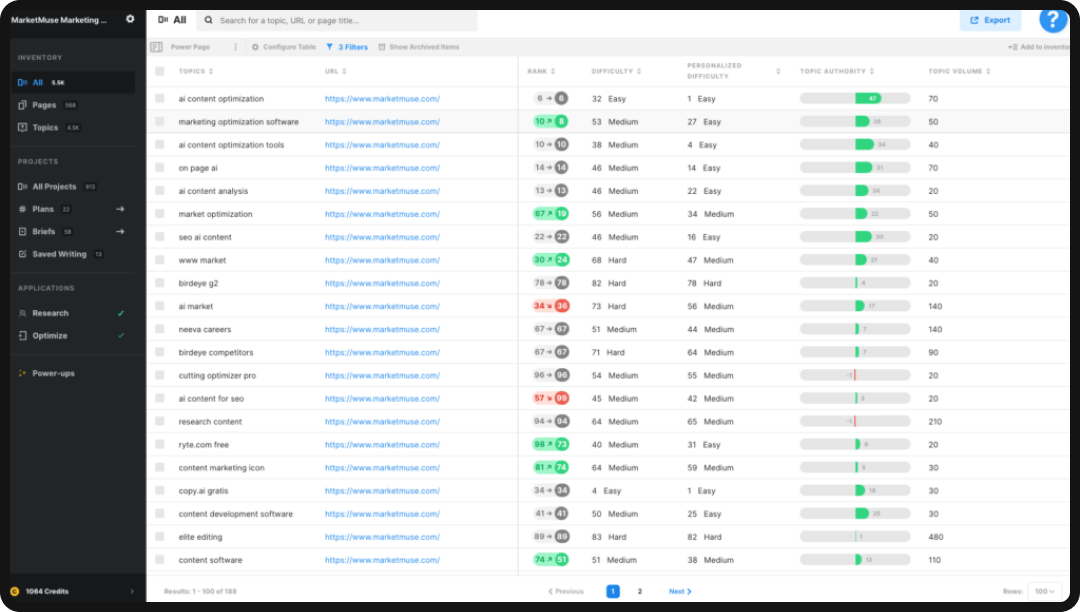
MarketMuse is the tool for content marketers managing large libraries who need to prioritize intelligently. It’ll audit your entire content inventory, identify topical coverage gaps, model competitive landscapes, and help you build content clusters that position your brand as an authority. That’s a lot, but from writer to writer, you know that it’s necessary.
Its Optimize module benchmarks your page against the top 20 results for a given topic, flags missing subtopics, and guides content rewrites. Independent reviewers describe it as “true inventory analysis others only promise”.
As for LLM optimization, the topic modeling and entity markup capabilities are pretty aligned with how AI systems understand content relationships.
I do have an honest caveat here: MarketMuse is a premium, complex platform; so much so that smaller teams or solo operators may find it more platform than they need. Its sweet spot is enterprise content operations where you’re making strategic portfolio decisions, not just optimizing individual pages.
The pricing? Well, there’s also a free trial here (though again, not sure how long it’ll last you). Their lowest tier is titled “Free,” which I assume means that it’s free. As for the other three plans (Optimize, Research, and Strategy), no dollar amount is listed. Very curious.
7. Scalenut: Best for All-in-One Content Lifecycle + GEO Tracking
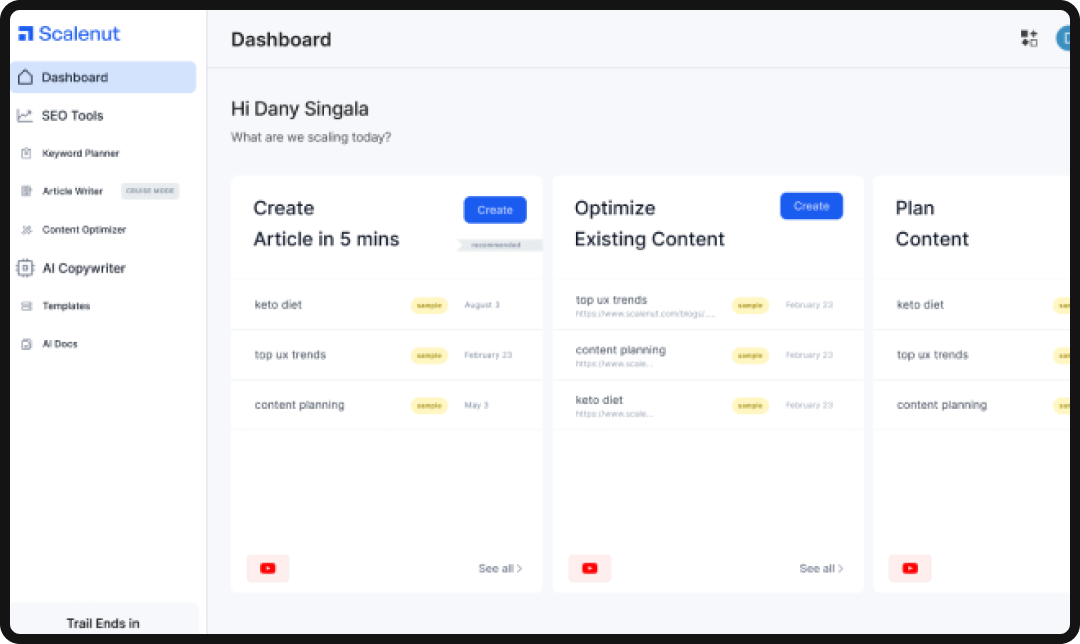
Scalenut is part of the camp of writing tools turned AI writing tools turned something more interesting: an all-in-one platform covering keyword clustering, content planning, AI article writing, on-page optimization, content audits, and AI visibility tracking.
- Their GEO Watchtower feature (good name) tracks brand visibility across ChatGPT and Gemini.
- Their Social UpReach tool monitors brand mentions across UGC platforms like Reddit and forums (which matters for AI visibility because LLMs increasingly pull from social media).
For teams that are drowning in tool sprawl, Scalenut’s consolidated approach is genuinely appealing. You can go from keyword to published, AI search-optimized content monitoring without leaving the platform. The UI has its quirks (copy-paste formatting issues have been noted by users), and it’s not the most technically deep tool in the GEO category, but the breadth-to-price ratio is hard to argue with.
Pricing for Scalenut is public (score!); the Starter plan is listed at $59 per month, or $30 per month when billed annually. The other two tiers are Plus and Professional, which go for $89 and $199 per month, respectively.
8. Clearscope: Best for Precision Content Optimization
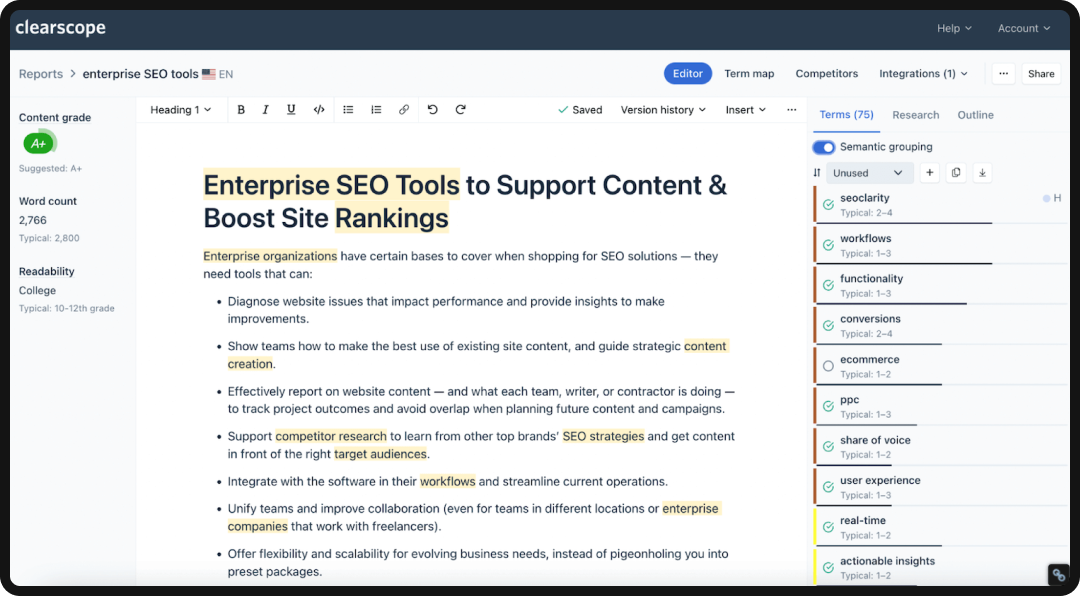
Clearscope hits the editorial gold standard for content optimization (and it’s well-deserved). The platform uses IBM Watson’s NLP to analyze top-ranking content for any keyword, generates precise keyword and entity recommendations, and grades your draft in real time. Plus, Google Docs and WordPress integrations make it easy to layer into existing workflows.
Another place in which Clearscope shines: accuracy and ease of use. Its content scoring is consistent and reliable in a way that matters when you have strict editorial standards or regulated topics. For teams where content quality is non-negotiable, Clearscope is one of the few tools that has genuinely earned the word “premium”.
Where it’s limited: Clearscope is primarily an on-page optimization tool. It doesn’t track AI visibility, manage content at scale, or handle technical SEO. If you’re building a GEO or AEO strategy, you’ll need to pair it with a dedicated visibility tracker. But as a pure content optimization layer? It sits at the top of its class.
Clearscope’s pricing is simple and straightforward: the Essentials plan costs $129 per month, the Business plan $399 per month, and the Enterprise plan is priced at a custom rate.
9. Rankability: Best for Semantic SEO + Entity Optimization
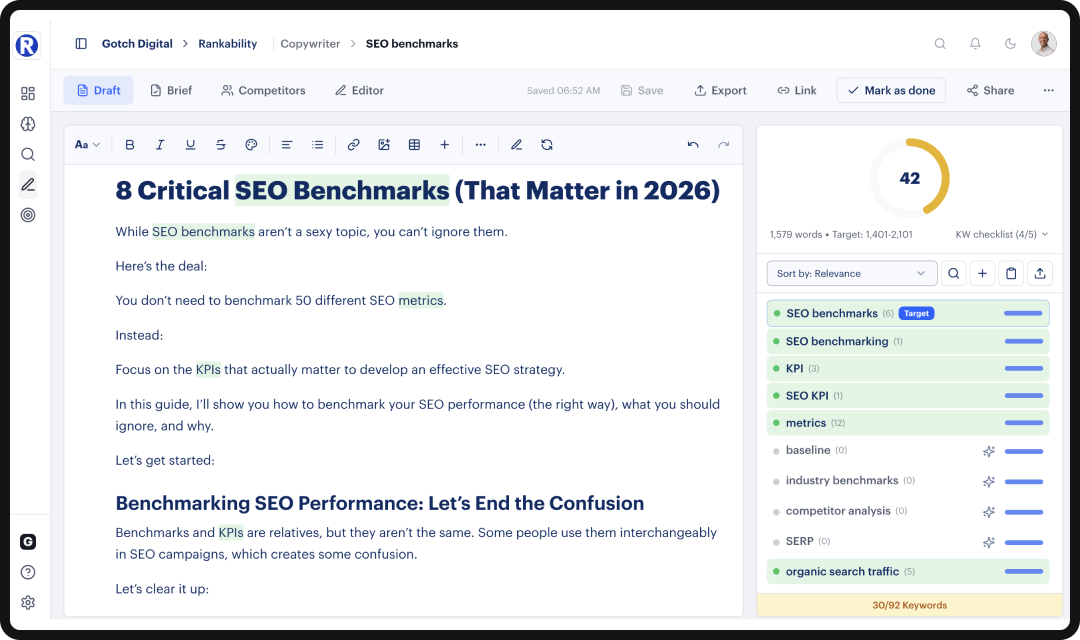
Rankability uses both IBM Watson NLP and Google NLP to generate keyword recommendations; an approach that advocates say creates more contextually relevant semantic suggestions than tools using a single model. The real-time content scoring, built-in content briefs, and AI search monitoring tools make it a solid all-in-one choice for agencies that want accuracy without complexity.
What stands out is the included monthly coaching calls with SEO experts (white glove service of this level is kind of a rarity in this space). For teams building SEO muscle rather than just using tools as black boxes, that education and hands-on support has real value.
Rankability’s Reporter tool also tracks brand mentions across ChatGPT, Google AI, and Perplexity, giving it a foot in both the content optimization and GEO monitoring camps.
Another case of “pay yearly, save monthly”! Rankability plan pricing starts at the Core tier ($199 per month, $1,990 per year) and goes up to the Agency tier ($799 per month, $7,990 per year).
This depends on what “optimizing for search” means to you in 2026… It’s no longer just about SERP rankings. Here’s a quick guide for how to choose:
- If your goal is traditional SERP performance: Surfer SEO, Clearscope, and Rankability are the strongest content optimization tools. They’re tested, accurate, and genuinely help pages rank.
- If your goal is AI visibility and citation: Goodie, RankScale, and Semrush One are the most robust options for monitoring and improving how your brand appears inside AI-generated answers.
- If your goal is content at scale: AirOps for workflow automation, Scalenut for all-in-one content operations, and Alli AI for technical deployment.
- If your goal is content strategy and topical authority: MarketMuse is the most sophisticated option for brands playing the long game.
The honest truth is that the brands doing the best in AI search right now are not using any single tool. They’re probably using a combination: one tool to monitor visibility, one to optimize content, and one to handle technical infrastructure. Not to sound like a broken record, but the ideal stack depends on your team size, budget, and whether you’re primarily building new content, refreshing existing content, or fixing underlying crawlability issues.
AI search optimization tools work along three dimensions that increasingly overlap:
- Content quality and relevance. Tools like Clearscope, Surfer, and MarketMuse help you create content that comprehensively covers a topic, uses semantic signals, and shows topical authority. This matters for traditional search engines and for LLMs, which favor content they can recognize as authoritative and well-structured.
- AI crawler accessibility. Your site may be beautifully optimized for Google’s crawler and completely invisible to GPTBot or ClaudeBot. Tools like Alli AI address the technical infrastructure layer, ensuring that JavaScript renders correctly for AI crawlers, managing bot whitelists, and deploying schema markup so that your content is machine-readable.
- Visibility monitoring and iteration. GEO tools like Goodie and RankScale track where your brand appears in AI responses, how it’s framed, which competitors are getting cited instead of you, and how those patterns change over time. That data informs your content strategy and helps you close gaps systematically rather than guessing.
I’ll say this: the fundamental principles of search optimization haven’t changed. The best content for AI search is the best content for humans 🤷 Accurate, specific, structured, written from genuine expertise. The tools just help you execute that faster and measure it more precisely.
AI Search Optimization: FAQs
What is the difference between SEO and GEO?
- SEO (Search Engine Optimization) focuses on improving rankings in traditional search engine results pages.
- GEO (Generative Engine Optimization) focuses on getting your brand cited inside AI-generated answers from platforms like ChatGPT, Perplexity, and Google AI Overviews.
They overlap significantly in tactics but diverge in measurement, goal-setting, and some technical requirements.
Do I need a dedicated GEO tool or can I use my existing SEO platform?
It depends on how central AI search is to your growth strategy. If you’re just getting started with GEO monitoring, Semrush One may be sufficient (especially if you’re already a Semrush customer). If AI search visibility is a genuine priority (which it increasingly should be for most brands), a dedicated platform like Goodie or RankScale will give you significantly more depth and coverage.
How quickly can I expect to see results from AI search optimization?
Honestly, faster than traditional SEO in some respects. Because AI search optimization is still relatively new, brands with solid technical infrastructure, strong E-E-A-T signals, and well-structured content can see measurable improvements in AI visibility within weeks of targeted intervention.
That said, I’ll tell you what I tell everyone: building genuine topical authority (which remains the durable long-term play) takes months and years, not days.
Are AI search optimization tools worth the investment for smaller brands?
Yes… with some caveats. For smaller teams on limited budgets, I’d prioritize tools that cover multiple needs: Scalenut for content operations, or RankScale’s entry plan for affordable GEO monitoring.
The expensive dedicated platforms are harder to justify until you’ve established that AI search is a meaningful acquisition channel for your brand. In short: start lean, measure, and invest more deliberately.
Final Thoughts
If you’re sitting there reading this thinking “we’ll deal with GEO when it matters more”, I’d (not so) gently push back on that. ChatGPT has long surpassed 800 million weekly active users. Google AI Overviews are now appearing above organic results for a significant and growing share of queries. Your customers are making decisions based on AI answers, and probably won’t see your actual website until they hit “Contact Us” or “Add to Cart”.
AI amplifies good work. It also amplifies neglect. Choose accordingly 🙂