The Trump administration is changing the way marijuana is regulated. In a major policy shift, it is reclassifying some marijuana by removing it from the Schedule I tier occupied by such drugs as heroin and LSD.
A Justice Department order on Thursday launched the shift, with a focus on state-licensed medical use. The administration is also moving toward an expedited reclassifying of marijuana more broadly. A Drug Enforcement Administration hearing is scheduled for June 29.
Marijuana still isn’t legal under federal law, though 40 states and the District of Columbia permit its medicinal or recreational use. Now, with licensed medical marijuana classified as a Schedule III substance, it will be subject to fewer regulations. And businesses selling the product might be eligible for federal tax breaks.
Why We Wrote This
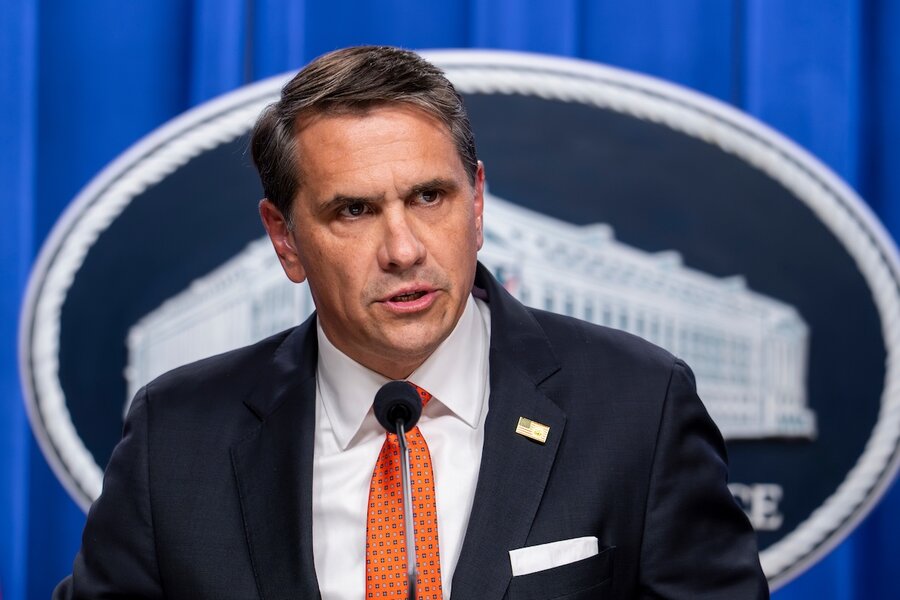
Acting Attorney General Todd Blanche signed an order reclassifying state-licensed medical marijuana as a less-dangerous drug, following President Donald Trump’s call for a more “common sense” policy. But many Americans have been growing more skeptical of the drug’s effects on users and on U.S. society.
President Donald Trump has described his marijuana policies as a “common sense” approach to a drug that many Americans rank as less harmful than alcohol. But some prominent leaders in the president’s own party disagree with the reclassification move, and a slim majority of Americans polled by Gallup in 2024 said they think marijuana harms most users and is detrimental to society overall. Views of the drug became more negative, compared with a poll taken in 2022, even as legal cannabis sales were expanding across the country.
At the same time, other recent polls find that most Americans support some form of legal marijuana use.
How a policy shift transpired
The reclassification, requested by Mr. Trump in December, comes days after the president signed an executive order requesting that federal agencies loosen restrictions on psychedelic drugs such as psilocybin and ibogaine. Influential podcaster Joe Rogan, a proponent of ibogaine, personally lobbied the president to initiate a review of the drug. Attending an Oval Office signing of the executive order this month, Mr. Rogan recalled a text message from the president: “Sounds great. Do you want FDA approval? Let’s do it.”
The change in marijuana’s status is a continuation of an initiative that began as a directive from President Joe Biden, whose 2019 election campaign platform included a call to decriminalize cannabis. In 2023, the Department of Health and Human Services proposed recategorizing marijuana as a Schedule III substance. The Justice Department formally moved to reclassify marijuana as a less-dangerous drug the following year. The DEA had been reviewing public comments on the matter when Mr. Trump took office last year. In December, he signed an order to fast-track that process.
The president said the move was in response to people seeking relief from pain but, he added, “It doesn’t legalize marijuana in any way, shape or form, and in no way sanctions its use as a recreational drug.”
In response, 22 Republican senators and 26 GOP House members wrote letters to the president last year to oppose the move.
The debate over medical use
Kevin Sabet, chief executive of the Foundation for Drug Policy Solutions and Smart Approaches to Marijuana, says the drug currently has no approved medical use through the Food and Drug Administration, making it unprecedented to have a Schedule III drug without a prescription. The group he heads, which opposes commercialized legalized marijuana as well as incarceration for users, intends to mount a legal challenge to the reclassification. It’s illegal to bypass the DEA’s rulemaking process, says Mr. Sabet. He described the reclassification of marijuana as a “giveaway” to the marijuana industry.
“We need to not allow an industry to copy Big Tobacco as they are and use celebrities, advertise on freeways,” says Mr. Sabet. “You’d think we would have learned from that.”
In signing the reclassification, acting Attorney General Todd Blanche said the Justice Department “is delivering on President Trump’s promise to expand Americans’ access to medical treatment options,” with the move opening a door for more “research on the safety and efficacy of this substance.”
Despite Americans’ reservations, only 12% of respondents in a Pew Research Center survey last year said no form of marijuana use should be legal. One-third said it should be legal for medical use only (33%), and more than half (54%) favored legalizing both medical and recreational use.
“Trump is trying to draw what is essentially an artificial distinction between medical and recreational,” says Alex Berenson, author of the 2019 book “Tell Your Children,” which posits that cannabis has severe psychiatric consequences in a small but significant minority of users, and can lead to violent outcomes.
“The worst part of this actually, is that the way he’s done this will just worsen that confusion. This is a recreational drug, that’s all it’s ever been, that is all it is today. If we’re going to legalize it, we should legalize on that basis.”
Amid tug and pull, political gain for Trump?
Bryon Adinoff, president of Doctors for Drug Policy Reform, said in a statement that, though the reclassification reduces barriers to cannabis research, it leaves “virtually all cannabinoid products illegal, except for a small number approved by the FDA as medicines.” Dr. Adinoff called for ending criminalization, allowing medical access to the drug, and treating cannabis as a public health issue, including research into its potential benefits and risks.
Advocates of decriminalization welcomed the reclassification but said it doesn’t go far enough.
“Americans deserve marijuana reform that fully ends and addresses the harms of criminalization, which includes needless arrests, incarceration, and lasting barriers to jobs, housing, and employment,” said Cat Packer, director of drug markets and legal regulation at the Drug Policy Alliance, in a news release.
Mr. Berenson sees politics as a main impetus for the move by Mr. Trump and his administration: “I suspect he thinks that, politically, it’s what a portion of his base wants.”