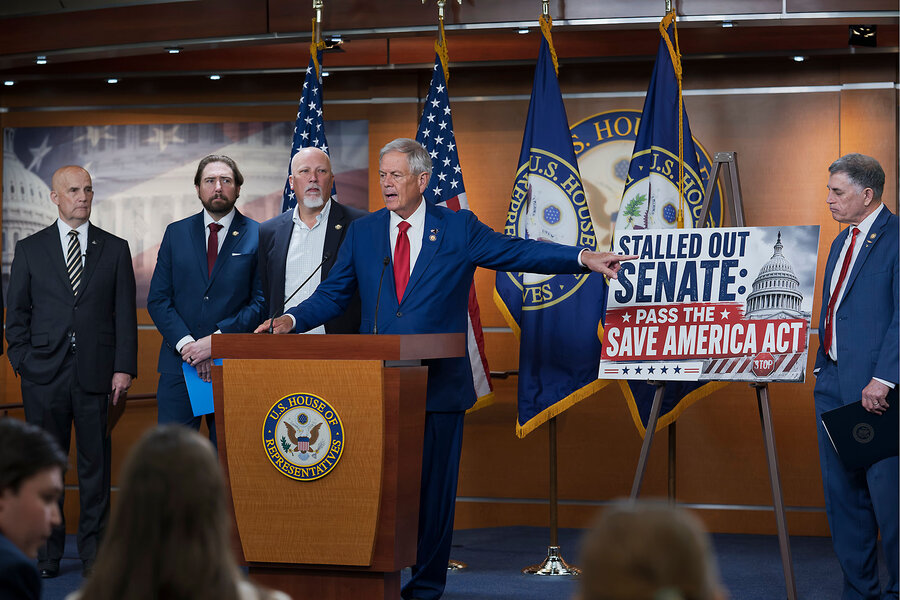
President Donald Trump has been talking for months about the SAVE America Act, a bill that would impose new proof-of-citizenship requirements on people registering to vote. First, he tried to pass the requirements as an executive order, which was blocked by the courts. Then, he tried to convince Republicans to use an unpopular “talking filibuster” to overcome the 60-vote threshold that’s preventing the act from getting through the Senate.
Most recently, Mr. Trump canceled at the last hour a signing ceremony for a landmark housing bill that his administration helped get through Congress. He has said he won’t sign it unless the SAVE Act is passed. If he doesn’t veto the housing legislation, the bill will become law without his signature on Friday night.
The president has directed public attention to the act, but his administration has taken multiple actions in the last two years that could affect midterm voting – including suing states for access to voter rolls, investigating the 2020 election results, and initiating an aggressive redistricting campaign. The White House says it is trying to improve election integrity, but Democrats counter that the moves are designed to give Republicans an edge in this year’s midterms.
Why We Wrote This
President Donald Trump has raised the public profile of the SAVE America Act, which does not have Senate votes to pass. Meanwhile, voters in November’s midterms might encounter changes as a result of other election-related efforts the administration is pursuing.
Courts have blocked most of the administration’s priorities, prompting Dan Tokaji, dean of the University of Wisconsin Law School, to quote Shakespeare in characterizing them as “sound and fury, signifying nothing.”
However, some of Mr. Trump’s efforts could affect outcomes in November. Democrats are favored to flip the House, but the odds are not overwhelming. Republicans are narrowly favored to maintain a majority in the Senate.
Other, less tangible effects could include what Professor Tokaji describes as “a loss of confidence on both sides of the ideological spectrum.”
As the SAVE Act remains sidelined in the Senate, here’s a look at the administration’s major efforts to shape elections and which are most likely to have practical consequences this fall.
Latest projections resulting from redistricting
Redistricting is the “biggest single impact of the administration” on elections, according to Justin Levitt, a professor at Loyola Law School in California, who previously served as a senior policy adviser for democracy and voting rights under President Joe Biden. Redistricting wars this year have given Republicans 10 additional competitive seats compared with last summer.
An April Supreme Court decision raising the bar for what constituted illegal racial gerrymandering meant that Republicans increased their prospects in 16 congressional districts, while Democrats increased theirs in six.
“The terrain on which the 2026 elections will be fought in terms of the district lines looks significantly different than it did last year,” says Professor Levitt.
However, he stresses that a new red-leaning district doesn’t mean the voters there will vote Republican – just that they voted Republican recently.
Administration questions election integrity
Mr. Trump has repeatedly cast doubt on the trustworthiness of U.S. elections. He has often used the word “emergency” to refer to the state of federal elections, and claimed without citing evidence that California primary elections and a Virginia redistricting referendum this year were “rigged” after outcomes favored Democrats.
He directed the FBI to investigate the results of the 2020 presidential election, including seizing more than 600 boxes containing 2020 ballots and voter rolls from a warehouse in Fulton County, Georgia, in January. The 2020 election was fair, and the results were accurate, according to studies and investigations from multiple sources – including a voter-data expert Mr. Trump hired and a study led by Republicans that examined why postelection lawsuits failed.
Rick Hasen, director of the Safeguarding Democracy Project at UCLA School of Law, says sowing doubt about election integrity without evidence lays the groundwork for candidates to refuse to consent to their defeat, even if the election was fair.
“The idea that people whose candidates lose the election still accept the election was legitimate, that’s a really basic tenet of democracy,” he says.

Michael Morley, who teaches election law at the Florida State University College of Law, notes that both parties have questioned the legitimacy of upcoming elections – Republicans, by questioning election integrity; Democrats, by saying disenfranchisement makes the system illegitimate – and predicts close races might be challenged by members of either political party. He also says GOP state election officials might try to remove alleged noncitizens from voter rolls as they did ahead of the 2024 election, which could lead to a flurry of emergency litigation before the November vote.
“Challenges to the validity of the election – I think that has become something of a political tool in recent years,” he says.
Trump cut election security funding
The Trump administration has cut election security funding and programs from the Cybersecurity and Infrastructure Security Agency, which has provided election security support to states since it was founded in 2018.
In 2025, Elon Musk’s Department of Government Efficiency slashed CISA’s workforce from about 3,500 employees to 2,500. The administration also ended or reduced funding for threat-sharing programs and allowed a $1 billion cybersecurity grant program for states to lapse.
The administration said it cut areas in which CISA had overstepped its intended role and that more pressing concerns, such as China, should take priority.
Some experts, including Professor Levitt, say states are equipped to fill in federal gaps, noting that CISA helped them build up solid foundations for responding to threats. Others are concerned that states could lack support for an emergency event such as a cyberattack.
DOJ court battle
The Justice Department has requested voter registration lists – sometimes containing information like partial Social Security numbers – from states since last May. It has sued 30 states and the District of Columbia. The administration has yet to see a legal victory, and courts have dismissed 11 of these lawsuits.
The Trump administration also issued two executive orders that would have restricted mail-in ballots and required states to use federal lists to purge their voter rolls, among other things. Federal judges have blocked the government from implementing the major provisions of both orders.
Jasleen Singh, a senior counsel for the Democracy Program at the left-leaning Brennan Center for Justice, believes the strength of the election system means it will be able to withstand challenges. The Trump administration’s actions are “unprecedented,” she says, but states “are ready and have been running elections for decades.”
Supreme Court decisions could also affect elections
Recent Supreme Court decisions have represented a split outcome for Mr. Trump. The court’s decision in Watson v. Republican National Committee, which held that states can count absentee ballots postmarked by Election Day but received later, was a major setback in the president’s efforts to block mail-in voting. The availability of mail-in voting has not broadly changed since Mr. Trump took office in 2025, though some states have tightened their rules around it.
But another June decision removed spending limits for party committees when coordinating directly with a candidate. Mr. Trump and Republicans celebrated the decision as a victory, given that the RNC currently has more than a $100 million cash-on-hand advantage over its Democratic counterpart.