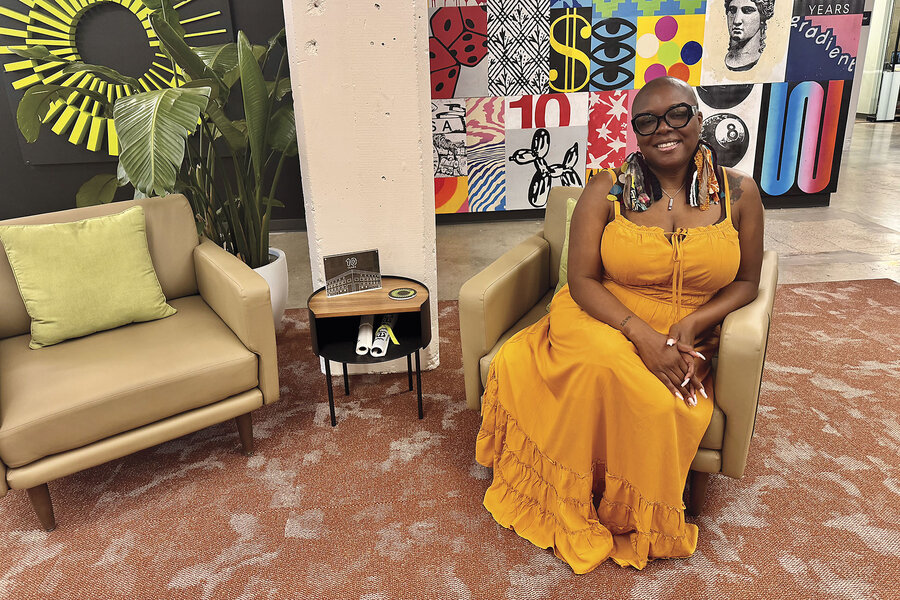
Angela Harris needed to start her life anew.
It was a daunting task to even consider, she knew. She was approaching 50, living once again in Houston, the city where she was born and raised. In the five years since her husband died, she had lost the sense of who she was, and needed to find it somewhere else.
“It was like an urgency,” says Ms. Harris, a senior compliance officer. “I said, ‘I can’t stay here. I have to go.’”
Why We Wrote This
The pandemic ushered in a profound shift in where many Americans can work, and now, places across the U.S. are offering incentives for remote workers to relocate. It’s a growing economic development strategy.
Work would not hold her back. She had a good job with a good salary, and worked remotely, so she had the freedom to live almost anywhere she wanted.
She was joining a distinctly 21st-century American migration. A century after Route 66 carried generations toward jobs, opportunity, and imagined futures farther down the road, remote work had reversed the old bargain for a small but durable class: They could take the job with them and choose the place where they hoped to begin again.
Among the dozens of American places with incentives inviting workers like Ms. Harris to settle was a city where, 100 years ago, a businessman helped christen Route 66 as “the Main Street of America.”
“Ready to turn a page”
Tulsa, Oklahoma, once, was a place you might pass through. Justin Harlan spent years trying to give strangers a reason to stay. Born in Tulsa, raised outside Kansas City, he came back for college and never left. As a recruiter for Teach For America in Oklahoma, he would ask graduates to stay two years in a place most knew nothing about. But he noticed something.
“Tulsa was always at the top of the list in terms of teachers staying beyond two years,” he says. “The barrier was often just getting someone to give it a chance.”
Tulsa Remote, which Mr. Harlan has run since 2021, is that observation turned into organized effort. Founded in 2018 by the George Kaiser Family Foundation, in a city trying to loosen its dependence on oil and gas, it pays remote workers $10,000 to live in Tulsa for a year. The money does not buy a resident. It buys a trial. More than 4,200 people have taken it; about 80% are still there two years on.
They arrive with jobs in hand, which Mr. Harlan calls the fairness of it. “You’re not taking away from a local,” he says. Not everyone who applies is accepted, and the average salary of those who arrive is around $100,000. What it mostly selects for is people at a hinge: “Folks experiencing some sort of major life change. Ready to turn a page.”
More people can pursue this change today without looking for a new job – untethering geography from employment. Rebecca Hinds began a doctorate on remote work at Stanford in September 2019, when it was an odd thing to study. But within six months, the whole country was her laboratory.
Before the pandemic, remote workers were stigmatized, she says – passed over, presumed to be slacking. Then the offices emptied and everyone was on the same screen. “For the first time, many of these remote workers felt a sense of leveling,” she says.
Roughly 12% of full-time American employees work entirely from home – more than double what it was before the pandemic, but still far less than what many predicted five years ago. Hybrid work turned out to be the durable change, and about 25% split time between home and office.
This past July, Mr. Harlan and Dr. Hinds joined a new body devoted to the question their two careers turn on. The Remote Work Institute, a partnership between Tulsa Remote and the London School of Economics and Political Science, was launched to study remote work – an attempt, its founders say, to replace a debate driven by anecdote and headline with evidence.
“Who am I now?”
The freedom Ms. Harris had to move and reinvent herself offered possibility and promise, but carried sorrow within it.
Her husband, Desmond, was a fashion photographer from New Orleans. She worked for a publishing company. They dated, then began to collaborate. Their relationship deepened, and they started a project: He was going to photograph firefighters and police officers in small American towns and she would sell them to book publishers.
“So we literally were in a vehicle, coast to coast, border to border, doing what we loved,” Ms. Harris says. For five years, they were co-workers, travel companions, husband and wife in a rhythm of joy and striving.
They fell ill with COVID-19 at the same time and went to the hospital together, and one day the nurses said they were moving Desmond to a different room. An hour later he was gone.
“For nine months, I did absolutely nothing,” she says. “I was just existing.”
Then her daughter from a previous marriage was pregnant with her first grandchild, so she moved back to Houston. Then her elderly father’s health faltered. For a while, she was useful to others. At her father’s funeral, she understood she was going to leave. Much in her deepest self remained in turmoil.
“Right after Desmond passed away, I immediately started asking myself, ‘Who am I now?’” Ms. Harris says. “I mean, I know who I am, but who am I now?”
She had heard that some places were paying remote workers to move. She considered West Virginia and Colorado. Tulsa was a few hours up the highway, a city she had driven through once with Desmond.
So about two years ago, she rented an apartment sight unseen and loaded a moving truck, the first she had ever driven, got on the road, and headed north.
“I see colors on this canvas”
Not long after she arrived, Ms. Harris shaved her head – an act of freedom, she says, in a city where no one had known her before.
Then a stranger told her about a beauty pageant. “I’m in a ‘Why not?’ phase of my life,” she says. In March she flew to Maryland for the 2026 Ms. Bald & Beautiful Pageant, which honors women who are bald or losing their hair, and found the company she had been missing.
“I don’t see a lot of bald women” in Tulsa, she says. “To hear their stories and find your tribe – it was more than a pageant.”
One category asked contestants to represent their city. Ms. Harris, still new to Tulsa, chose Greenwood – Black Wall Street, the district a white mob burned in 1921 – and took from it, she says, resilience, the work of continuing to show people who you are.
For the talent portion, she delivered a monologue to her late husband – thanking him, she says, “for letting me know that beauty is not in what I wear, but who I am.” She was named first runner-up. Her trophy sits in her apartment window, facing out.
Her story is what Justin Harlan and his city hope to see: Someone agrees to try Tulsa, and finds something they were looking for.
Ms. Harris does not yet feel settled, and does not intend to be. She renews the lease a year at a time; if a chance came to go overseas, she would take it. But she’s decided to stay a third year in Tulsa for now.
When she arrived, “I felt like I was just a blank canvas,” Ms. Harris says. “And I had these watercolors, but no direction. … It’s been good since I’ve been here. I see colors on this canvas now that once was empty.”