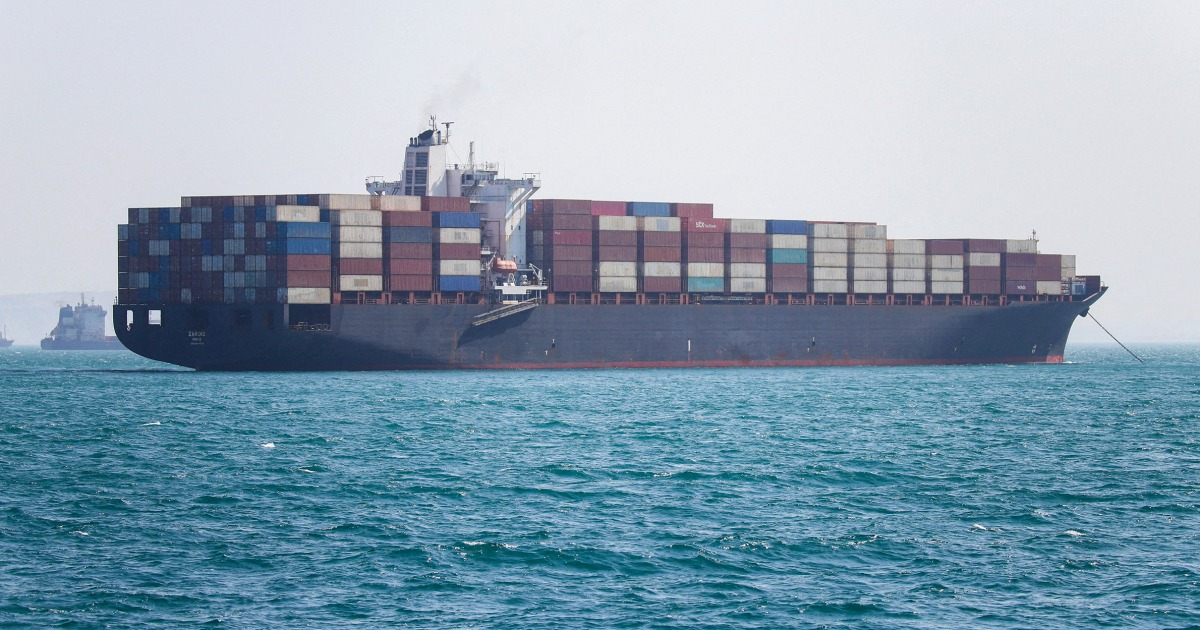
The ceasefire in the Middle East was in peril Tuesday after the United States and Iran traded fire and threats over President Donald Trump’s new mission to force open the Strait of Hormuz.
Subscribe to read this story ad-free
Get unlimited access to ad-free articles and exclusive content.

But Trump announced on Tuesday evening that the effort to force the strait open, called “Project Freedom,” was being put on hold.
“Based on the request of Pakistan and other Countries, the tremendous Military Success that we have had during the Campaign against the Country of Iran and, additionally, the fact that Great Progress has been made toward a Complete and Final Agreement with Representatives of Iran, we have mutually agreed that, while the Blockade will remain in full force and effect, Project Freedom (The Movement of Ships through the Strait of Hormuz) will be paused for a short period of time to see whether or not the Agreement can be finalized and signed,” Trump wrote on Truth Social.
Trump’s “Project Freedom” aimed to use the U.S. military to break Tehran’s chokehold on the critical waterway, which has throttled international shipping and sent energy prices soaring.
But Iran’s aggressive effort to retain its grip on the strait saw it attack U.S. ships, hit a neighboring Gulf state for the first time in weeks and come under American fire itself.
Defense Secretary Pete Hegseth asserted at a Pentagon briefing Tuesday that the ceasefire was “not over” despite the clashes in the strait.
Chairman of the Joint Chiefs of Staff Gen. Dan Caine said that since the ceasefire was announced, Iran had attacked U.S. forces more than 10 times, but he said they were still “below the threshold of restarting major combat operations.”
Asked at a White House event Tuesday what Iran would need to do to violate the ceasefire, Trump replied, “Well, you’ll find out, because I’ll let you know. They know what to do, and they know what to do. They know what not to do more importantly, actually.”
The U.S. military said that on Monday Iran’s forces attacked U.S. Navy and commercial ships with cruise missiles, and launched drones and small boats at the vessels under U.S. escort, but that no American ships were struck. Trump said the U.S. destroyed eight Iranian boats.
Two U.S.-flagged merchant vessels made it through the strait on Monday, the U.S. military also said, with shipping giant MAERSK confirming that one of its vehicle carriers was escorted out “under U.S. military protection.”
In Tuesday’s briefing, Hegseth said that hundreds of ships from nations around the world were now lining up to transit the strait and that the U.S. military was in active communication with them. “As a direct gift from the United States to the world, we have established a powerful red, white and blue dome over the strait,” he said.
Secretary of State Marco Rubio said in a press conference on Tuesday that Operation Epic Fury, the U.S. military’s name for the war with Iran, is over and that the current military actions to help ships safely navigate the strait is not an “offensive operation.”
“The operation is over. Epic Fury is — the president notified Congress, we’re done with that stage of it. Okay? We’re now on to this project of freedom,” Rubio said.
He added, “This is not an offensive operation. This is a defensive operation. And what that means is very simple, there’s no shooting unless we’re shot at first. Okay, we’re not attacking them.”
Rubio’s comments came before Trump announced that “Project Freedom” was being paused.
Rubio also noted that Iran’s attacks on ships and mining of the strait were a “criminal act.”
“It’s completely illegal, completely illegitimate and completely unacceptable,” he said.
Iran denied there had been any successful crossings of commercial vessels or oil tankers, and said none of its navy ships suffered damage.
Top Iranian officials sounded defiant Tuesday.
While the situation in the strait was clearly “unbearable” for America, Iran has “not even begun yet,” parliamentary speaker and lead negotiator Mohammad Bagher Ghalibaf said in a post on X.
Events in the strait make clear that there is “no military solution to a political crisis,” Foreign Minister Abbas Araghchi also said in a post on X late Monday. He added “Project Freedom is Project Deadlock.”
The escalating tensions raised questions about whether the war might be about to reignite.
In a separate interview with Fox News, Trump warned that Iranian forces would be “blown off the face of the Earth” if they attack American ships.
The hostilities in the strait on Monday also involved a South Korean-operated ship, which suffered damage after an explosion and fire.
Trump called on South Korea “to join the mission” in a TruthSocial post, as he blamed Iran for taking “some shots” at the ship. Seoul said it was reviewing Trump’s proposal.
Hegseth said at his briefing that the operation was temporary and aimed at “stabilizing the situation so commerce can flow again, but we expect the world to step up at the appropriate time.”
Meanwhile, the United Arab Emirates, a key U.S. ally in the Gulf, said that on Monday it engaged 12 ballistic missiles, three cruise missiles and four drones fired from Iran. The attack sparked a fire at an oil facility and injured three Indian nationals, officials said, drawing widespread condemnation.
Iran did not explicitly confirm or deny the attack, but said it had no plan to target its neighbor. Araghchi, the foreign minister, warned both the U.S. and U.A.E. against “being dragged back into quagmire.”
Araghchi was set to travel to Beijing on Tuesday. China, which has close ties with Tehran, has come under mounting pressure to help end the war.
Pakistan, a key mediator in stalled peace talks, urged the two sides to keep their cool.