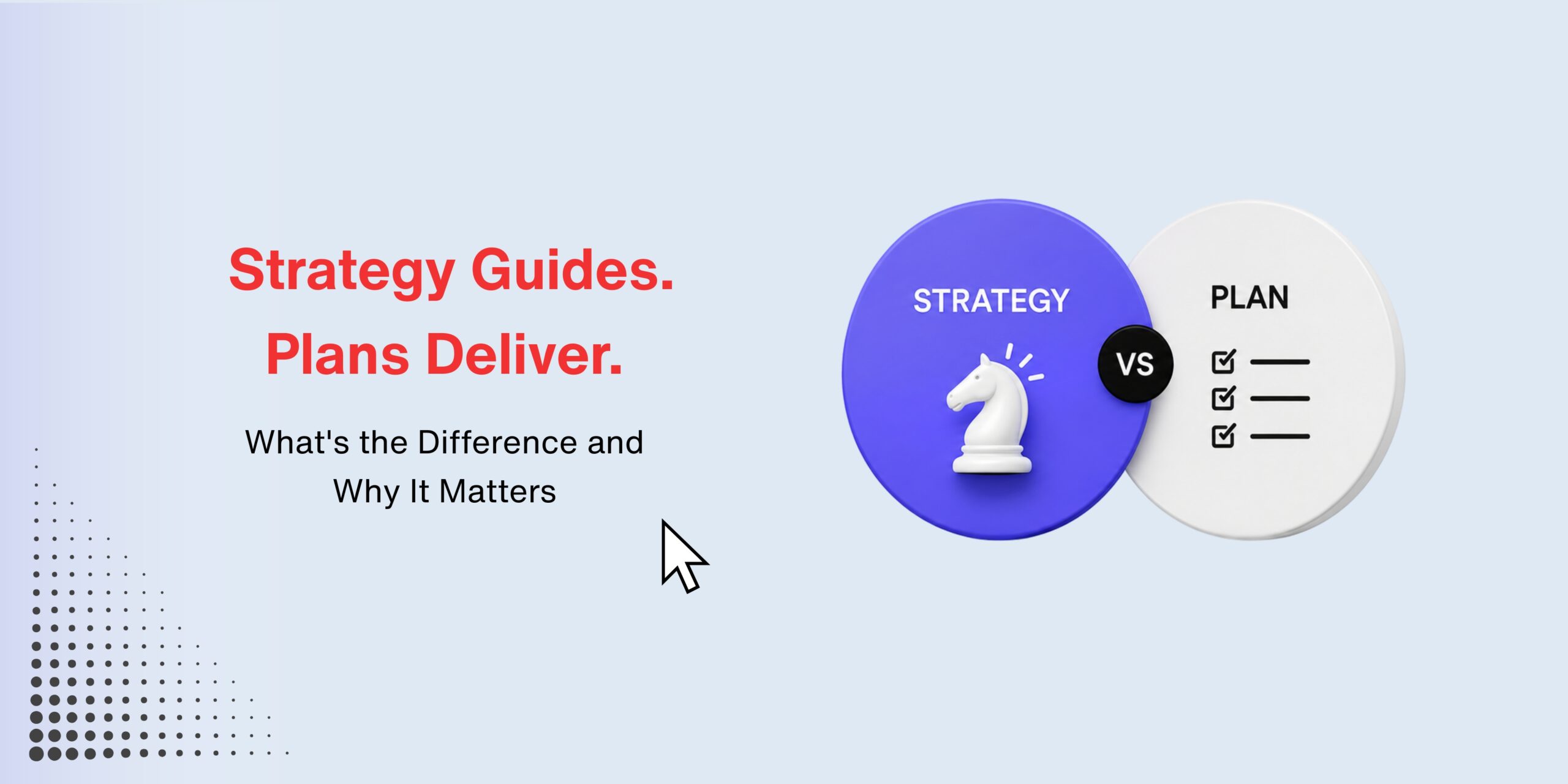
Many business leaders and marketers find themselves asking, “What is a marketing strategy?” and “What is a marketing plan?” These terms often get used interchangeably, but understanding the difference between marketing strategy and plan is one of the most important steps in successful marketing. Knowing how these two pieces fit together helps you save time, avoid waste, align your team and grow your business more efficiently. This blog will clarify the meaning of each, compare them side by side and offer guidance on how to leverage both.
Marketing Strategy vs Marketing Plan: Defining the Concepts
Before you can build effective campaigns or allocate budget, you need to know what a marketing strategy is and what a marketing plan actually includes. While the terms overlap, each serves a distinct purpose and answers different business needs. Understanding what sets them apart helps you answer other questions down the road – like how to write a marketing strategy document, how to make your marketing more measurable and how to build better campaigns that deliver results.
What is a Marketing Strategy?
A marketing strategy is the blueprint that defines the ‘why’ and ‘where to play’ for your business. It identifies your business goals and the big-picture context for achieving them. Marketing strategies begin with research: Competitor analysis, customer understanding and industry insights. They also cover elements like positioning, audience targeting and brand messaging. If someone asks how to write a marketing strategy, the answer starts with defining overarching goals, understanding who you want to reach and shaping the messages that set your business apart. This strategy is your foundation for all downstream activity, ensuring consistency and relevance in everything you do.
What is a Marketing Plan?
A marketing plan answers the ‘what, when and who.’ It translates the big-picture strategy into specific actions and timelines. Components include campaign briefs, monthly or quarterly content calendars, assigned roles, deadlines and budget allocation. A marketing plan example typically features a detailed 12-month roadmap showing which campaigns to launch, who owns tasks and when each activity happens. This plan operationalizes your strategy, bringing the ideas and initiatives to life in a systematic, trackable way.
Key Differences: Marketing Strategy vs Marketing Plan
At first glance, marketing strategy and marketing plan sound similar – both guide your path and both involve planning. Yet the difference between marketing strategy and plan is fundamental. Strategy defines direction and intent; plan covers execution and detail. The two documents should work in tandem, but each one answers different business questions:
| Marketing Strategy | Marketing Plan |
|---|---|
| Sets vision, goals and positioning | Translates strategy into actions |
| Includes analysis, target audiences, messaging | Builds calendar, assigns tasks, sets deadlines |
| Rarely changes, reviewed quarterly or yearly | Updates often as campaigns launch |
| Answers “Why?” and “Who?” for the business | Answers “What?” “When?” and “How much?” |
The Relationship Between Strategy and Plan: Why Both Matter
Too many businesses jump straight into building a marketing plan example or launching campaigns without crafting a real strategy first. This leads to disconnected tactics, wasted spend and results that are hard to measure. You need strategy to set the direction and a plan to move the business forward with clarity. The best marketing teams rely on both, connecting the high-level goals in their marketing strategy document with granular, task-driven marketing plans that can be tracked and managed in real time. When you use both, your team works together, resources get used more efficiently and results become more predictable.
What Should a Marketing Strategy Document Include?
An effective marketing strategy document contains core building blocks that provide context and clarity. These include:
- Executive summary outlining main objectives and approach
- Market and competitor analysis identifying threats and opportunities
- Target audience personas, buyer journeys and channel mix
- Messaging architecture and brand positioning statements
- Budget guidelines and resource allocation principles
- Measurable outcomes that allow you to track results over time
What Should a Marketing Plan Include?
A marketing plan example often spans 50 pages or more, with a focus on operational details. Typically, it covers:
- A 12-month content and campaign calendar
- Individual campaign briefs with channels, messaging and objectives
- Task assignments to team members and third-party specialists
- Resource requirements, such as creative assets, platforms and tools
- Deadline tracking and timeline management for every activity
- A working budget that matches planned campaigns to available funds
How to Write a Marketing Strategy: Step-by-Step for Clarity
Many ask how to write a marketing strategy that not only looks good on paper but also guides decisions. Here is a step-by-step guide for building a strategy that truly supports business growth:
- Start with business objectives and map them to achievable marketing goals
- Analyze competitors and industry benchmarks, noting what sets your brand apart
- Define your target audiences – demographics, preferences, behaviors and pain points
- Identify priority channels for engagement (email, social, PR, search, etc.)
- Craft key messages tailored to each buyer persona and channel
- Document actionable KPIs and success measures
Following these steps ensures that your marketing strategies have depth, clarity and a measurable link to organizational success. Pairing this strategy document with a detailed marketing plan example creates a strong foundation for any marketing program.
The Risk of Skipping Strategy: Common Mistakes and Fixes
One of the most common mistakes in small and mid-sized business marketing is building a plan before defining the strategy. This usually results in scattered activity, inconsistent messaging and campaigns that do not deliver growth. Common traps include jumping from idea to idea, investing in channels with low or unclear ROI or running campaigns that do not fit your core business objectives. Moving from tactical chaos to strategic clarity requires making strategy the starting point, then building the plan as a direct extension of that foundation.
Sample Scenario: The Value of Connecting the Dots
Consider a business that decides to launch a new product. Without a marketing strategy, the team may run ads and send emails, but results will likely disappoint if they have not defined their audience or how to stand out in the market. When the business first creates a strategy – analyzing competitors, mapping buyer journeys and defining goals – the plan becomes much more precise. Every campaign, piece of content and metric now ties back to those original objectives.
How AI Marketing Strategy Platforms Transform the Process
The process of shaping a consultant-grade marketing strategy used to take weeks or months, often requiring extensive team input or outside consultants. Today, the rise of the AI marketing strategy platform changes the equation. By analyzing business data automatically and generating strategy documents in hours, these platforms provide the depth and rigor of traditional consulting in a fraction of the time. This approach also connects the dots between strategy creation, marketing automation implementation and ongoing optimization so that marketing becomes more measurable, agile and aligned with growth goals.
Speed and Scale With AI Marketing Operations Platform
In many organizations, marketing plans live in isolated files, strategy documents get lost in email chains and project management is split across multiple disconnected tools. An AI marketing operations platform brings everything together by linking high-level strategy with day-to-day planning, campaign management, performance reporting and collaboration – all within a single structure. This integration eliminates the usual handoff risk and makes marketing more repeatable and scalable, even for smaller teams.
How Licensing and Third-Party Implementation Services Expand Capability
For agencies, consultants or businesses looking to scale their marketing without growing headcount linearly, licensing AI marketing strategy technology is a game-changer. Licensing lets partners use best-in-class strategy generation and project execution tools under their own brand, improving speed, consistency and quality. Approved third-party implementation services bring experienced hands to campaign buildout, allowing lean teams to focus on core strengths while ensuring execution never loses context from the strategy document.
The Value of Connecting Strategy, Plan and Marketing Automation
Gone are the days of treating strategy, planning and execution as separate challenges. The best organizations use technology to connect the entire marketing lifecycle, from initial goal-setting to launching campaigns and monitoring outcomes. Marketing automation systems tie recurring actions to the original strategy, ensuring that new content, social posts or ads always stay on message and on brand. This seamless connection improves marketing performance and visibility, showing leaders what works, why and where to refine efforts next.
How Often Should You Review and Update?
Best practice suggests reviewing your marketing strategy document annually or when there is a significant market change, while marketing plans should be reviewed monthly or quarterly. Regular review guarantees that plans stay relevant, budgets are used wisely and results get measured against real business objectives. AI-driven platforms accelerate this process by benchmarking performance, suggesting optimizations and closing the loop with clear next steps.
Next Steps: Building a Foundation for Growth
Understanding marketing strategy vs marketing plan is the first step toward more effective, connected marketing. Combining a strong strategy document with a well-structured marketing plan drives focus, accountability and measurable growth. Whether you are a small business owner, a marketer inside a larger team or an agency lead, bringing these documents together with the right technology and services means you can finally move from reaction to direction and start measuring marketing by impact rather than just activity.
!function(f,b,e,v,n,t,s)
{if(f.fbq)return;n=f.fbq=function(){n.callMethod?
n.callMethod.apply(n,arguments):n.queue.push(arguments)};
if(!f._fbq)f._fbq=n;n.push=n;n.loaded=!0;n.version=’2.0′;
n.queue=[];t=b.createElement(e);t.async=!0;
t.src=v;s=b.getElementsByTagName(e)[0];
s.parentNode.insertBefore(t,s)}(window, document,’script’,
‘https://connect.facebook.net/en_US/fbevents.js’);
fbq(‘init’, ‘1122401991165798’);
fbq(‘track’, ‘PageView’);