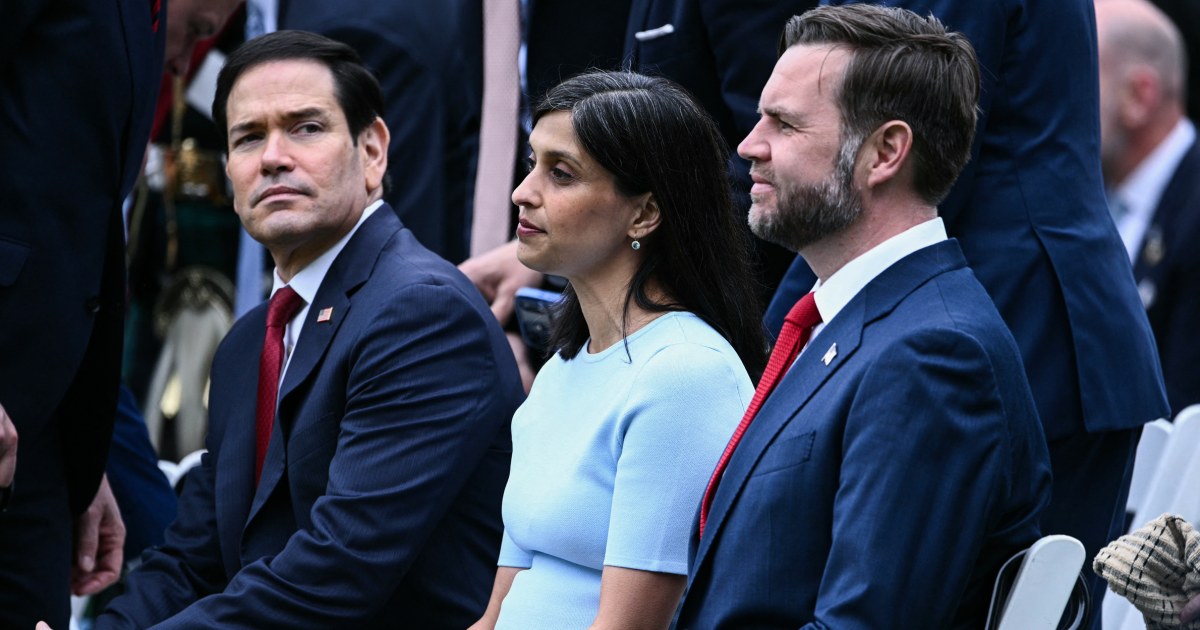
Vice President JD Vance had, in his words, a “vicious editor” for his new book: second lady Usha Vance.
Subscribe to read this story ad-free
Get unlimited access to ad-free articles and exclusive content.

“She doesn’t sugarcoat things,” Vance said of his wife Tuesday in an interview with NBC News. “She’s very direct.”
Usha Vance, he added, was heavily involved in nearly every facet of shaping “Communion,” which is set to be released June 16 by HarperCollins. She helped to “harmonize different chapters” and excise parts that “didn’t add anything of value.” She also played a meaningful role in the memoir’s narrative — a Hindu wife who encouraged her searching husband throughout his faith journey from Protestant to atheist to Catholic convert.
“Fundamentally, the book wouldn’t exist without her,” Vance, speaking by telephone in his first interview to preview the book, said of the second lady. “I talk about this in the book. There is a certain irony to it, because she is not herself a Christian. But I certainly, I don’t think, would be a Christian today were it not for my wife.”
“Communion” serves as a follow-up to “Hillbilly Elegy,” the 2016 memoir that was adapted into a movie and made Vance famous years before he entered politics. An early excerpt, published this month by USA Today, focused on how he fell in love with his wife, the former Usha Chilukuri.
Vance faced criticism last fall for sharing his hope that the second lady might one day become a Christian. Asked about the uproar Tuesday, he described his comments as a “pretty simple observation” as a Christian wanting to share his faith with his partner. He also acknowledged that Usha Vance is not likely to convert.
“And I’m OK with that,” Vance said. “What I’d say about Usha is that one of the things I love about her is that she’s brilliant, but she’s also fiercely independent. … You know, fundamentally Christianity is a faith where, if you believe in it, you would like other people to believe in it, too, and that’s going to be particularly true for those that you’re closest to and those you love.”
Over the 25-minute call, Vance shared how themes explored in the book have applied to his relatively short political career since becoming a senator in 2023 and Donald Trump’s running mate 16 months later. Vance, seen as a likely Republican presidential contender in 2028, also shared thoughts on how Catholic faith has shaped the work of Secretary of State Marco Rubio, his friend — and potential White House rival.
“Being vice president has definitely strengthened my faith. I’ve just seen things that feel like they’re way too unusual to just be coincidences or luck or chance,” Vance said, mentioning as examples well-timed phone calls or prayers that he has been offered since taking office.
“These are not like the miracles of turning water to wine,” he added, “but they are these things that make you feel like God is listening to you.”
On the Iran war
Vance, whose reputation as an anti-interventionist has collided with his defense of the war Trump started in Iran, acknowledged that his faith has informed his thought process throughout the conflict. He spoke of how Christians’ “just war” theory requires leaders “to ask very difficult questions about whether a war is justified.”
The answers, Vance said, aren’t always easy.
“But at its best,” he continued, “it’s forcing you to ask the right questions. So I find myself constantly asking myself, ‘Is this justified? Is this moral? Is this the right thing to do?’ And that does provide a limitation on political leaders, as it should.”
Trump and Vance, whose initial skepticism about launching the attack has been reported by NBC News and others, have justified the war as an effort to ensure that Iran does not develop nuclear weapons. Efforts to end the war appeared to be in flux Tuesday, with Iran accusing the U.S. of violating ceasefire terms.
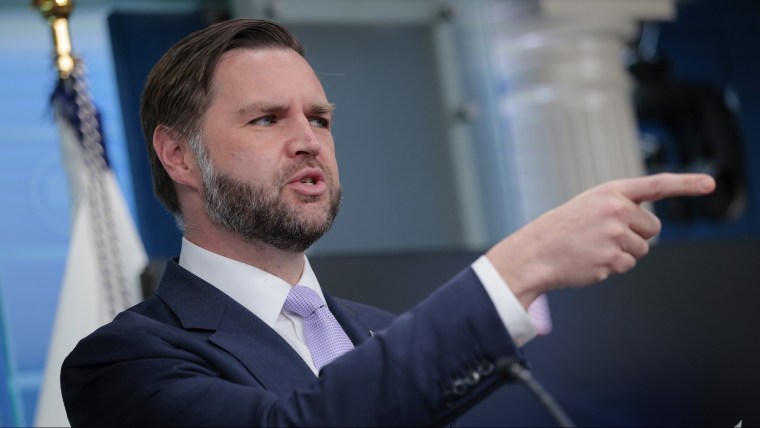
Vance, who has been involved in talks to negotiate peace, described himself as “extremely hopeful” that Iran will agree as part of any deal to not develop nuclear weapons.
“I think the more difficult question,” Vance added, “is whether they agree to the kind of enforcement mechanism, the kind of monitoring mechanism, that gives us confidence that they won’t violate the deal in the future.”
On Trump, loyalty and the ‘anti-weaponization’ fund
In a parable from philosopher Basil Mitchell that Vance has cited as formative in how his views on God and religion have evolved, a partisan places unshakable trust in an ostensibly infallible “stranger.” The partisan justifies the trust by acknowledging having moments of doubt that, in his mind, don’t meaningfully undermine his belief that the stranger is “on our side.”
Asked Tuesday if he sees any parallels between Mitchell’s stranger and Trump, who has converted onetime skeptics like Vance into close allies and commanded unbending loyalty from other followers, Vance demurred.
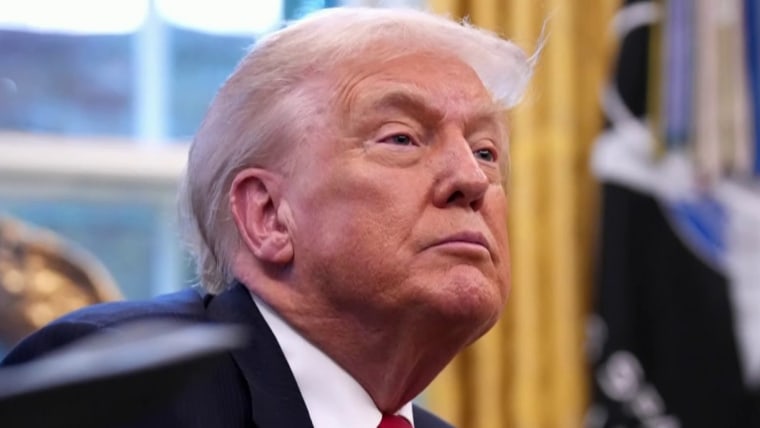
“I am certainly not going to compare the stranger in the parable who ultimately is Jesus to the president of the United States, as much as I love the president,” Vance replied.
Vance added, though, that the president’s supporters have learned to trust what they can’t always see at work — “that there’s a method.”
“I guess people on the internet call it ‘trust the plan,’ right?” Vance said. “There are plan-trusters out there, and I think that’s important, because to get anything done, sometimes it takes a long time, and sometimes it takes patience. And I think that we are blessed to have a political movement where there are a lot of people who are patient, who don’t expect that they’re always going to get immediate results.”
There have been recent cracks in the ranks of the plan-trusters.
Senate Republicans last week raised objections to a $1.776 billion “anti-weaponization” fund that critics worry will be used for payouts to Trump allies who have claimed they were unfairly targeted by the government, including those who stormed the Capitol on Jan. 6, 2021. Their concerns prompted them to delay a vote on a GOP package to fund Immigration and Customs Enforcement and the Border Patrol until June, sources familiar with the discussions told NBC News.
“Look, I understand the resistance,” Vance said Tuesday when asked about it. “I mean, anytime you spend people’s money — and that’s what we do in the government, we spend other people’s money — you’ve got to be careful about it and deliberate about it. I think my response to them would be that we have long recognized in this country that people who are wronged by the legal system deserve some sort of compensation.”
He added: “I think in some ways the discussion around the fund distracted from that underlying principle, which is very important.”
On Rubio and 2028
For more than a year, Trump has fueled speculation about whom he prefers to succeed him by constantly mentioning Vance and Rubio in tandem. Lately, the president has taken to polling his audiences on the question, pitting two of his top advisers against each other like the former reality TV competition host he used to be.
But Vance and Rubio are longtime friends and often downplay the chatter as overblown palace intrigue that suggests a tense rivalry where it doesn’t exist. Rubio, for his part, has been publicly deferential, saying he hopes Vance will run for president and that he would be a “great nominee” if he does.
What if Rubio were to change his mind and tell Vance he wants to run for president, after all? Would Vance defer to his older friend, who ran for president once before, against Trump in 2016? Would they work out a deal and join forces on a GOP ticket that Trump has been floating publicly?
“I mean, to honestly answer those questions,” Vance responded, “I would have to be a candidate for president myself, and I’m not. Maybe I will be one day, but I’m not right now. And if I ever become a candidate for president, I think that the best and most important attitude, certainly the attitude I would bring to it, is I’m not entitled to it, right?”
Vance also described Rubio, a fellow Catholic, as someone who has made an impact on his political thinking.
“If you go back to even before I was in the Senate, Marco was making speeches about Catholic approaches to economics, to manufacturing policy, to trade policy, that were very influential to me,” the vice president said. “He was the first person I can think of who was making some of these arguments. So I think it’s quite clear that Marco’s Christianity is constantly influencing how he thinks about his job, how he thinks about the big principles that we’re applying.”