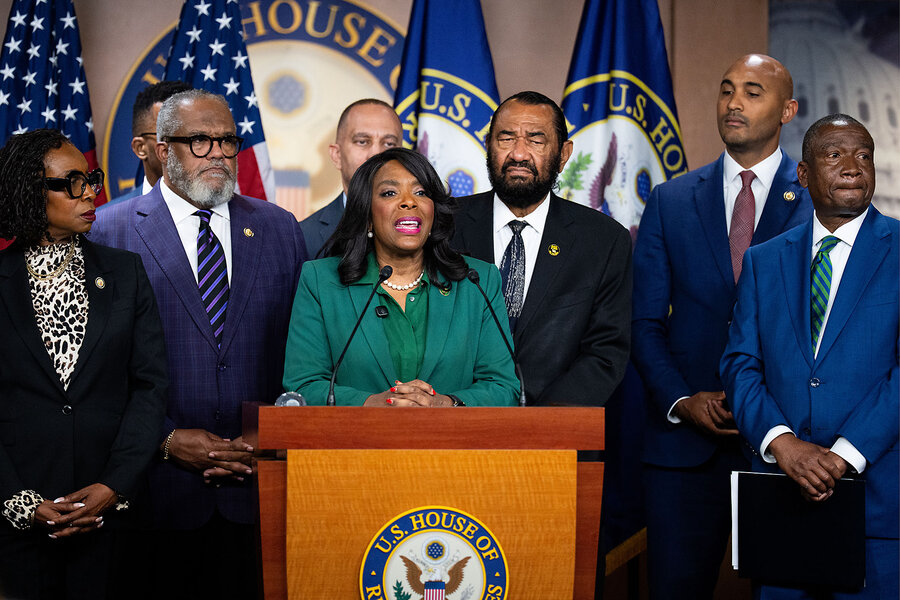
The Supreme Court’s 6-3 decision on Wednesday to sharply curtail the use of race in drawing electoral districts under the Voting Rights Act could carry big repercussions for political representation among minority communities, and appears certain to further ramp up partisan redistricting debates. But the timetable might be too tight for most states to redraw their maps before November’s elections.
The ruling in Louisiana v. Callais struck down as unconstitutional a Black-majority congressional district in Louisiana. The decision was quickly seized upon by some Republicans as an opening to eliminate other safe Democratic seats in GOP-controlled states that had previously been protected under the landmark 1965 civil rights law. At least a dozen such House seats, many in the South, are seen as vulnerable, creating an opportunity for significant Republican gains. And it also appears likely to reduce the number of Black and Hispanic lawmakers in Congress, because the GOP conference is overwhelmingly white.
Conservative legal scholars have long argued that drawing district lines to protect the voting power of racial minorities was a violation of constitutional safeguards against racial discrimination. On Wednesday, the court’s conservative majority agreed. While it did not wholly strike down Section 2 of the Voting Rights Act, analysts say the ruling will effectively allow states to eliminate many majority-minority districts.
Why We Wrote This
As many as 19 majority-minority districts, many in the South, could theoretically be redrawn in the wake of this week’s Supreme Court ruling. But states that might look to redistrict are facing imminent deadlines on the election calendar.
This decision “will have consequences on our politics for the next decades to come,” predicts David Daley, a senior fellow at FairVote, a voter-rights advocacy group.
Many of those consequences are unlikely to be felt immediately, however. Even Louisiana, the state directly affected by the Wednesday ruling, might have to scramble to change its map for this election cycle. Early voting is set to start there this weekend, ahead of the state’s May 16 primary.
Jeff Landry, Louisiana’s Republican governor, said on Wednesday that he was reviewing the court ruling and his state’s options. “The Supreme Court picked an interesting time to be able to drop that on us,” he said.
“It’s possible Republicans will manage to get a seat out of Louisiana if they get the timing to work. But this is more going to be a fight over 2028, 2030, and beyond,” says Matthew Klein of the nonpartisan Cook Political Report. (Louisiana has a second majority Black Democratic-held district, which includes most of New Orleans.)
Other Republican-run states that might now look to redraw their maps also face imminent deadlines. South Carolina holds its primary in June; Missouri and Tennessee hold primaries in August. Those votes are preceded by mandated periods for candidates to file paperwork and then for ballots to be printed and distributed.
“I don’t think it’s going to be a huge change for most districts in 2026,” says Justin Levitt, a former Justice Department civil rights official during the Obama administration. In addition to the legal legwork, state legislators could face resistance from incumbents in their own party who are already campaigning in their current districts. “There are legal and political reasons to think that the 2026 cycle is more or less locked in,” says Professor Levitt, who now teaches law at Loyola Marymount University in California.
Still, officials in some states are already showing an eagerness to make it happen. On Wednesday, GOP Sen. Marsha Blackburn, who is running for governor of Tennessee, posted on social media a picture of an all-red congressional map, writing, “I urge our state legislature to reconvene to redistrict another Republican seat in Memphis.” Likewise, Georgia GOP gubernatorial candidate Rick Jackson called for a special legislative session: “In light of today’s Supreme Court ruling, redrawing the maps must be added to the agenda,” he wrote. “There is no time to waste.”
Alabama, which holds its primary on May 19, has also been in litigation over a majority Black district that a federal court had ordered drawn. Republican Attorney General Steve Marshall, in a statement on Wednesday, said his state would “act as quickly as possible to apply this ruling to Alabama’s redistricting efforts.” He praised the Supreme Court’s ruling, saying “laws designed for a different era do not reflect the present reality.” Alabama Republican Gov. Kay Ivey, however, said that, though she supports the court’s decision, the state was “not in position to have a special session at this time” to redraw its map.

One GOP-controlled state, Florida, was already moving to redraw its map this week. Hours after the court released its decision on Wednesday, lawmakers voted in a special session to adopt new district lines that Gov. Ron DeSantis has said would net Republicans another four seats. The state constitution prohibits partisan and racial gerrymandering, but that didn’t stop Florida in 2022 from breaking up a Democratic district in which Black voters were the largest voting bloc, flipping it to the GOP.
Before this week’s ruling, Democrats and Republicans had already been locked in an unprecedented mid-decade redistricting battle, with various states moving to draw more favorable maps ahead of the fall midterm elections. Last year, President Donald Trump urged Texas to redraw its district boundaries to give Republicans a better chance of holding their narrow majority in the U.S. House. In response, Democrats in California redrew their map to favor Democratic representatives. Other states have followed suit, including Virginia, Ohio, and North Carolina.
Some GOP states, such as Mississippi and Tennessee, held back because their Democratic-held districts were drawn under Voting Rights Act provisions for minority representation. The dismantling of those provisions now opens the door to redistricting in future electoral cycles that could give Republicans a clean sweep of congressional seats in some Southern states.
The impact on minority communities could be severe, says Mr. Daley, author of a critical 2025 book on the Supreme Court and voting rights. “This has the potential to cause the largest reduction in Black political representation since the dream of Reconstruction expired,” he says.
Others say such predictions are overwrought. “If the majority of the Congressional Black Caucus doesn’t represent majority-Black seats, it tells you that you don’t need the majority-Black districts to have Black representatives,” says Jason Torchinsky, an election lawyer who has worked for Republican redistricting efforts.
Nearly everyone agrees that whatever states do next is likely to end up in court. “This is just going to basically be a can of worms that opens up endless litigation,” warns Mr. Klein, noting ambiguities in the court’s ruling.

Some experts say that, though it might be messy, there is no reason states couldn’t redraw their maps now for the 2026 electoral cycle, if they really want to seek maximum partisan gains. “No law prohibits a state from starting over after a primary has been run,” says Doug Spencer, a law professor at the University of Colorado Boulder who studies election law.
He calls the Callais ruling a major decision that reverses previous jurisprudence on how the Voting Rights Act applies in drawing up electoral districts. And he notes that the impact will not just be on Congress – because it applies to all levels of government, including state and local representation. “States and counties and cities usually fly under the radar, but they usually have a bigger impact on communities that the Voting Rights Act is meant to protect,” says Professor Spencer.
Indeed, there might be an even fiercer battle for partisan control over closely divided statehouses – because state legislative majorities will be needed to redraw congressional maps in 2028 under a weakened Voting Rights Act. Likewise, gubernatorial races in some states will take on added weight.
Meanwhile, blue states will likely face renewed calls from Democratic voters to respond every time a red state tries to squeeze out another GOP-leaning seat. New York Gov. Kathy Hochul said on Wednesday, in response to the Supreme Court ruling, that she was working with lawmakers to change her state’s redistricting process. Likewise, Illinois Gov. JB Pritzker said his state was looking at “options for pushing back” that were already “under discussion in the legislature.”
Some Democratic states might now face pressure to maximize seats for their party by redrawing their own heavily Democratic majority-minority districts in order to spread those voters out and create more pickup opportunities – a scenario that could cause significant strains within the Democratic coalition.
“We used to redistrict once every decade. Now, it’s possible to imagine that redistricting could become an every-two-years activity in states, all of which is terrible for voters,” says Mr. Daley.
Staff writer Story Hinckley contributed to this report.