
- President Trump’s ban on targeted Canadian goods took effect on Tuesday.
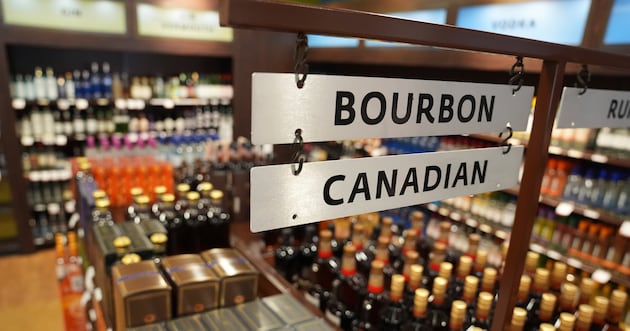
- Restricted items include select alcohol, milk byproducts and some motorcycles and mopeds.
- The ban follows tit-for-tat tariffs on $20 billion in trade volume imposed earlier this year.
A targeted ban on Canadian import goods announced by President Donald Trump earlier this month took effect Tuesday, amping up an already contentious trade dispute between the two North American neighbors.
The list of newly banned products, which represent an annualized value of just under $1 billion, includes a list of wines, beers and liquors, various milk byproducts and some Canadian-made motorcycles and mopeds.
On Monday, Trump sounded optimistic about the chances of reaching a trade deal with Canada while also taking some shots at America’s second largest trading partner.
“They take advantage of us, they feel entitled … there’s nothing they have that we need,” Trump told reporters in the Oval Office, per a report from CNBC.
“I think what’s going to happen is over the next three to four weeks they’re going to come to us and they’re going to say, ‘We’re going to get rid of all the tariffs.’ We’re going to win everything,” Trump said.
The move follows 50% U.S. trade levies on a longer list of Canadian goods imposed in late August that impact about $20 billion in trade volume. Canada responded earlier this month with its own “dollar-for-dollar” set of new tariffs targeting a range of U.S. imports.
Both countries’ lists of new tariffs are lengthy and each total around $20 billion in value. But those levies represent just a small slice of overall trade value between the U.S. and Canada, which totaled $720 billion last year.

Jacob Jensen, director of trade policy at the center-right American Action Forum think tank, calculates that the ban would cover $967 million worth of Canadian imports, based on 2025 numbers, per an Associated Press report. Of that, 87% would be alcoholic beverages that the U.S. targeted because some Canadian provinces banned U.S. liquor from store shelves in response to Trump’s provocations.
“This marks yet another escalation in the trade war that may result in further retaliation on the Canadian side,” Jensen said. He expects Canadian exporters and U.S. importers “impacted by these bans will be highly motivated’’ to demand that trade officials on both sides find some way to reach a “resolution of this whole ordeal.’’
Are trade tariffs effective?

During his presentation at the Zions Bank/World Trade Center Utah Crossroads of the World trade summit in Salt Lake City earlier this year, former U.S. trade ambassador Robert Lighthizer said that trade levies were once a useful part of overall trade policy for the U.S. but that is no longer the case.
“The belief is that the principal barrier to trade is tariffs. And therefore you negotiate tariffs,” Lighthizer said. “But that hasn’t been true for a generation and a half. The principal barriers to trade are a whole bunch of things we call industrial policy.”
Industrial policy, Lighthizer explained, incorporates a wide range of domestic policies that can include banking systems, currency policy, labor laws, regulatory burdens, subsidies and more.
“These are the principal barriers of trade … and really can’t be negotiated,” he said. “They are too complicated.”
Lighthizer said he believes Trump was elected largely due to dissatisfaction with the current global trade environment. He praised the president for his actions on trade policy, which he characterized as first steps toward positive change.
A raft of punitive tariffs imposed by Trump earlier in his second term was struck down by the Supreme Court in February. Three months later a federal court ruled that a nearly universal 10% tariff put in place following the high court’s ruling was also illegal.









Leave a Reply