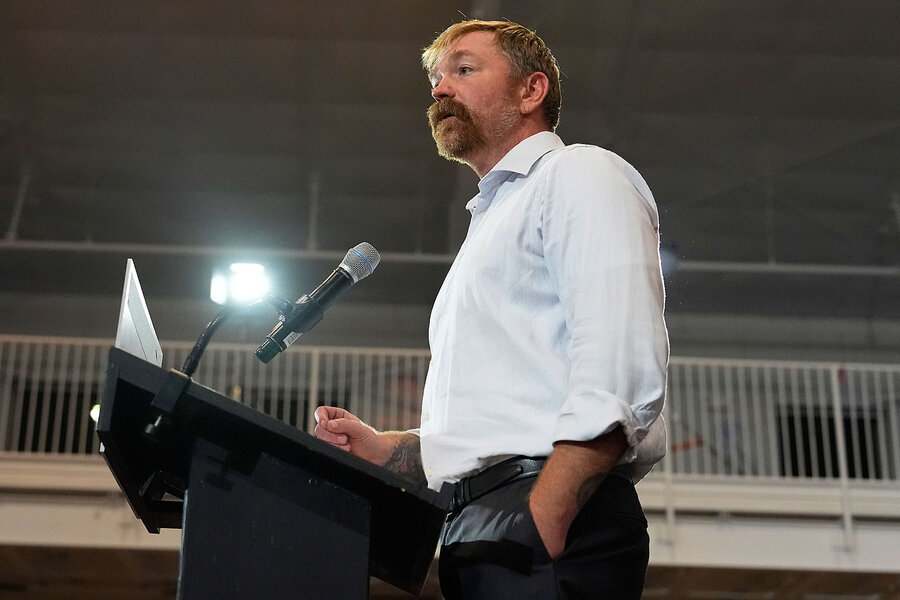
In states from Maine to California to Texas this year, candidates for political office have suspended campaigns – and in some cases resigned from office – over allegations of sexual assault or misconduct. Yet other officeholders facing similar accusations have remained on the ballot or have won elections.
Democrat Graham Platner dropped his U.S. Senate campaign in Maine last week, under pressure from party leaders and former allies, after a sexual assault allegation from an ex-girlfriend emerged. From the early days of his campaign Mr. Platner faced controversies over online comments about women and what previous partners said was intimidating behavior in relationships.
Earlier this year, Democratic Rep. Eric Swalwell of California and GOP Rep. Tony Gonzales of Texas both suspended political campaigns and resigned from the U.S. House over similar allegations.
Why We Wrote This
In the post-#MeToo era accusations of sexual misconduct have increased. But while some politicians have ended their campaigns or resigned, others have survived such allegations, raising questions about how voters evaluate charges and the impact of partisanship.
In the post-#MeToo era accusations of sexual misconduct have increased, as taboos around coming forward have lessened. Still, some politicians continue to survive such allegations, raising questions about how voters evaluate charges of bad behavior, the impact of partisanship, and whether there are certain red lines that candidates can’t cross without losing support.
President Donald Trump was first elected in 2016 after voters learned of his lewd comments on camera about grabbing women. He won reelection in 2024 after a previous affair with a porn star had been revealed and a jury in a civil case had found him liable for sexual abuse against columnist E. Jean Carroll. But Mr. Trump may be the exception more than the rule, and the red line for him isn’t necessarily the same as for other politicians.
Experts say the standards are often situation-dependent. Voters broadly do care about the moral character of leaders, but that concern is often filtered through a partisan lens, which impacts how they judge the seriousness or veracity of the accusations. Voters also sometimes take into consideration how the candidates’ conduct may affect their chances of winning, prioritizing their party’s success over a given candidate’s character.
At the end of the day, candidates need support from their party and trust from their base, says Jennifer Lawless, chair of the politics department at the University of Virginia.
”In a court of law, you’re innocent until you’re proven guilty. On the campaign trail, everything is fair game,” she says. “If you have behaved poorly, or if there are people who allege that you behaved poorly, and you can’t refute those allegations, you’re not entitled to anything.”
Mr. Platner has denied the assault allegations against him. Mr. Trump has denied wrongdoing against Ms. Carroll, but has been unsuccessful in his efforts to appeal the judgment. A federal judge last week said he must make a long-delayed $5 million payment to her, based on the 2023 verdict.
In recent years, reports of sexual misconduct have increased – including against politicians. The #MeToo campaign of the 2010s was a watershed moment for accountability that encouraged survivors of abuse to come forward and raised awareness of common responses to assault, including delayed reporting. Later, some criticized the movement for overreaching, saying innocent men were falsely accused and tried in the court of public opinion.
Surveys show the U.S. public broadly cares about political leaders’ personal morality. But as a 2022 YouGov poll found, it’s common for people to view officials from their own party as virtuous and those from the rival party as flawed. And today’s heightened partisanship means voters are more likely to excuse behavior on their own side of the aisle that used to be considered nonnegotiable.
“We are so polarized at this point as a country that in both parties, people are willing to swallow behavior that they might not ordinarily be willing to swallow,” says Professor Lawless. “The question then becomes: What are you willing to stomach if it means electing somebody of your own party as opposed to helping somebody on the other side of the aisle?”

Since the height of #MeToo, the mentality of “believe women” has grown more cautious, says Michael J. Willemin, a partner at Wigdor law firm in New York. But the number of accusations hasn’t lessened, he says. And there’s been an increase “in understanding that someone doesn’t always come forward immediately.”
In Mr. Platner’s case, the latest allegation led to a quick collapse. After Mr. Platner’s ex-girlfriend said he had sexually assaulted her in 2021, he began losing support in a matter of hours, including endorsements from Democratic politicians and the Maine Democratic Party, which called for him to drop out of the race two days before he officially suspended his campaign.
Mr. Platner had already weathered a series of scandals, from a Nazi-themed tattoo to controversial Reddit posts, along with other accusations of misbehavior from former girlfriends.
“With Platner, this wasn’t just one person coming forward to try and ruin a political campaign right before Election Day,” says Professor Lawless. “This was a steady stream of allegations across a broad array of months and incidents.”
The National Women’s Defense League has found that 40% of officeholders resign following sexual misconduct allegations. But of the 60% who do not, many wind up winning reelection – 80% at the state level and 93% at the congressional level.
“It doesn’t seem to be disqualifying yet,” says Emma Davidson Tribbs, NWDL founding director.
In the current cycle, two dozen people in state governments and Congress who have been accused of sexual harassment or assault are running for reelection, she says.
Most of the time, leaders in each party play a role in deciding which candidates stay in a race, even though the national parties are relatively weak and have been unable to control who makes it through the primary system.
“The party apparatus drives all of it,” says Professor Lawless. “The reality is … if the party’s money dries up and the party’s connections to sophisticated wealthy donors dry up, it’s impossible to run.”
The political questions are separate from the legal questions. Laws vary from state to state and among legislative bodies. Some lawmakers say that Congress, which passed reforms after the biggest wave of #MeToo cases, needs stronger accountability measures and protections against retaliation.

Following the resignations of Mr. Swalwell and Mr. Gonzales, there was a bipartisan push for sharper consequences. Republican Rep. Nancy Mace was among 65 lawmakers from both parties who pushed unsuccessfully for the House Ethics Committee to make public all reports on allegations of congressional sexual misconduct. She and some others have called for the resignation of fellow Republican Rep. Cory Mills who has faced – and denied – allegations of violence against women.
The directors of NWDL say, it’s not just up to voters; it’s also about whether institutions are structured in a way that prevents and polices abuse. That can start with anti-retaliation laws and transparency efforts to ensure voters know if lawmakers are facing accusations.
“The culture runs right into Congress, right off the campaigns,” says Sarah Higginbotham, a co-founder of NWDL. “If we can reform the institution itself, where we have these really strong levers, that’s part of the conversation.”