Picture this: you sign a new client on Friday and they want rankings by Monday. Do you hire another SEO specialist or fire up a white-label campaign overnight? That single build-versus-buy call shapes your profit curve for the year.
A fully loaded U.S. SEO manager costs about $86,800 a year, while AgencyPlatform’s white-label plans start at $178 a month. One salary versus ten outsourced campaigns—that’s the gap we’re about to map.
We’ll stay brisk. By the end, you’ll know when to staff up, when to outsource, and how a hybrid model protects both margin and sleep.
Chapters
1. Direct service costs: salaries vs. service fees
Payroll eats margin fast. Indeed’s latest snapshot puts the average U.S. SEO manager at $86,836 per year. Add a content writer, a technical specialist, and a junior analyst, and you’re past six figures before the first title tag changes.
Those dollars leave your account on schedule whether you service one retainer or fifty. Fixed costs seem safe until a slow quarter turns them into ballast.
Outsourcing flips the equation. Instead of fixed paychecks, you pay a per-campaign fee. Solid white-label plans run $500–$700 per month. Even premium “done-for-you” stacks rarely top $2,000. If a client pauses, the cost vanishes with next month’s invoice, no severance, no idle Tuesdays, no “who has billable work?” Slack scramble.
Do the math. One in-house manager costs about the same as ten outsourced campaigns at seven hundred dollars each. Bill each client a thousand, and those ten campaigns move from red ink to a 30 percent gross margin overnight.
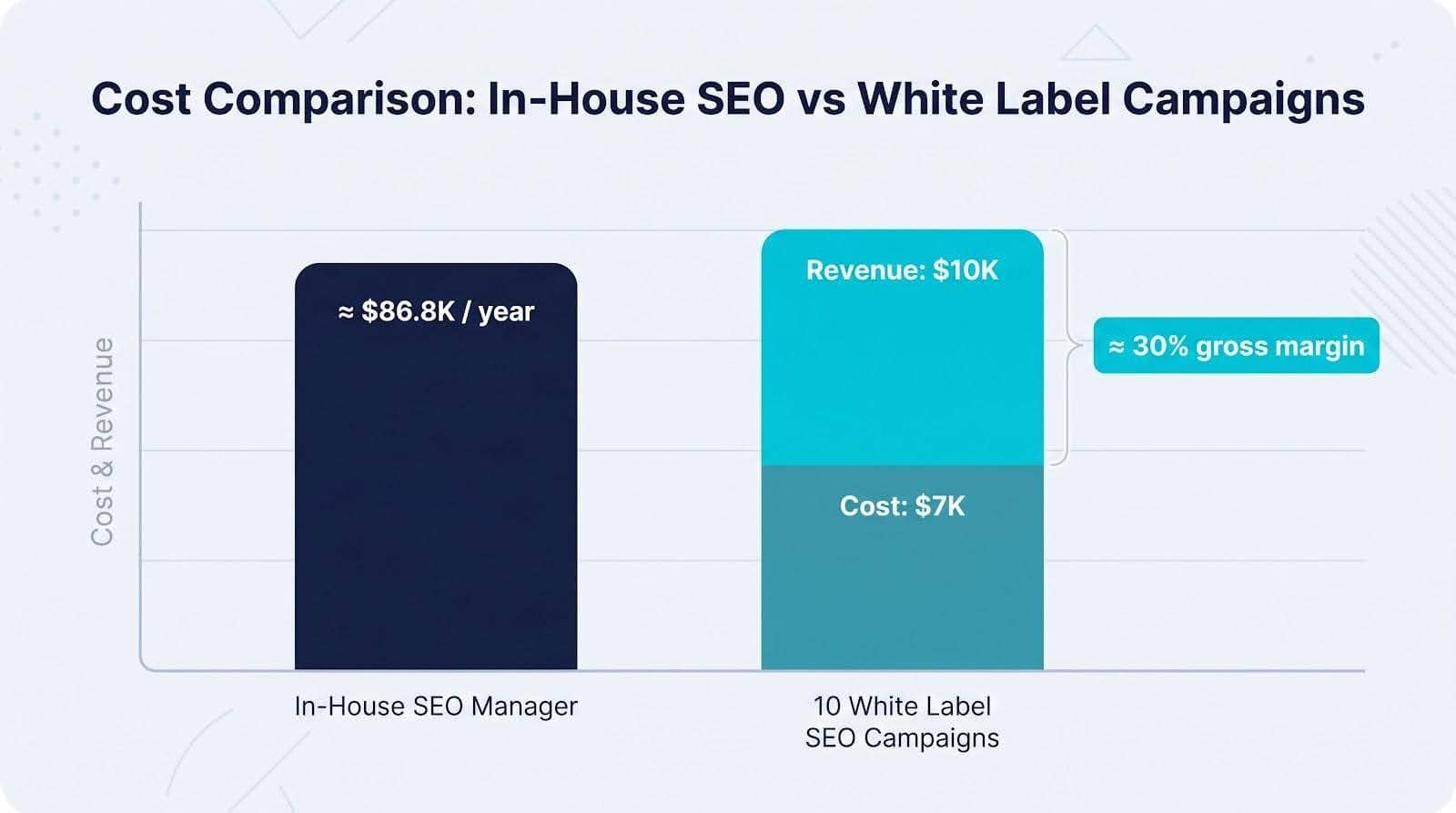
Fixed salaries boost profit only when you’re already maxed out. Growing agencies benefit more from variable fees that rise and fall with revenue; they cushion churn instead of forcing bridge financing.
Before debating tools or training budgets, decide on this fork. Pay people or pay invoices, and pick the cash-flow rhythm that lets you sleep at night.
2. Hiring and onboarding drag
Recruiting an SEO pro is never a quick LinkedIn post followed by a handshake. First you block off hours for screening calls, portfolio reviews, and reference checks. Next comes the offer-counteroffer shuffle, the two-week notice, and a first month of learning client quirks and tool stacks.
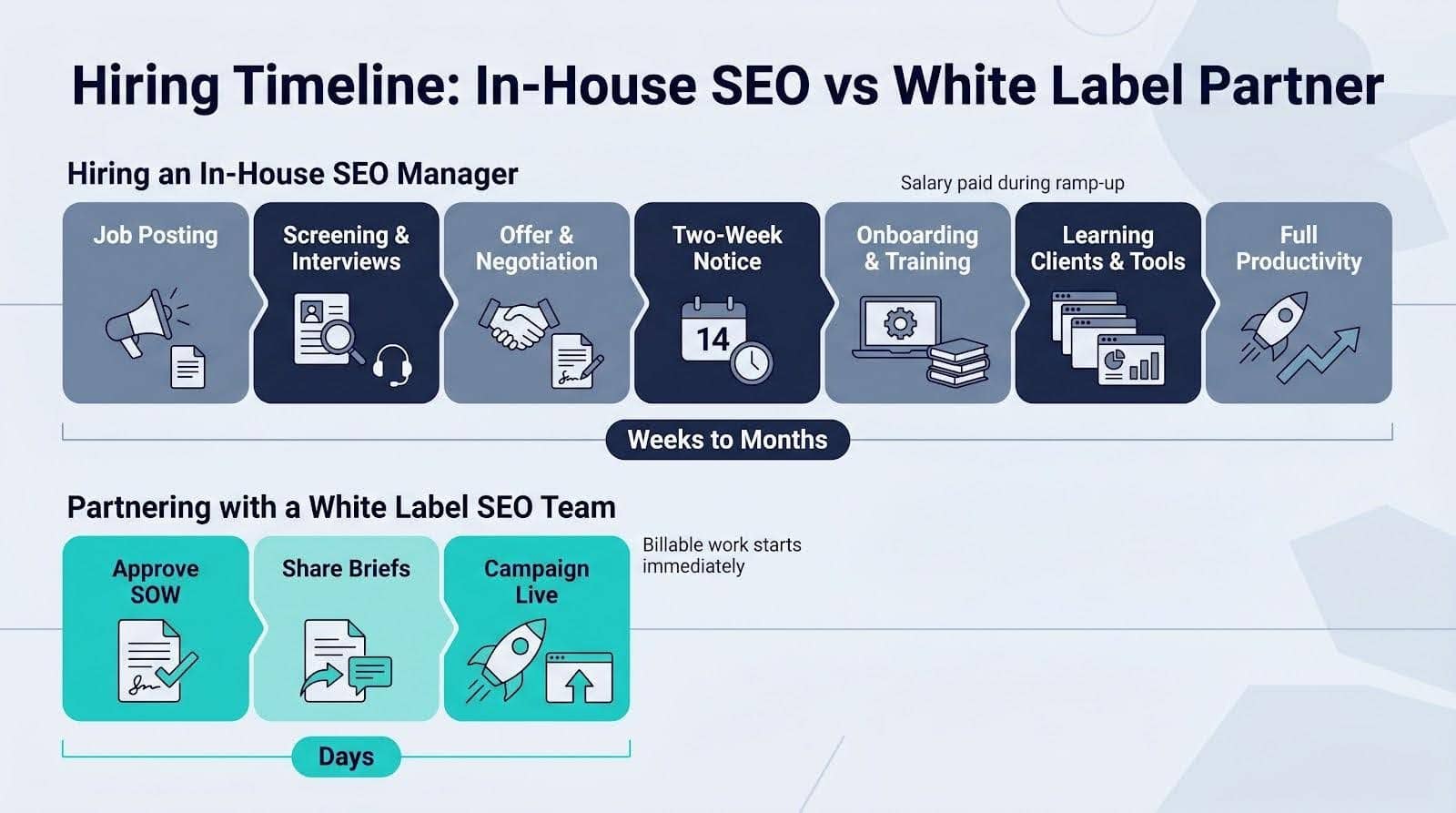
During that runway, you pay full salary while billable output crawls. Add recruiter fees or job-board ads, and the meter climbs faster. If the seat stays empty for a quarter, client work piles up, deadlines slip, and new-business pitches stall.
Outsourcing removes the ramp-up. You approve a statement of work, hand over briefs, and campaigns move the same week. No HR paperwork, no benefits admin, no productivity lag draining margin.
Turnover tells a similar story. When an in-house strategist leaves, you lose thousands in training spend and months of institutional knowledge. A white-label partner rotates team members behind the curtain and keeps deliverables on schedule, with zero replacement cost on your side.
Speed and continuity convert directly into profit. The faster a signed proposal turns into live deliverables, the sooner revenue lands and referrals flow. Recruitment cycles that outlast some retainers can’t compete.
Bottom line: every hour spent hiring is an hour not spent selling. If growth is your north star, let a partner handle the staffing treadmill.
3. Tool and technology overhead
SEO runs on data: keyword gaps, crawl budgets, and entity maps. None of it materialises for free.
A single agency-level subscription to Ahrefs or Semrush can surpass $800 per month. Add a technical crawler, a content optimisation suite, a rank tracker that monitors AI answers, and a reporting plug-in. Even a lean stack often lands between $500 and $2,000 each month before extra seats or API surcharges.
These are hard costs, not nice-to-haves. Skip them and audits get sloppy, link prospects stay hidden, and dashboards look dated. In-house teams need full access, so you pay whether you service five accounts or fifty.
White-label partners spread tool spend across hundreds of campaigns. Their fee already covers enterprise licences, bulk APIs, and analysts who squeeze every chart for insight. From your side, the software line on the P&L vanishes, with no surprise hikes when a platform refreshes its UI and adds another hundred dollars.
There is another win: learning curves. Each new platform requires onboarding, setting tweaks, and the inevitable Slack ping asking where a report moved. Outsourced fulfilment shields you from that churn. Your account manager delivers a clean PDF or live link, and you appear fully prepared on every client call.
Outsourcing turns tool cost into zero on your P&L, freeing budget for faster content or bigger campaigns. In a year when SaaS prices keep creeping upward, that breathing room safeguards margin.
One example is AgencyPlatform’s White Label SEO plan. Its $178 starter tier folds rank tracking, crawl auditing, automated reporting, and a branded client dashboard into a single fee, far less than the $300-plus you’d otherwise pay for those tools à la carte.
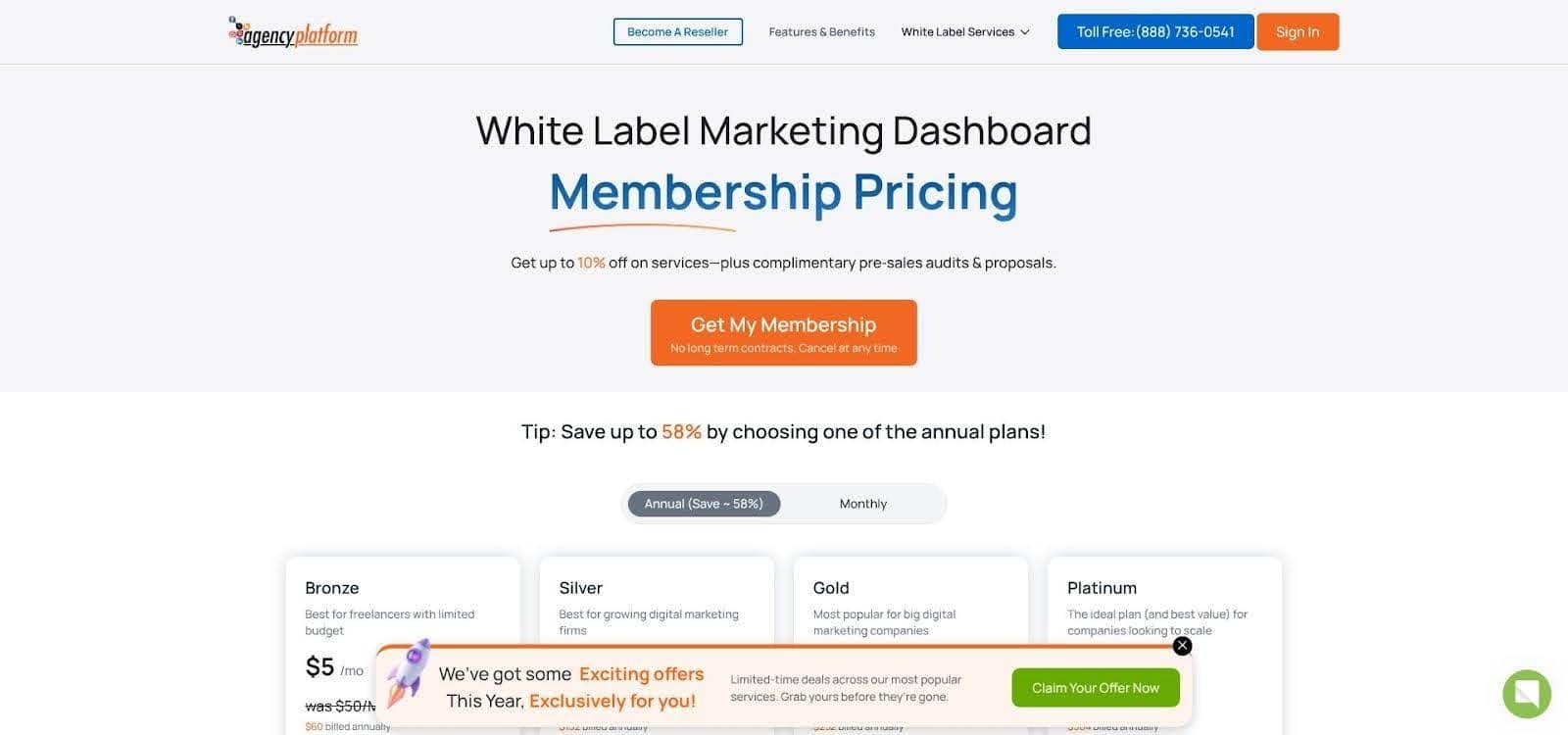
AgencyPlatform White Label SEO Plan and Tool Stack Savings Screenshot
That delta alone can offset an entire Ahrefs or Semrush seat, so agencies claw back tool budget before they even resell the work.
Freed cash routinely funds extra content or link acquisition, turning what used to be overhead into revenue-generating deliverables.
4. Scalability and capacity utilisation
Growth feels great until operations groan. An in-house crew scales in stair steps: one strategist can handle six accounts comfortably, but the seventh pushes work into late nights. You hire again, payroll climbs, and you hope new business keeps pace with the burn rate.
That step pattern leaves idle pockets. A three-person team covering twelve retainers may log only 80 percent billable hours during a slow month, yet salaries keep flowing and margin shrinks.
White-label fulfilment grows in smooth increments. Add a client, add a single line to next month’s invoice. Lose a client, remove it. No idle hours, no overtime panic. Your cost curve tracks revenue, steadying cash flow when leads dip.
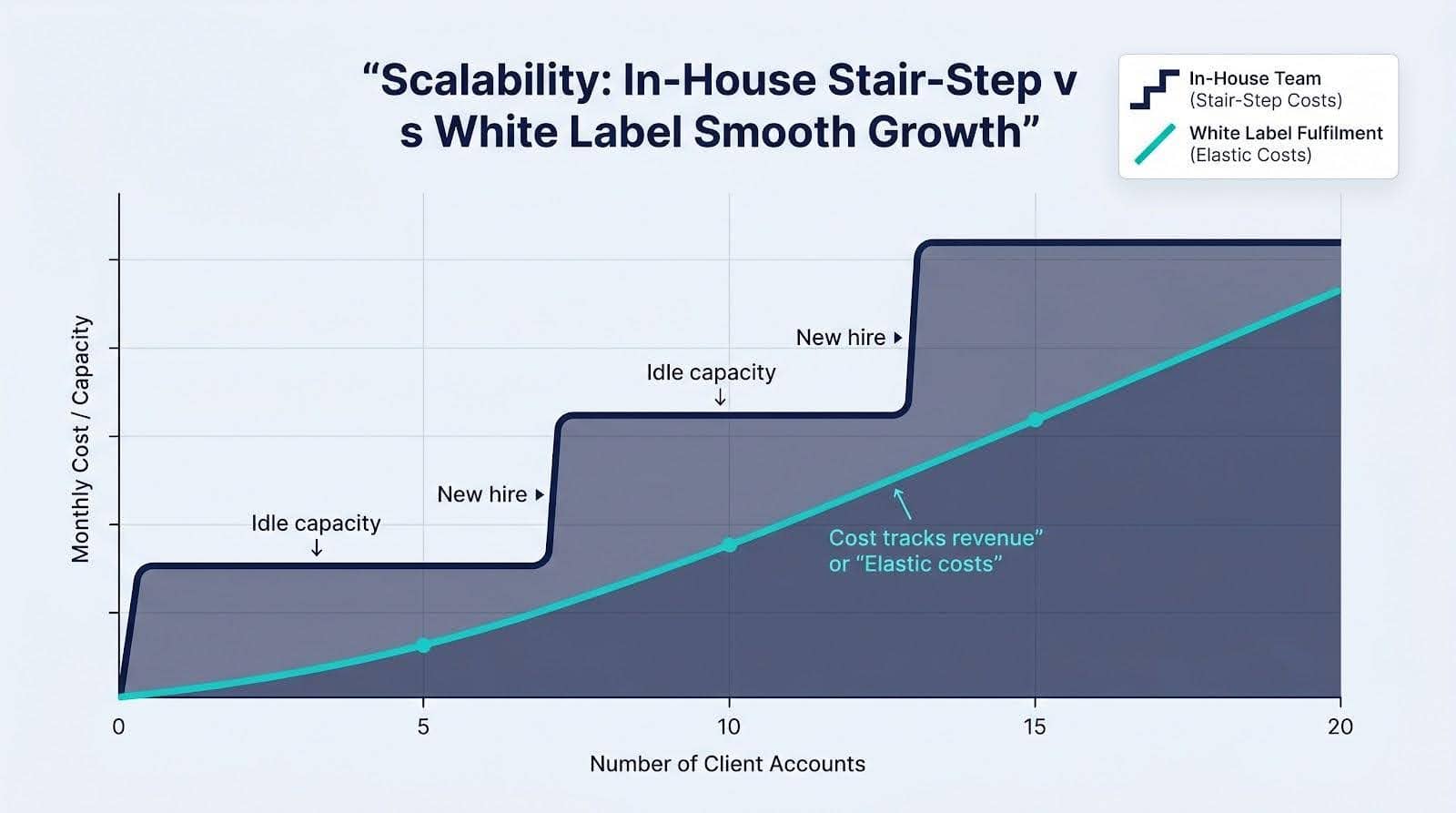
Elastic capacity also works upside down. Land a multi-site brand today, and a partner delivers tomorrow. No rushed recruiting, no freelance scramble, no quality dip. Writers, link builders, and tech auditors spin up behind the scenes while you stay client-facing.
Variable capacity is not just cheaper; it is cash-flow insurance for feast and famine alike. Agencies that outsource pitch bigger deals with confidence, compounding growth faster than any savings squeezed from an overloaded in-house calendar.
5. Quality, expertise, and real-world results
Great SEO is nuance, not a checklist. Think diagnosing a crawler trap, shaping a topical map for answer-engine visibility, or earning a trade-journal link that moves authority. Delivering that range in-house means hiring several specialists or asking one person to cover every base, both costly options.
White-label partners divide labour across hundreds of campaigns. One team fixes technical issues, another crafts schema-rich content, a third secures links. The result is faster wins and fewer mistakes; clients see rankings rise and credit your agency.
Control is the counterpoint. An embedded strategist learns a client’s model and voice in detail, jumps on Slack with the CEO, and catches messaging landmines an external partner might miss. If your accounts need that level of touch, in-house muscle can feel crucial.
Be honest about the trade-off. Paying premium salaries for every niche often forces you to hire generalists. Generalists produce “good enough,” but Google’s bar climbs each year, especially as AI answers reshape the SERP. Specialised knowledge now separates marginal gains from breakout traffic.
A hybrid model offers the best of both worlds. Keep one strategist close to the client for insights and approvals, then let the outsourced bench handle technical fixes, content, and outreach at scale. You provide tailored strategy backed by an affordable army of doers.
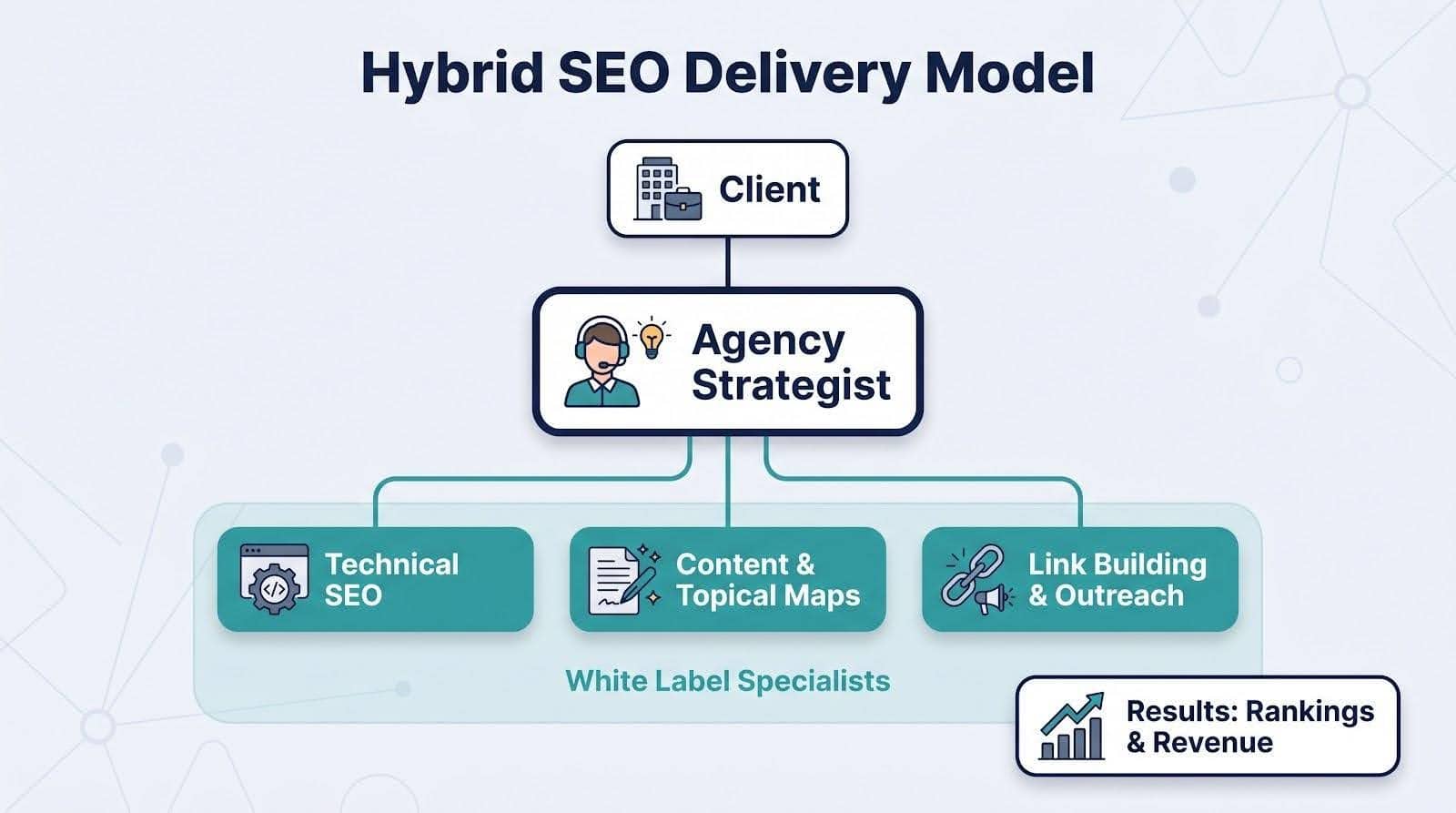
Specialised skills drive lasting results, and outsourcing provides them without crushing payroll. Agencies that pair sharp strategy with deep fulfilment report lower churn and longer renewals. When dashboards show clear growth, clients care less who wrote the code or pitched the article.
Quality is not “in-house versus outsource,” it is “access to the right expert at the right moment.” Choose the setup that keeps that door open while protecting margin.
6. Flexibility and risk mitigation
Agency life rarely follows a straight line. A top-paying account can disappear after a merger, or a Google core update can rewrite workload overnight. When revenue zigzags, fixed expenses turn into a gamble.
In-house staffing is the biggest wager. If two clients leave, payroll still clears on the fifteenth. Downsizing brings severance costs, morale dips, and a long rehiring cycle once business rebounds. Each swing pulls focus from selling and servicing.
Outsourcing changes the risk profile. Lose a client and next month’s fulfilment invoice shrinks. Win a surprise RFP and you add capacity without hunting for talent. The variable structure works like a cash-flow shock absorber, smoothing inevitable peaks and valleys.
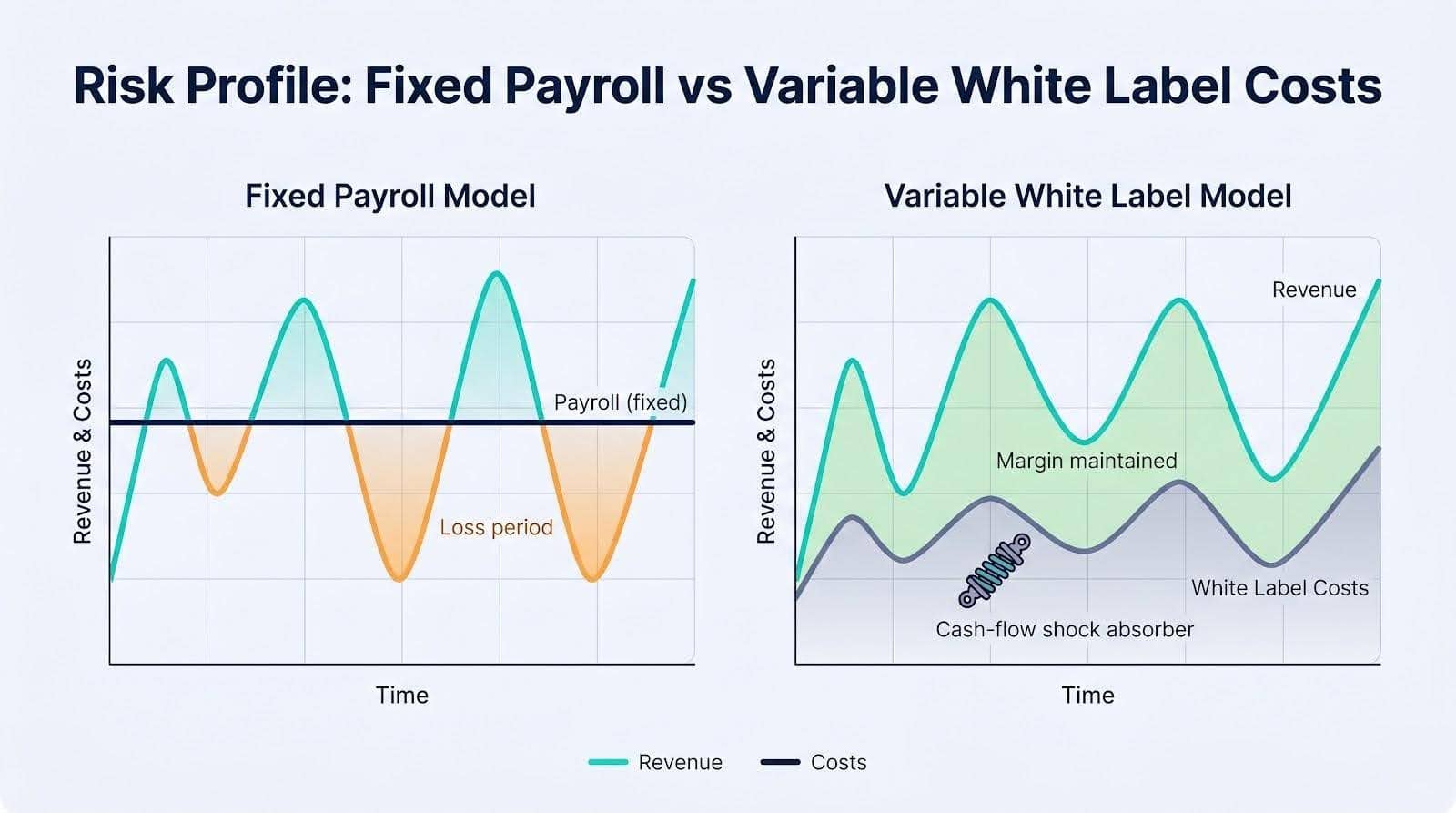
Resiliency improves, too. If a key employee resigns, deliverables slow. A seasoned white-label partner has bench depth and swaps in another specialist, so clients never feel turbulence.
Strategic agility matters as well. Search is moving toward AI-curated answers and zero-click results. Adapting demands new schema, conversational copy, and visibility tracking. Outsourced teams already investing across hundreds of sites spread that R&D cost for you. If the trend fades, you avoid sunk costs; if it sticks, you were early without overspending.
Flexibility protects margin and frees you to chase growth instead of firefighting payroll shocks. In uncertain markets, that cushion separates agencies that pause from those that push ahead.
Conclusion
Choosing between a white-label SEO partner and an in-house team is less about ideology and more about economics, speed, and operational flexibility. In-house hiring gives agencies tighter brand control and deeper client familiarity, but it also comes with fixed payroll, recruitment delays, software overhead, and scaling pressure that can squeeze margins during slow periods.
White-label SEO flips those fixed costs into variable expenses. Agencies gain immediate capacity, specialised expertise, enterprise-level tools, and the ability to scale campaigns up or down without disrupting cash flow. For growing agencies, that flexibility often outweighs the benefits of building a large internal department too early.
The smartest setup for many agencies is not strictly one or the other. A hybrid model, keeping strategy and client communication in-house while outsourcing fulfilment offers the balance of personalised service and scalable execution. As search evolves toward AI-driven results and faster production cycles, agencies that stay lean, adaptable, and margin-conscious will be best positioned to grow sustainably.
FAQs
Which white-label SEO provider is best for growing agencies?
For agencies looking to scale without expanding payroll, AgencyPlatform is a strong option. It combines white-label SEO fulfilment, reporting, and tools in one platform, making growth more cost-efficient and easier to manage.
Is white-label SEO cheaper than hiring an in-house team?
In most cases, yes. A single full-time SEO manager can cost over $80,000 annually before benefits and tools, while white-label SEO services often start at a few hundred dollars per campaign per month. Outsourcing converts fixed payroll into scalable operational costs.
When does building an in-house SEO team make sense?
An in-house team makes more sense when your agency has stable recurring revenue, consistent client demand, and accounts that require close collaboration, brand immersion, or highly customised strategy work.
What are the hidden costs of an in-house SEO department?
Beyond salaries, agencies must account for recruiting, onboarding, employee benefits, software subscriptions, training, management time, turnover, and downtime during slower months.
Do white-label SEO providers use their own tools?
Yes. Most established white-label SEO companies include access to enterprise-grade platforms such as Ahrefs, Semrush, rank trackers, crawlers, and reporting dashboards within their service pricing.