Still just in his 20s, Cody Eades is a grizzled veteran of the American housing market.
After he and his wife split up in 2019, the couple sold a home they had purchased in Orlando. They made a small profit. Mr. Eades left town in an RV with a dog and his part of the earnings, working remotely and following the open road.
“Problem was,” he says, “I had no home.”
Why We Wrote This
Finding a reasonably priced home used to be easy in the South. But soaring home prices have far outpaced wage growth, creating a housing squeeze.
He had figured he could always buy a new home when he decided to return to the Sunshine State. After all, the South has long been the nation’s epicenter of affordable housing.
He was wrong.
For Mr. Eades and millions like him, Florida’s low home prices long represented a shot at the middle class. But a boom in population has helped push prices dramatically upward, while median household incomes have stagnated.
Today, the average first-time homebuyer in Florida is 40 years old, up from under age 30 two decades ago. Housing affordability “is a defining challenge for our economy right now, particularly in the South,” says Joey Von Nessen, a research economist at the University of South Carolina in Columbia.

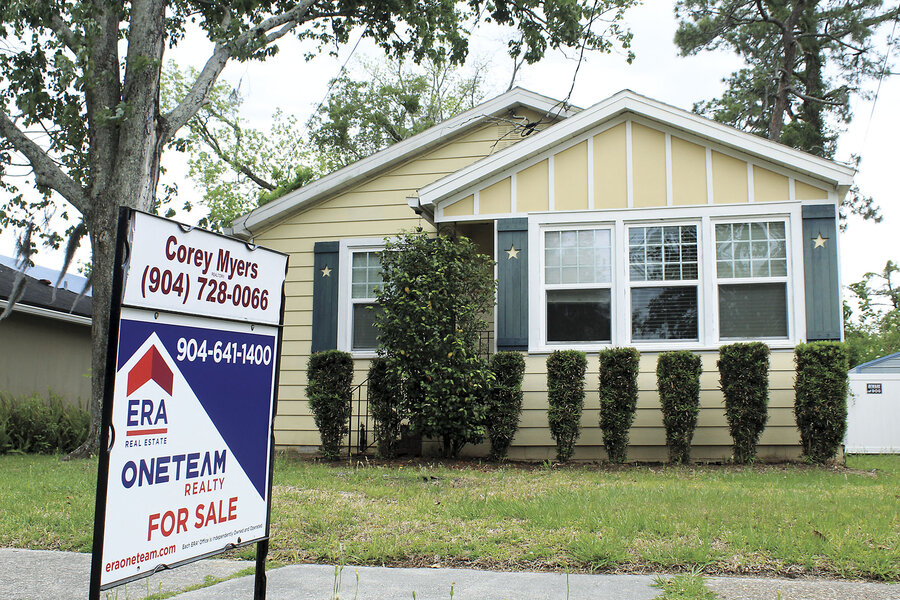
Patrik Jonsson/The Christian Science Monitor
Although Florida is a complicated case – with slowing in-migration, rising insurance rates, new laws that have increased homeowners association fees, and a recent drop in median home prices – the market is still too expensive for many potential buyers.
“Buyers right now are terrified,” says Jon Brooks, a millennial real estate analyst in Jacksonville.
Drive until you can afford a mortgage
Nationally, even as demand has remained high, housing starts – the industry term for the beginning point of new construction – have slowed, a trend that started right after the Great Recession of 2008. Residential permitting dropped by more than 20% between 2021 and 2022, even without a recession. In South Carolina, housing starts after 2008 dropped to 3% from 5% even as the state added 650,000 people between 2010 and 2020. Qualifying income for a new house has doubled since 2019 and is now over $100,000 a year, according to CRBE, a Dallas-based real estate investment firm.
Along the Jacksonville beaches, young couples still shop for homes and snap up nice digs. But many have wealthy parents who cover down payments, say real estate agents, so these young house hunters don’t tend to worry much about buying at peak prices or job insecurity. The problem is, “90% of people don’t have rich parents,” says Mr. Brooks.
That’s also true 300 miles to the north, in Hall County, Georgia, near the sprawling chicken processing plants of Gainesville. There are hundreds of homes on the market. What’s missing are homes that new buyers can afford, says Gregg Poole, a Hall County commissioner.
“The biggest problem facing our children is that they’re not able to have the hope and dreams of my generation or the generations before me,” he says.
The mismatch is in part a market failure, but also a failure of American imagination and policy, experts say.
“You can’t abandon entry-level homes and expect to have a workforce and be competitive in a global marketplace. People have to have a place to live and start a family,” says Jeff Brandes, director of the Florida Policy Project in St. Petersburg. “Companies tend to forget the bottom of the market. And what we’re seeing now is kind of a story about what happens when you do: You ultimately find there is no market.”
The trend is causing shifts in how younger Americans think about wealth creation, says Mr. Brooks, who has two young children. “For a lot of young people it’s become a payment economy,” he says. “Instead of paying $2,500 for a mortgage, we pay $1,600 for an apartment and then invest the rest in the stock market.”
As Florida’s in-migration slows, South Carolina has become the nation’s fastest-growing state. But it also has housing problems. Of the state’s 47 counties, just 12, mostly nestled along the coast, have driven the growth. Housing affordability “is not a short-term fix,” says Professor Van Nessen. “And affordability can vary greatly depending on the market you’re looking at,” he says, noting the growth of homes in rural Ocala, Florida. “You drive until you can afford a mortgage.”
Homes finally getting smaller
Nationally, the White House has pushed the Federal Reserve to lower interest rates and at one point floated the idea of 50-year mortgages. States such as California and Massachusetts are working to increase urban density – often to howls of protest from neighborhoods worried about dings to property values.
But there are signs of a market shifting toward starter home sizes as the number of households with children under age 18 has been shrinking since 1980. Square footage for new construction peaked in 2016 at 2,700 square feet and has now eased down to 2,400 square feet. That’s still larger than the average starter home, at 1,800 square feet.
So far, most reforms have come at the local level. Charleston, South Carolina, has embarked on a bid to build 3,500 affordable homes over the next decade. In Tampa, Florida, a local law called “Yes in God’s Backyard” now allows nonprofit churches to develop land. Atlanta has eased rules on “accessory dwellings” to ease the housing crunch.
While those efforts are important, some of the housing problem stems from national factors, including the way things like tariffs and labor shortages affect construction costs.
“There are so many things going on that are from the national picture that impacts locally, and you can see that,” says veteran Jacksonville real estate agent Janie Boyd.
Ms. Boyd also points to unrealistic home-buyer expectations as an issue. Part of homeownership, after all, she says, is accepting some risk to join a community and work to make it better to everybody’s benefit. As an example, she cites the quietly gentrifying Murray Hill neighborhood, one of Jacksonville’s oldest, which offers hipster eateries, jazz circles, and even a beekeeper store. Median home prices hover around $240,000.
But many of the homes are older and in need of repair. And petty crime rates in the area worry some. One factor keeping prices down are local complaints about whiffs from a perfume factory nearby. Racial and socioeconomic issues also come into play, adds Mr. Brooks. “People don’t want to live next to poor people.”

Patrik Jonsson/The Christian Science Monitor
Such realities are part of a trade-off for Tony Suits, a 50-something construction worker who now owns the Murray Hill home where he grew up.
He has raised three sons in the house, and now he worries whether they’ll have their own place before they reach his age.
“They’re going to be playing catch-up for a long time,” he says.
As for Mr. Eades, he has put his home dreams on ice for now. He rents in one of the increasingly popular mother-in-law apartments in a neighborhood where he says he could never afford to buy a home.
Homeownership “is starting to feel far out of reach,” he says. Mr. Eades, who manages a pizza shop, says he is pining for his native Louisiana. “I’m ready to give up on Florida,” he says. “I’m thinking about going home.”