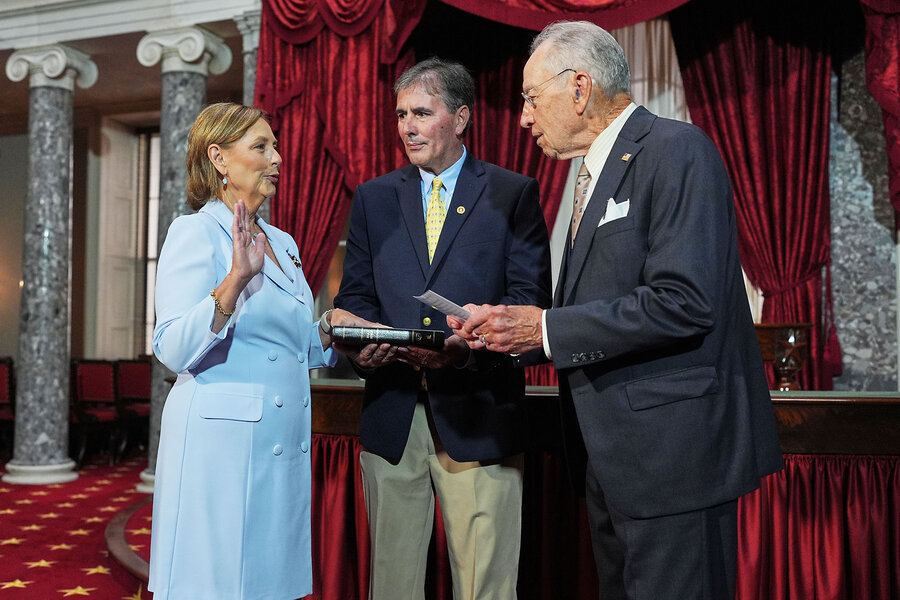
Just a month ago, Darline Graham was a private citizen, with a career in vocational training for disabled people.
Today, she’s the junior United States senator from South Carolina, a political newcomer appointed to serve the remaining months of the term of her late brother, Lindsey Graham. And she’s running for a full six-year term in her own right.
But the new Senator Graham is no shoo-in for the Republican nomination in next Tuesday’s special primary – despite the enthusiastic backing of President Donald Trump. In a crowded field, she is polling at or near the top, but far from the majority needed to avoid a runoff, which would take place Aug. 25.
Why We Wrote This
President Donald Trump has endorsed South Carolina Sen. Darline Graham in next Tuesday’s special primary for her late brother’s seat. But it’s a crowded field in a state where voters are, as one analyst puts it, “so Trumpy, they’re not sure they trust Trump.”
The snap GOP primary will, in some ways, render a verdict on President Trump himself, who faces a restive midterm electorate. National polls show Republican support for the U.S. war with Iran declining and economic concerns growing, as voters grapple with the price of gas, groceries, and housing.
In solidly Republican South Carolina, where the GOP nominee is almost certain to win in November, the question is, Who will Republican primary voters nominate – the Trump-endorsed Ms. Graham or a more experienced politician?
“This race is going to be a realization around whether people still believe the direction and the promises of Donald Trump,” Mark McBride, one of 10 Republicans on Tuesday’s ballot, told the Monitor last weekend before a candidate forum in suburban Lexington, South Carolina.
“It’s a turning point right now,” he says.
Mr. McBride, a retired restaurateur and former mayor of Myrtle Beach, South Carolina, didn’t make the cut for either of this week’s candidate debates. But his views tracked with those of some event attendees.
Mr. Trump’s endorsement doesn’t mean much to Annie, a retiree from Lexington who didn’t share her last name for privacy reasons. She said she came to the event hoping to find some clarity about whom to support, but found the opposite.
“I mean it, I’m confused,” she says. “The socialism, communism that’s coming into the country, the illegals, the Senate not getting anything done – it’s a mess.”
Though she’s a longtime Lindsey Graham voter, Annie says she’s not likely to vote for his sister. “Yeah, that’s a tough one. Lindsey was a good man. I don’t know if she’s strong enough. We need a fighter.”
In her debate appearance Monday night, Ms. Graham sought to establish her bona fides as a U.S. senator, sticking mostly with the positions of her brother and Mr. Trump. When the candidates were asked if they would prioritize the president’s agenda or the needs of South Carolina voters, should they differ, Ms. Graham was unequivocal.

“I completely support the president’s agenda,” she said.
Ms. Graham even sided with Mr. Trump over her brother on getting rid of the filibuster, the Senate procedure requiring a 60-vote supermajority to pass some legislation. She has also sought to portray herself as an everywoman, living frugally as part of “that 60%” of South Carolinians who would not be able to cover three months of living expenses in an emergency.
“I am a hard worker who knows your struggles because I live them, too,” Ms. Graham said at last Saturday’s forum in Lexington. “Trust me, I’m not an expert on Congress. I don’t claim to be one. I’m an expert on the problems facing families in South Carolina.”
Following the event, 265 attendees participated in a straw poll. Ms. Graham narrowly edged out Rep. Russell Fry – 25% versus 23% – with Rep. Ralph Norman taking 20%. Subsequent polling has also shown those three at the top, though in varying orders.
The memory of Mr. Graham, who died suddenly on July 11, looms large over the race for what would have been his fifth Senate term. After he and Mr. Trump clashed in the 2016 presidential primary, the two eventually became fast friends – earning Mr. Graham the nickname of “Trump whisperer” for his ability to help the president win Senate votes.

But in South Carolina, Mr. Graham’s legacy is mixed. In the June Senate primary, as an incumbent, he won with just 57% of the vote, to businessman Mark Lynch’s 29%. The late senator faced pushback over his support for Mr. Trump’s wars, particularly with Iran, as a violation of the MAGA principle of “America First.”
Many GOP chairmanships in major South Carolina counties have been taken over by people who are “Trump cubed,” says Jim Guth, a political scientist at Furman University in Greenville, South Carolina. “They’re so Trumpy, they’re not sure they trust Trump.”
That does not bode well for Ms. Graham, who is relying heavily on the president’s backing, as well as the Graham name. She’s not just Mr. Graham’s sister; she’s also his adopted daughter, after the death of their parents when she was a young teen. Mr. Graham, who was nine years older than his sister, initially became her legal guardian and then formally adopted her so she would be eligible to receive his military benefits.
But here’s the rub: South Carolina can at times be famously independent. In May, the state Senate rejected a Trump initiative to redistrict the state’s congressional districts, in an effort to squeeze out powerful Democratic Rep. James Clyburn.
South Carolinians also at times look askance at candidates who might be seeking to benefit from the family name. Carroll Campbell III, son of the late former Gov. Carroll Campbell Jr., lost a congressional primary in 2010. Two sons of the late, legendary Sen. Strom Thurmond served in public office, but never reached their father’s heights.
In Ms. Graham’s case, the issue is that she’s so new to office, she’s a bit of a cipher.
“I think [South Carolinians] are worried about what she really believes because they don’t know her,” says David Woodard, an emeritus political scientist at Clemson University in Clemson, South Carolina, and a retired GOP political consultant who ran Mr. Graham’s first two congressional campaigns.
Aside from Representatives Fry and Norman, Ms. Graham’s top primary challengers include Mr. Lynch, the businessman, and former Gov. Mark Sanford. The latter, who made headlines in 2009 when he ran off with his mistress while claiming to be hiking the Appalachian Trail, went on to serve in Congress and ran for president in 2016. After Mr. Trump won the election, Mr. Sanford became a prominent critic and advocate for fiscal responsibility.
But it’s Ms. Graham who’s getting the most attention, as the heir apparent to her brother’s political brand. Mr. Trump had looked set to endorse Mr. Fry, a two-term member of Congress and Trump loyalist, but then veered toward calling on Ms. Graham to run. If she wins the nomination and a full term, she will owe Mr. Trump her loyalty.
Linda Feldmann reported from Washington, and Patrik Jonsson reported from Lexington, South Carolina.