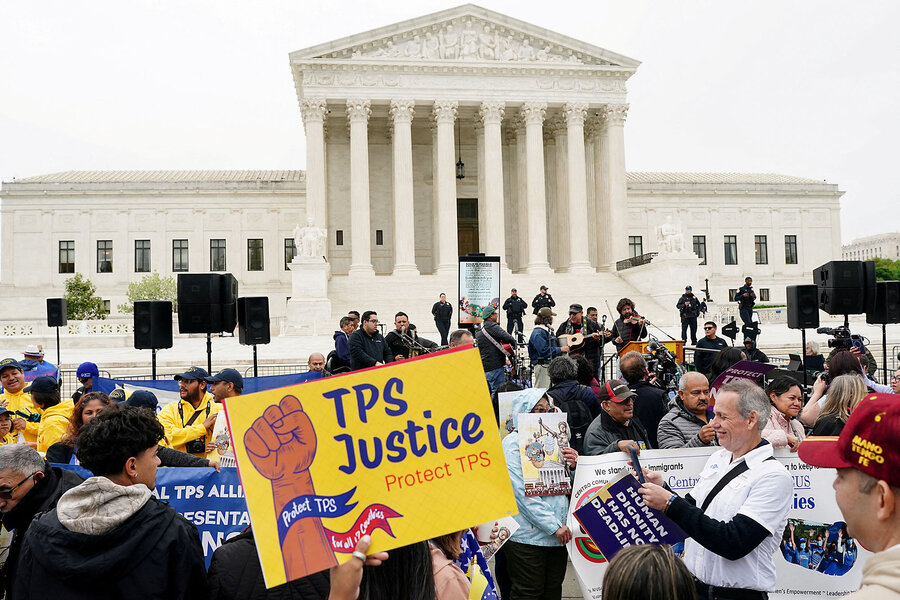
The U.S. Supreme Court upheld two restrictive immigration policies on Thursday, delivering notable victories for the Trump administration on one of its key priorities.
The court’s decisions in the cases affirmed the administration’s broad power to restrict immigration both at the border and in the interior of the country. In Mullin v. Al Otro Lado, the court upheld a policy allowing U.S. border agents to block immigrants on the Mexican side of the U.S.-Mexico border from seeking asylum on U.S. soil. In Mullin v. Doe, the court upheld the administration’s decision to revoke a humanitarian policy known as temporary protected status (TPS) from hundreds of thousands of Syrian and Haitian immigrants who now may face deportation to their unstable homelands.
The high court ruled 6-3 in both cases, with the justices dividing along ideological lines.
Why We Wrote This
In a pair of immigration rulings Thursday, the court held that the law permits the government to turn away asylum-seekers on the Mexico side of the U.S. border and end temporary protected status for Haitians and Syrians living in the United States.
The rulings represent an “expansion of the administration’s larger plan – to try to both limit protection at the border and increase the deportable population in the interior,” says Colleen Putzel-Kavanaugh, an associate policy analyst at the Migration Policy Institute. Moving forward, she says, these court wins raise enforcement questions around whether the government will focus on targeted arrests of those losing their TPS, and how officials may try to “meter” immigrants at border ports of entry when relatively few people are arriving now.
In both cases, the majority of justices focused on the “plain language” of the relevant immigration law, while affirming the court’s long-held deference to the White House on immigration and national security matters.
“Metering” at the border
The asylum-seeker turnback policy known as “metering” dates back at least to the Obama administration, which used it in 2016 in response to a surge of asylum-seekers at the U.S. southern border. The Trump administration expanded and continued the policy and instructed officers at ports of entry to turn away asylum-seekers before they reached the border.
The immigrant rights group that challenged the policy argued that it violates U.S. immigration law and helped “create a humanitarian crisis in Mexico.” DHS countered that it’s a necessary tool for the president to manage immigration at the southern border with strained resources.
For Justice Samuel Alito, who wrote the majority opinion, the case boiled down to a “straightforward” matter of statutory interpretation. Specifically, federal law holds that an immigrant who “arrives in the United States” may request asylum. The immigrant rights groups argued – and a federal appeals court agreed – that an immigrant can request asylum if they “present” themselves to an official at the border.
“In ordinary speech, no one would say that a person ‘arrives in’ a place – for example, a house, a city, or a country – before the person enters that place,” wrote Justice Alito. He also noted that the metering policy continued into the Biden administration, which rescinded the policy in 2021.
In a dissent, Justice Sonia Sotomayor – joined by Justices Elena Kagan and Ketanji Brown Jackson – described the majority opinion as “illogical.”
“It is natural to say that asylum seekers are arriving, i.e., reaching their destination, when they come to the threshold of a port of entry,” Justice Sotomayor wrote.
The immigrant rights groups warned that upholding metering would encourage more immigrants to enter the U.S. illegally. Justice Alito described that concern as “overstated.”
Furthermore, the “wisdom of the policy of metering alien arrivals at the southern border is not before us,” he added. “We decide only that an alien standing in Mexico does not ‘arriv[e] in the United States.’”
DHS praised the court’s decision, without commenting on whether or how the metering practice would be reinstated. In court documents, government lawyers had said the Trump administration wanted metering as an available policy option.
“We have yet AGAIN been vindicated by the Supreme Court,” said James Percival, the DHS general counsel, in a statement. “This decision opens up an important tool to continue securing our southern border.”
Protected status in the interior
Thursday’s Mullin v. Doe ruling relates to the TPS program. Created by Congress in 1990, the program authorizes certain foreign nationals to live and work lawfully in the U.S. if DHS deems it unsafe for them to return to their home countries.
Reasons for protected status range from natural disasters to armed conflict. Critics of the program – including Trump administration officials – argue that it has effectively ceased to be temporary. DHS reviews each TPS designation at least 60 days before its expiry, and some designations have been extended for years (or, in the case of El Salvador and Honduras, decades).
In this case, the high court upheld the Trump administration’s decision to revoke TPS for hundreds of thousands of Haitians and Syrians living and working in the U.S, ruling that courts cannot second-guess the decisions of the DHS secretary on TPS. Those decisions “are not subject to judicial review,” wrote Justice Alito in the majority opinion.
The court also dismissed a constitutional claim from the Haitian immigrants, who argued the rescission of their protected status was motivated by race. That claim, Justice Alito wrote, “is unlikely to succeed.”
In their briefs, the Haitian immigrants pointed to statements from Trump officials – and President Donald Trump himself – denigrating Haitians. Mr. Trump falsely claimed that Haitian immigrants in an Ohio town were eating household pets. In a social media post days after announcing that she would be terminating protected status for Haitians, then-DHS Secretary Kristi Noem described immigrants from certain countries as “killers, leeches, and entitlement junkies.” The post likely referred to Haitian immigrants, a federal judge ruled in February.
The Haitian immigrants “seek to capitalize on the statements’ heated language,” wrote Justice Alito in Thursday’s decision. “But whatever one may think of the cited statements, they are insufficient to show that the termination of Haiti’s TPS designation was based on the race of the Haitian people.”
Justice Alito pointed to what he called a “strong, race-neutral explanation” for ending the designation for Haitians. Namely, he wrote, “the current administration, which has terminated every TPS designation that has come up for renewal, simply opposes the TPS program, at least as it has been implemented in the past.”
The capital of Haiti is currently controlled largely by armed gangs, with a central government effectively nonexistent since 2021. Syria experienced a devastating civil war from 2011 to 2024, and the country is still slowly recovering. The State Department currently advises U.S. citizens not to travel to Syria or to Haiti.
The Trump administration also celebrated this ruling. In his statement, Mr. Percival described the decision as “a win for the rule of law and common sense.”
“The T in TPS stands for TEMPORARY, yet many of these designations became de facto amnesty,” he said.
The court’s ruling is a “significant departure from a decades-long history of extending a humanitarian relief,” said Melissa Keaney, the legal director at Muslim Advocates, an organization involved in the litigation, on a press call.
“We’ll continue to harness whatever legal tools available to us to fight for our clients’ right to remain in the United States in safety and with dignity,” she added. “We also call on Congress to immediately restore these vital humanitarian protections that the TPS program represents.”