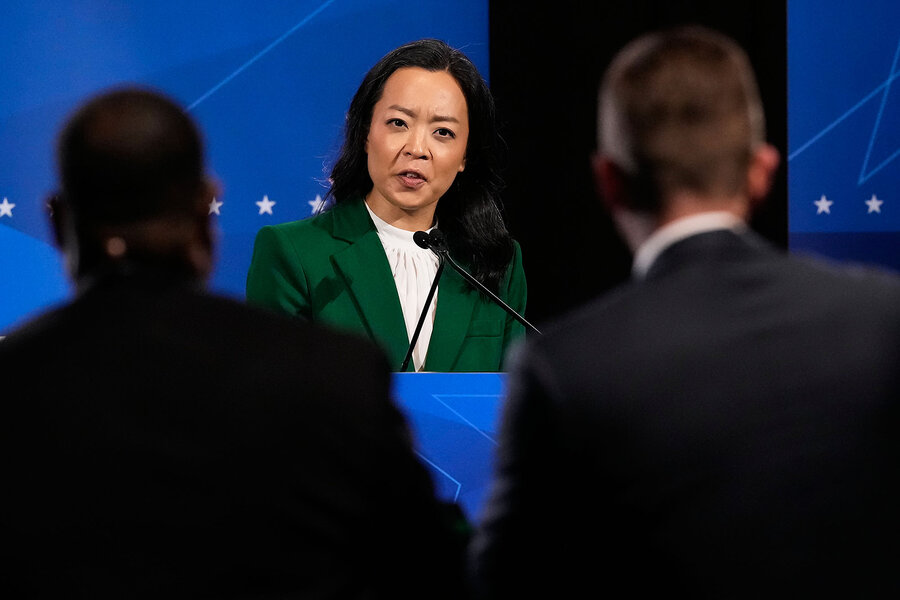
After more than 15 years of Republican legislative dominance, Democrats in Wisconsin see a path to win unified control of their state government. That path to a trifecta runs through redrawn electoral districts, GOP lawmaker retirements, and voter dissatisfaction with Republican rule in Washington.
But can Democrats win a clean sweep with a socialist at the top of the ticket?
That’s the big question in this crucial bellwether state, where statewide margins are razor-thin, and voters have chosen the winning president in the last five elections. Francesa Hong, a state lawmaker and member of the Democratic Socialists of America, is seeking the Democratic nomination for governor in an Aug. 11 primary. And in a crowded race, she is the clear front-runner, thrusting Wisconsin into the national conversation about how much left-wing populism is too much for Democrats.
Why We Wrote This
Wisconsin, a political bellwether, might see a Democratic takeover after 15 years of Republican rule. But having a socialist at the top of the ticket raises questions for some voters.
A primary victory for Ms. Hong would be an “epic test” for the electoral clout of the Democratic Socialists of America, or DSA, says Anthony Chergosky, a politics professor at the University of Wisconsin-La Crosse. “They can win all of the blue districts they want, but to be a truly viable political movement, they need to win over purple states and purple districts.”
The viability of progressive candidates in the Midwest will also be tested on Tuesday in Michigan, where establishment-backed Rep. Haley Stevens is narrowly ahead in polling against left-wing insurgent Abdul El-Sayed in the Democratic primary for the U.S. Senate.
In Wisconsin, several Democrats jumped in to replace two-term Democratic Gov. Tony Evers. One, current Lt. Gov. Sara Rodriguez, dropped out on July 17 after her campaign was found to have mishandled funds. Within days, another candidate – David Crowley, the executive of Milwaukee County, who had suspended his run and later endorsed Ms. Rodriguez – decided to reenter the race with Mr. Evers’ backing. He’s now the main center-left challenger after former Lt. Gov. Mandela Barnes ended his campaign last week. A former state administrator and a state senator are still on the ballot. The winner will likely face Republican Tom Tiffany, a former House member.
Amid this churn, Ms. Hong has led in virtually every poll, though in a late-July survey by Marquette University Law School, 34% of Democrats were still undecided. Unless the race consolidates, she could win with a quarter of the vote, says Dennis McBride, the mayor of Wauwatosa, a Milwaukee-area Democratic stronghold. He has endorsed Mr. Crowley, but he understands why establishment candidates are struggling. “This is an angry electorate. People are angry” at the status quo, he says.
Ms. Hong insists she can win the primary and the governorship by offering voters a bold policy platform. She wants to introduce free childcare, a $20 minimum wage, and publicly run grocery stores. In an interview at her campaign headquarters in Madison, the state capital, she says voters want a government that serves “working-class people first” and uproots a “rigged economy.” She adds, “Many people right now do not want politics as usual.”
Shifts in policies, maps, and views
A left-wing governor would be a sharp break with the pragmatism of Mr. Evers, a plainspoken former educator who has often been at loggerheads with Republicans in the legislature. He succeeded Scott Walker, a Republican who swept to victory amid a GOP wave in 2010 and enacted major changes to labor laws that set off a political crisis for Democrats. Under Mr. Walker, Wisconsin became a petri dish for conservative policymakers.
Mr. Walker’s deregulatory agenda was undergirded by highly partisan maps that Republicans drew to entrench their lock on the legislature. Democrats have spent more than a decade trying to change these maps and rebuild the state party. After a string of expensive state Supreme Court elections, the court’s liberal majority forced Republican lawmakers to adopt more neutral maps that now give Democrats a shot at turning Wisconsin a bluer shade of purple in November.
Republicans have voted with their feet: One in five GOP lawmakers is retiring this year, including Robin Vos, the Assembly speaker, and Devin LeMahieu, the majority leader in the Senate. No Democrat is stepping down except to run for another office.

This is the backdrop to the hand-wringing over Ms. Hong’s candidacy, says Joe Zepecki, a Milwaukee-based Democratic strategist who isn’t working for any of the candidates. “Democrats feel a ton of pressure to get it right this fall. We’re not just talking about the governorship. We’re talking about the first chance to win a trifecta” since the Walker era, he says.
He understands the panic within the party over Ms. Hong and the scrutiny she would face as the nominee, though he believes she can still win in November. “I believe there is a cap on her support and any DSA candidate in a race here. But what that cap is, we don’t know,” he says.
A working-class agenda
Ms. Hong is the daughter of South Korean immigrants and is the first Asian American lawmaker ever elected to the Wisconsin legislature. She dropped out of college to work in restaurants and later co-owned a ramen restaurant in Madison that closed in 2024, leaving her with debts that she’s still paying off. Her experience in the hospitality industry – she still works occasional bartending shifts – is similar to that of Rep. Alexandria Ocasio-Cortez of New York, a fellow democratic socialist and millennial.
In her deep-blue district in Madison, Ms. Hong is known as a restaurateur as well as a lawmaker, and she leans into her work experience and life as a single parent to present her policies as a working-class agenda. She also harks back to Wisconsin’s history of electing left-wing leaders who focused on hands-on governance. “We are the state where ‘sewer socialism’ was born,” she says.
Polls suggest Wisconsin might not be primed for a socialist revival: More than half of registered voters expressed an unfavorable view of democratic socialists in the July Marquette Law School survey. Seeking a favorable midterm matchup, a Republican group has run TV ads that call Ms. Hong “too liberal for Wisconsin,” a backhanded way to boost her chances.
Asked about the GOP-funded ads, Ms. Hong smiles. “If they want to elevate the work that I’ve done and put money towards that, I think that is a losing strategy for them,” she says.
The TV ads, which aired in Madison and Milwaukee, highlight Ms. Hong’s opposition to the Trump administration’s deportations of migrants and to state cooperation with Immigration and Customs Enforcement. The narrator says her policies “will weaken public safety and make us less safe.”
Democrats fret that Ms. Hong’s past calls for defunding and even abolishing police and prisons would sink her in a general election. She says her platform is to invest in services that make communities safer and focus on the root causes of crime; abolishment is an end goal, not a first step. “We need to be serious about safety. We have not funded the things that are proven to prevent crime, lower crime, and bring resources to victims,” she says. (In a televised debate last week, she said as governor she wouldn’t sign a bill to cut police funding.)
Just hours before the Monitor interviewed Ms. Hong in Madison, a man was shot and killed by police a few blocks from her office. Bystander videos showed the man, who had allegedly tried to break into cars in the neighborhood and was carrying a knife, surrounded by four city police officers and lying on the ground before one officer fired at his prone body. The officers have since been put on leave while a state agency investigates the shooting.

Near the scene, dozens of protesters gathered behind police tape and chanted the name of the slain man, Corey Ruiz. Some yelled, “murderers” at a row of stony-faced officers. A chant went up, “Defund the police!”
Ms. Hong later addressed a group of demonstrators. “This state-sanctioned violence was an execution,” she said. “We no longer can have a system that protects a power and a privilege that puts the pain and lives of armed officers over Black people.”
What do Wisconsinites want?
Ms. Hong’s left-wing politics resonate with some Wisconsinites. “A lot of the time it feels like the Democrats are just Republican-lite,” complains Dan O’Dwyer, who plans to vote for Ms. Hong on Aug. 11. “I believe in a lot of socialist ideals, such as free healthcare, such as a universal wage or leave for medical things such as childbirth. … I think she would help people across the board.”
On a recent afternoon, Mr. O’Dwyer was selling bathroom fittings at the annual Washington County Fair in West Bend, north of Milwaukee, where he lives. His booth was next to that of the Washington County Democratic Party, which is a minority affiliation in a mostly Republican county, one of three that ring Milwaukee and provide the ballast for statewide GOP candidates.
Among Democrats at the fair, there was trepidation over the primary and what could happen in November. Some appeared unsure about the choices on the ballot, though Ms. Hong’s proposal for a one-year pause on building data centers struck a chord. Others said they were waiting to see whether the race produces a mainstream front-runner who can unite the party.
Ms. Hong is “who I would like to vote for,” says Brian Bunzel. “I’m more liberal than she is.” But Mr. Brunzel, a carpenter and a Democratic volunteer, said he worried that she was too liberal for Wisconsin and an easy target for Mr. Tiffany, so he would cast a “pragmatic” ballot.
“I vote for a person who can beat the Republican candidates. … I’ve never been able to vote for who I want. It’s just who is the best one,” he says.