With the United States and Iran ramping up attacks and counterattacks against each other this week, the ceasefire now seems defunct in all but name. Indeed, the question for many is not whether the two nations are back at war – but when this war will ever end.
While Iran and the U.S. on June 17 signed a memorandum of understanding that ostensibly halted hostilities for 60 days, the U.S. military has, in the weeks since, carried out hundreds of strikes on the country at President Donald Trump’s direction.
Iran has retaliated. After the regime once again attacked ships transiting the Strait of Hormuz last week, President Trump raised the possibility of officially resuming the conflict. “I think it’s over,” he said of the ceasefire. Hours later he walked back this statement, saying negotiations could continue.
Why We Wrote This
The U.S.-Iran conflict has moved from a faltering ceasefire into what looks like renewed but limited war – with few signs of a clear end point. The American public shows little appetite for escalating the conflict to press for concessions from Iran.
Confusion over the war’s status stems from gaps in America’s political rhetoric, legal definitions of armed conflict, and the reality of U.S. military operations, which have continued apace despite the ceasefire.
In a primetime speech Thursday focused around election security, Mr. Trump mentioned the war briefly. America is “winning big in Iran,” he said.
“You will see the fruits of that labor very, very shortly,” he added.
What has been happening lately?
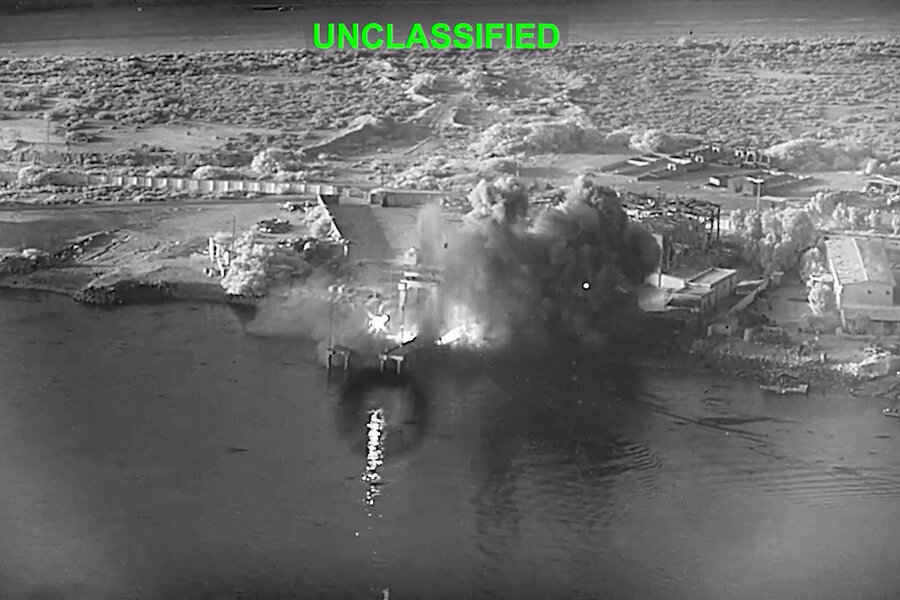
At the direction of President Trump, the U.S. military has been striking hundreds of targets in Iran on consecutive nights this week, an effort to “hold Iran accountable” for attacks on “innocent mariners” and commercial ships in a key international waterway, according to statements from U.S. Central Command, which runs Pentagon operations in the Middle East.
Iran has retaliated by hitting back at countries hosting U.S. military bases in the region, including the Gulf states of Bahrain, Kuwait, and Qatar.
The U.S. on Tuesday reimposed its naval blockade on Iranian ports and coastal areas along the strait. A blockade is in itself an act of war, analysts note.

Majid Asgaripour/WANA/Reuters
President Trump also said earlier this week that he planned to charge a 20% fee that he described as a “reimbursement” for providing security for commercial ships in the strait.
By Wednesday he had backtracked, saying he would instead replace this fee with trade agreements in which Gulf states would make “massive” investments in the United States.
Mr. Trump on Thursday praised Iran for releasing an Iranian-American aid worker who had been accused of espionage and detained since December, 2024. It was a gesture of “goodwill,” he said. It was also a potential diplomatic off-ramp for the conflict that, analysts noted, the White House didn’t take.
What does Congress say about the conflict?
Lawmakers in June passed – with bipartisan support in both the House and the Senate – what is known as a “war termination resolution” directing the White House to halt U.S. military operations against Iran.
That marked the first time Congress invoked this clause to force an administration to stop a conflict in the 53-year history of the War Powers Resolution.
Though the Constitution gives Congress the power to declare war, lawmakers haven’t used it since World War II. They passed the 1973 War Powers Resolution in the wake of the wars in Korea and Vietnam, when many on Capitol Hill believed presidents had accumulated too much power to send troops into harm’s way without formal declarations.
The 1973 resolution requires the president to notify Congress within 48 hours of sending U.S. forces into hostilities, which then starts a 60-day clock. Unless Congress authorizes action or extends the deadline, the president is expected to end the use of force after those 60 days.
Presidents of both parties have argued that the War Powers Resolution is an unconstitutional limit on the president’s constitutional powers as commander in chief of the U.S. military.
The war termination resolution last month was one of the strongest bipartisan rebukes of a president’s use of military force in decades, but what it means in legal terms is less clear. Though supporters say the resolution is legally binding, the administration has argued it is not and has continued military operations.
Historically, most presidents have complied with the War Powers Resolution’s reporting requirements without conceding its constitutionality.
This is what Mr. Trump did last Friday, when he gave Congress notice that the administration had relaunched hostilities against Iran. As the ceasefire falters, it was a calculated step, analysts say, to restart the 60-day clock once again.
“The president is saying, ‘Oh, it’s not war,’ but he’s also reporting it under the War Powers Resolution,” says Katherine Yon Ebright, counsel in the Liberty and National Security Program at New York University School of Law’s Brennan Center for Justice. “We just haven’t seen anything that actually concludes hostilities in a durable way that gives us peace.”
Will the war ever end?
U.S. officials, for legal reasons and public palatability, tend to prefer terms like “limited strikes,” “operations,” “hostilities,” or “self-defense” rather than calling these military actions “war.”
That said, “It’s definitely war,” says retired Col. Peter Mansoor, former executive officer to Gen. David Petraeus during the Iraq War and now professor of military history at Ohio State University.
At the moment, it’s a limited war – with few signs of a clear end point. “Though we have all the forces available to end it, it’ll just sort of go on indefinitely,” Professor Mansoor predicts.

The U.S. doesn’t have conscription, and so far the number of casualties, at 14 U.S. service members killed and more than 400 wounded, have remained low enough that the war hasn’t caused a large public outcry, says Monica Duffy Toft, director of the Center for Strategic Studies at Tufts University’s Fletcher School. Surveys show voters are unhappy about higher gas prices, but for now it’s a cost that the administration appears prepared to pay, she adds.
To end what has become a stalemate of sorts, the administration could escalate and “double down” in conducting full-scale military operations, Professor Mansoor says. But that option would probably be expensive, unpopular with Americans, and further deplete critical U.S. military munitions.
The original aim of heading off a nuclear Iran has been eclipsed by concern over the closing of the economically vital Strait of Hormuz.
Perhaps the administration could have made a case for a broader war early on, but it “didn’t come before the American people, they didn’t explain why they were going to war, they got no vote,” Professor Mansoor says. Overthrowing the regime “would take basically marching to Tehran” and forcing the Islamic Revolutionary Guard Corps to cede power while Congress gets “increasingly jittery,” he adds.
That said, the administration is reportedly considering expanding its war in Iran anyway, including options that range from stepping up airstrikes to sending in ground forces.
“Iran has demonstrated that it can absorb a lot of pain,” but the administration is hoping that stepped-up U.S. military strikes will ultimately force the regime to yield, Dr. Toft says.
In the meantime, “This could linger on for some time,” she adds. “And that, unfortunately, is the nature of war.”