Congress appears to be having a #MeToo, Part 2, moment.
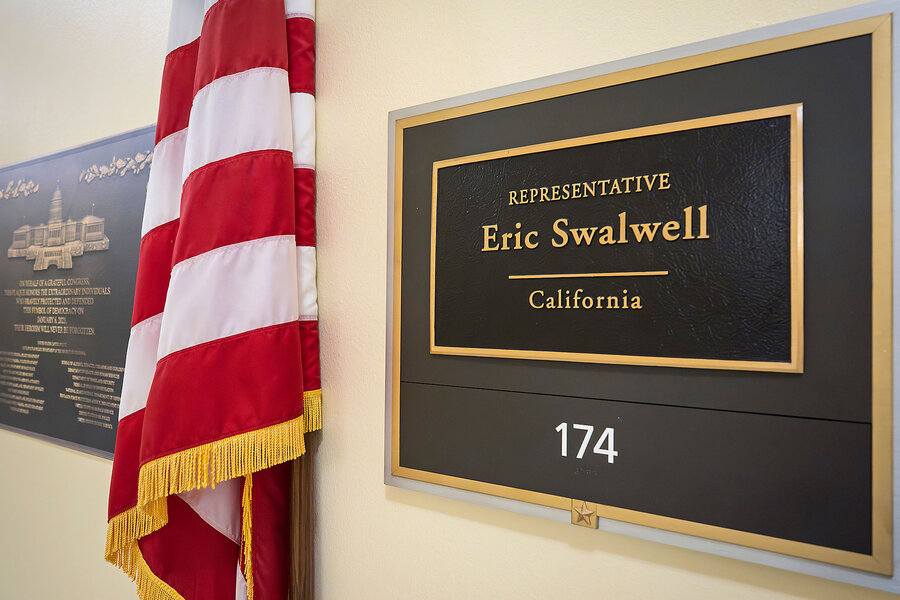
This week, Democratic Rep. Eric Swalwell of California and Republican Rep. Tony Gonzales of Texas announced their resignations from the U.S. House of Representatives ahead of expected expulsion votes.
Both men face serious allegations of sexual misconduct. Notably, each also faced a chorus of calls from colleagues on both sides of the aisle to step down.
Why We Wrote This
Fallout from the Epstein scandal and a changing media environment might be contributing to a new push for sunlight and accountability on Capitol Hill. This week’s unusual resignations could be followed by even more.
The outcry highlights a new push for accountability on Capitol Hill, driven in part by fallout from the Epstein scandal and a media environment in which allegations can spread faster than ever online. To some extent, it’s part of a growing “callout” culture, with lawmakers increasingly censuring one another as a new weapon in partisan politics.
But it also suggests a changing landscape for politicians, as well as for women speaking out about abuses by powerful men, some 10 years after the #MeToo movement first exploded across America – even as survivors of the late sex offender and financier Jeffrey Epstein’s crimes say they still haven’t seen justice.
“What’s unusual is that [the resignations are] actually happening, where there have been ethical lapses in the past and allegations in the past – and excuses have been made,” says Jennifer Lawless, a politics professor at the University of Virginia and co-author of “Women on the Run: Gender, Media, and Political Campaigns in a Polarized Era.”
Representative Swalwell, who suspended his campaign for California governor over the weekend after two outlets published accusations of sexual assault by a former staffer and other women came forward with stories of sexual harassment, said he plans to resign his seat. In a statement, he denied the most serious allegations but also apologized for “mistakes in judgment.” Representative Gonzales, who has admitted to an extramarital affair with a staffer who later died by suicide and who has faced other accusations of sexual misconduct, said he will file his retirement from Congress on Tuesday.
On Tuesday, another woman gave a press conference accusing Mr. Swalwell of sexual assault. Her attorney said they planned to file a police report with the Los Angeles County Sheriff’s Department.
Two other House members, both from Florida, are also facing calls to resign and potential expulsion votes, though the accusations against them do not involve sexual misconduct. Republican Rep. Cory Mills faces accusations ranging from domestic violence to stolen valor, and Democratic Rep. Sheila Cherfilus-McCormick faces federal charges for allegedly stealing $5 million in pandemic relief funds that she used to support her campaign. House Speaker Mike Johnson told reporters Tuesday he believed Representative Cherfilus-McCormick should be expelled.
The House Ethics Committee has opened investigations into all four members. An Ethics subcommittee has already found Representative Cherfilus-McCormick guilty of multiple violations, and the full committee is expected to determine next week what consequences it will recommend.
The Epstein effect
Several members who have been most vocal in calling for these lawmakers to resign or be expelled – like Democratic Rep. Ro Khanna and Republican Rep. Anna Paulina Luna – were also outspoken in demanding the release of files related to Mr. Epstein. The steady drip of information from those released files, detailing many public figures’ connections with Mr. Epstein, has ignited a firestorm of public anger and mistrust.
Former Republican Rep. Marjorie Taylor Greene drew a direct line between the resignations in Congress and the upheaval caused by the Epstein files, arguing that much more still needs to change.
“Both Congressmen [who resigned] were linked to Jeffrey Epstein type sexual issues,” she wrote in a post on the social platform X. “To this day, no one in the Epstein files has been prosecuted. And Congress is still a cesspool.”
Indeed, some observers say that fallout from the Epstein scandal is a factor in why so many lawmakers have supported consequences for these members.
“I think the Epstein stuff is probably creating more pressure on people not to let bad behavior go unaddressed,” says Michael Gerhardt, a professor at the University of North Carolina at Chapel Hill with expertise in legal ethics.
The fact that the members of Congress currently facing calls for expulsion are divided evenly between Republicans and Democrats has also made it easier for lawmakers to take a stand. This week’s departures will not change the balance of power in the House.
Allegations about Mr. Gonzales surfaced months ago, leading him to end his reelection campaign in March. But with House Republicans holding an exceedingly slim majority, Speaker Johnson showed little inclination to push him to an early exit. That calculation changed when information began to come out about Mr. Swalwell, as he campaigned for California governor, leading to calls for his removal.
“If Gonzales would have resigned four or five days ago [before Representative Swalwell resigned], I don’t know what the Democrats would have done,” says Dr. Lawless.
Political calculations
Historically, it’s very rare for Congress to expel one of its members. The process requires a two-thirds vote in the House or Senate, all but ensuring bipartisan agreement. Only six members have ever been expelled, with the most recent being former New York Republican Rep. George Santos in 2023.
Prior to this week’s resignations, Representative Luna had planned to file a motion to expel Mr. Swalwell, while Democratic Rep. Teresa Leger Fernández was leading an effort to expel Mr. Gonzales.
Richard Painter, who served as chief ethics lawyer to former President George W. Bush, says the rare discussion that took place about expelling four members at once raises difficult questions about balancing Congress’ authority to police itself with the will of the voters who elected those members into office.
“When you start expelling members because you say their conduct is unfit, that can dramatically change the outcome of the electoral process and what the Constitution intends,” he says. “And so I think there needs to be a very high bar for that.” With regards to Representatives Swalwell and Gonzales, Mr. Painter says he believes that bar has been met.
Some congressional experts note that members seem to be increasingly taking it upon themselves to call out their colleagues’ misbehavior – particularly those of the opposing party.
Last November, at least four different members from both parties introduced resolutions to censure other members over the course of one week. A censure resolution is a symbolic measure to formally condemn a member for misconduct. Some of these members’ colleagues became so frustrated with these votes taking up floor time that they tried to pass a law to raise the bar to censure someone.
According to Professor Gerhardt, tribal politics and a “tit-for-tat” culture in Congress has fed into the latest momentum around censorship and expulsion.
“People are trying to outdo each other in terms of what kind of harm they could do to each other,” he says. “With that kind of mentality already set up in the House, then when you get information that feeds it, it gets extremely intense and we have the circumstance we’ve got now.”