

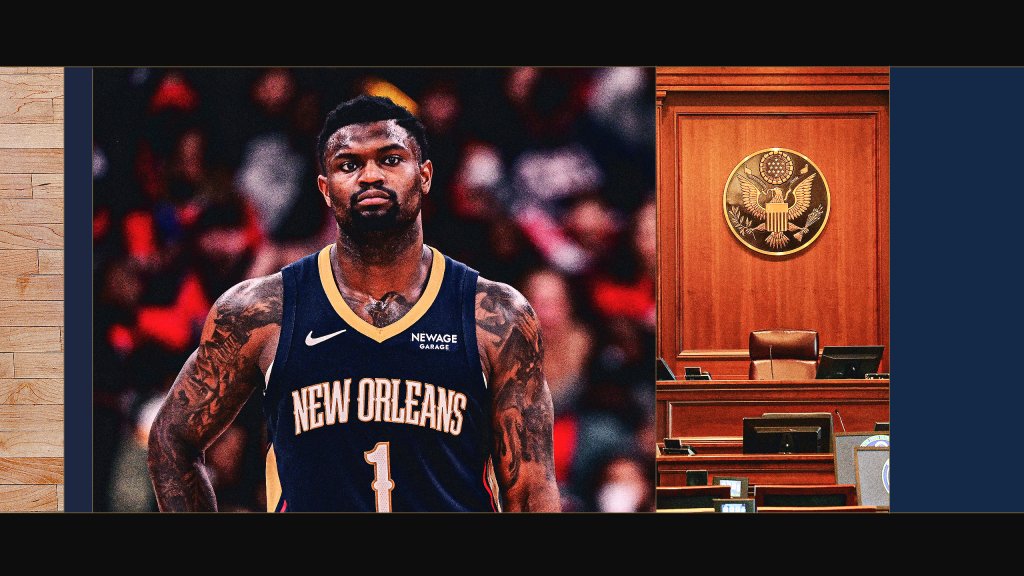
Zion Williamson’s former marketing agent, Gina Ford of Prime Sports Marketing, contends in a new filing that a trial judge wrongly ordered her to pay Williamson nearly $700,000 in attorneys’ fees after the New Orleans Pelicans star defeated Ford in a $100 million lawsuit.
“This court,” Ford’s attorney, Douglas Eaton, wrote to the U.S. Court of Appeals for the 4th Circuit last week, “should correct this injustice by quashing the Fee Order, and allowing Ford to go hence without day, defeated but not financially devastated.”
Eaton added that, in Ford’s view, “Williamson was the bad actor here” and “was fortunate that he was able to avoid any consequences for his actions due to a technicality that was designed to protect actual student athletes, not No. 1 NBA draft picks.”
The legal battle between Williamson and Ford goes back to April 2019, when the 18-year-old Williamson had finished his freshman season at Duke and declared for the 2019 NBA Draft, for which he was the presumptive first overall pick. At 18, Williamson was just old enough under North Carolina law to sign an enforceable contract.
Williamson and Prime Sports signed a five-year marketing representation contract, covering endorsement and sponsorship deals and designating Ford as Williamson’s exclusive representative for those types of deals. Williamson was one of the most celebrated and high-profile NBA prospects, and he was expected to earn considerable endorsement money.
Ford acted as Williamson’s marketing agent for only about six weeks before he fired her and signed with Creative Artists Agency, which he had retained as his player agency. But Ford insists she performed significant services during that time, including creating a detailed marketing plan with endorsement opportunities.
Court records also indicate that Ford negotiated on Williamson’s behalf with several major brands, including Puma, Activision, EA Sports, 2K Sports, General Mills, Chase Bank, Mercedes-Benz and HarperCollins. Ford also argues that Williamson unlawfully shared her plan with CAA.
Two features of the contract Williamson signed with Prime Sports and Ford attracted legal attention. The first was that it could only be terminated “for cause,” meaning a serious mistake. If Williamson couldn’t show such a mistake, his firing of Ford would constitute a breach of contract and expose him to potential monetary damages, including a 15% agency commission on deals over the five-year contract term. Ford has argued that damages exceed $100 million.
The second feature was an omission. The North Carolina Uniform Athlete Agents Act requires contracts with student-athletes to contain a warning that the player would lose NCAA eligibility by signing. The Williamson-Prime contract didn’t contain that warning. A district court judge and the 4th Circuit held that the omission allowed Williamson to void the contract, meaning he won the case. Compounding Ford’s problems was that she wasn’t registered as an athlete agent in North Carolina, a deficiency that also rendered the contract void.
The core question in Ford’s latest filing is whether she should have to pay Williamson’s legal bills.
The general rule in U.S. civil litigation is each party pays its own attorneys’ fees. However, statutes sometimes allow courts to shift fees to the losing party. In North Carolina, a judge can award fees when there is a “complete absence of a justiciable issue” of law or fact raised by the losing party. That’s true when a party won’t give up litigating even when it’s clear there’s no viable case.
In March, U.S. District Judge Loretta Biggs ruled Ford and Prime must pay Williamson $685,748 in attorneys’ fees, less than half of the $1.49 million Williamson sought.
Biggs reasoned Ford should have known her failure to include the student-athlete eligibility warning put her in the wrong. Biggs identified other flaws in Ford’s case, including that Ford keep pursuing claims even after the court put her on notice of serious problems; Williamson didn’t have to disclose that he was in touch with CAA; and while information about possible endorsement deals might be valuable, it doesn’t qualify for trade-secret protection.
Ford concedes that the 4th Circuit sided with Williamson, but she hopes the appellate court finds she presented a defensible viewpoint on how North Carolina law applied to a unique scenario: a contract signed by a presumptive first overall NBA pick who, though enrolled at Duke at the time, wasn’t returning for his sophomore year, making his student-athlete status arguably irrelevant.
Remember, 2019 was before NIL and revenue sharing. Nowadays, a star college player of Williamson’s prominence could earn millions of dollars. That wasn’t true in 2019, when NCAA rules meant players would lose eligibility if they signed endorsement deals. Although Williamson technically could have declared for the NBA draft, withdrawn (perhaps because he didn’t want to play for the team that landed the first overall pick) and returned to the Blue Devils for the 2019–20 college season, the odds of that happening were extremely slim. NBA stars have an incentive to begin their pro careers sooner rather than later, since they can become eligible for maximum contracts and free agency earlier in their careers, before their prime ends.
But technicalities matter in law, and the judges who have reviewed the litigation found Williamson’s arguments more persuasive, because the contract didn’t contain the warning.
“This was not a frivolous lawsuit,” Eaton wrote. “Ford advanced good faith, meritorious legal and factual arguments. She simply did not prevail on them.”
Eaton also described judges “grappling” with atypical issues and noted NCAA eligibility issues are hardly clear-cut. To that end, Eaton cites ongoing litigation involving college athletes and former college athletes seeking to extend their collegiate careers, with conflicting court decisions, as evidence the topic raises debatable interpretations of the law.
Attorneys for Williamson will try to rebut Ford’s arguments. Williamson is represented by several law firms, including Weil & Gotshal, which is in the process of winding down.






Leave a Reply