
TL;DR — Key Takeaways
- Debian rejected both an outright AI ban and a hands-off approach, instead holding contributors responsible for everything they submit.
- AI-assisted work must be reviewed, tested and corrected by a human, while sensitive data and credentials cannot be shared with third-party AI services without authorization.
- The policy offers enterprises a practical model: govern risky behavior around AI rather than trying to detect or prohibit the tools themselves.
Most organizations writing AI usage policies right now are stuck between two bad options: ban the tools and watch people use them anyway, or say nothing and hope code review catches whatever slips through. Debian just spent two weeks working through that exact problem in public, and the way the vote landed is worth paying attention to, whether you maintain a package archive or a private repo.
The Debian Project ran a General Resolution from August 15 through August 28, asking developers to settle the community’s stance on AI-assisted contributions. Eight separate proposals were on the ballot, ranging from an outright ban written into Debian’s Social Contract to a hands-off position treating AI tools like any other developer choice. Debian used the Condorcet method for the vote, meaning developers ranked their preferences rather than picking a single option, and just over 130 of roughly 1,000 eligible developers cast ballots.
The ban needed a three-to-one supermajority to pass, since it would have amended the Social Contract itself. It didn’t come close. Instead, developers settled on an approach that neither endorses nor prohibits the use of generative AI in Debian’s development process. Project Secretary Kurt Roeckx announced the outcome once the vote closed.
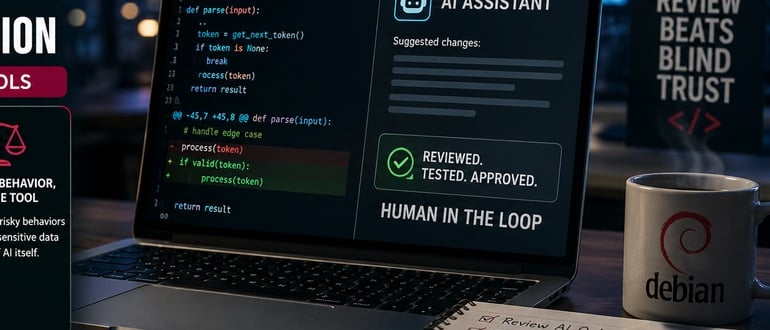
The policy that won is notable for what it doesn’t do. It doesn’t require anyone to disclose that they used an LLM to draft a changelog, debug a build script, or triage a bug report. Disclosure is encouraged, not mandated. What the policy does instead is put the obligation on the human in the loop. Contributors have to review, test, and fix model output before it goes anywhere near the archive. “Blindly accepting or uploading AI-generated material without appropriate human review” is treated as a violation of normal Debian practice, full stop, regardless of whether the contributor labels it as AI-assisted.
Three specific guardrails came with it. Confidential material, private communications, embargoed security bugs, cryptographic keys, and credentials can’t go to a third-party AI service without explicit authorization. Bulk automated contributions, like mass bug filing or large-scale patch sweeps, require upfront discussion and someone accountable for the results. And Debian is staying out of the copyrightability question entirely; existing licensing rules apply to AI-touched contributions exactly as they do to everything else.
That credentials clause isn’t hypothetical caution. Researchers tracked 28.65 million hardcoded secrets leaked in public GitHub commits in 2025, with leaked AI service credentials up 81% year over year. A project the size of Debian pasting embargoed vulnerability details into a third-party AI service isn’t a rules violation waiting to happen; it’s a leak waiting to happen.
Mitch Ashley, VP and practice lead for software lifecycle engineering and AI-native software engineering at The Futurum Group, sees a harder problem sitting underneath that requirement. Putting the obligation on the reviewer is the right call, but reviewers are the resource Debian has the least of.
“Debian put the obligation on the reviewer, the right place for it, and this is the component that runs out of capacity first,” Ashley said. “Review was already scarce in a volunteer project where roughly 130 of a thousand developers voted. AI-assisted contributions do not arrive at volunteer reviewer speed. Every organization borrowing this model inherits the same arithmetic. Policy language is free but reviewer hours are not.”
What makes Debian’s outcome worth watching outside the Linux world is the logic behind it. The project didn’t try to regulate the tool. It regulated behavior around the tool, which is much easier to enforce. Banning LLMs assumes you can detect their use reliably, and you mostly can’t. Requiring disclosure assumes people will self-report accurately, and plenty won’t, especially once AI assistance is baked into the editor rather than something you consciously reach for. Debian’s approach sidesteps both problems by holding contributors to the same standard regardless of how the code was written: you own what you submit, you tested it, and you didn’t leak anything on the way there.
That’s a template DevOps and platform teams should recognize, because it maps onto the problem enterprises are chewing on right now. Most internal AI policies fixate on “did you use AI,” when the more useful question is “did a human review this before it shipped, and did anything sensitive leave the building to get an answer?” But Ashley’s point holds whether the reviewers are volunteers or salaried: writing “humans must review AI output” into a policy doesn’t create the capacity for reviewers to do it. Debian’s vote looks that fact squarely in the face and refuses to pretend that a ban would do the job review already does — even without solving the underlying capacity problem.
The vote doesn’t resolve every open question. Copyright status of AI-assisted contributions remains genuinely unsettled, and Debian punting on it just pushes the ambiguity downstream to anyone redistributing the archive. But as a governance model, “trust the review process, restrict the specific behaviors that actually cause harm” is a more honest starting point than most enterprise AI policies manage, and it’s one other projects and IT organizations will likely borrow from as this debate keeps repeating itself across the industry.
Frequently Asked Questions
Did Debian ban AI-generated code?
No. Debian’s developers chose a policy that neither bans nor explicitly endorses generative AI. Contributors can use AI tools, but they remain accountable for reviewing, testing and fixing anything they submit.
.Does Debian require developers to disclose AI use?
No. Disclosure is encouraged rather than mandatory. The emphasis is on whether the submitted work meets Debian’s existing quality and security standards, regardless of how it was produced.
Why does Debian’s approach matter to DevOps teams?
It shifts governance away from trying to police AI-tool usage and toward enforceable controls such as human review, protection of sensitive information and accountability for automated contributions.












Leave a Reply