
If you spend enough time around marketers these days, it can feel as though advertising has entered an arms race of artificial intelligence.
Brands are testing AI-generated ads, agencies are integrating AI into creative processes, and tech firms promise faster, more targeted and near-instant campaign optimisation. Every conference panel seems to contain at least one prediction that AI will fundamentally reshape the industry.
Martin Sorrell thinks everyone is looking at the wrong thing.
The founder and executive chairman of S4 Capital, who also founded WPP and led the company for 33 years, envisions technology reshaping agencies, media buying, hiring, and the role of chief marketing officers. Throughout a wide-ranging conversation, he argues the advertising industry’s AI journey has only just begun.
“The industry hasn’t really incorporated AI yet,” Sorrell says when asked about the growing number of AI-led marketing campaigns appearing across the world.
“The instances of brands using AI for their campaigns are largely fringe activities, experiments, tests and audits. They’re not fundamental.”
Sorrell challenges the prevailing narrative that AI is already transforming advertising, arguing that current achievements are merely early prototypes and that the industry is vastly underestimating what lies ahead.
“If you think it’s significant, stand by it, because what you’ve seen is totally insignificant,” he says.
To understand why he feels that way, it helps to look at where he believes genuine AI adoption is actually taking place.
Sorrell points to sectors under existential threat. Car makers facing Chinese EV competition, financial services disrupted by fintech, and, to a lesser extent, consumer goods challenged by pricing and geopolitical pressures, are those with the strongest incentives to act quickly.
“The rest of it, it is very slow,” he says.
The irony, according to Sorrell, is that consumers are adapting faster than corporations.
“The simple fact is consumers are adopting AI at scale far faster than companies.”
Large organisations, he says, are slowed by bureaucracy and legacy systems, while entrepreneur-led companies adapt quickly because founders can push change through the organisation without navigating layers of approval.
Forget the AI ad. Fix the workflow.
Sorrell spends little time discussing AI-generated creative, instead repeatedly shifting the focus from industry debates about machines replacing creatives to the less glamorous topic of workflow.
For him, that is where the real story begins.
“AI is not about technology,” he says. “AI is about workflow simplification first.”
Companies often rush to automate existing processes, assuming efficiency will automatically follow. Sorrell believes that approach can make things worse.
“If you automate processes which are inefficient, you compound the inefficiency.”
Organisations should first streamline collaboration, reduce client-agency friction, and clarify decision-making before adopting AI. With these foundations, Sorrell predicts rapid transformation in three key areas.
The first is visualisation and copywriting, where AI can dramatically reduce the time and cost involved in producing creative assets. The second is personalisation powered by first-party data.
He describes it as “Netflix on steroids”.
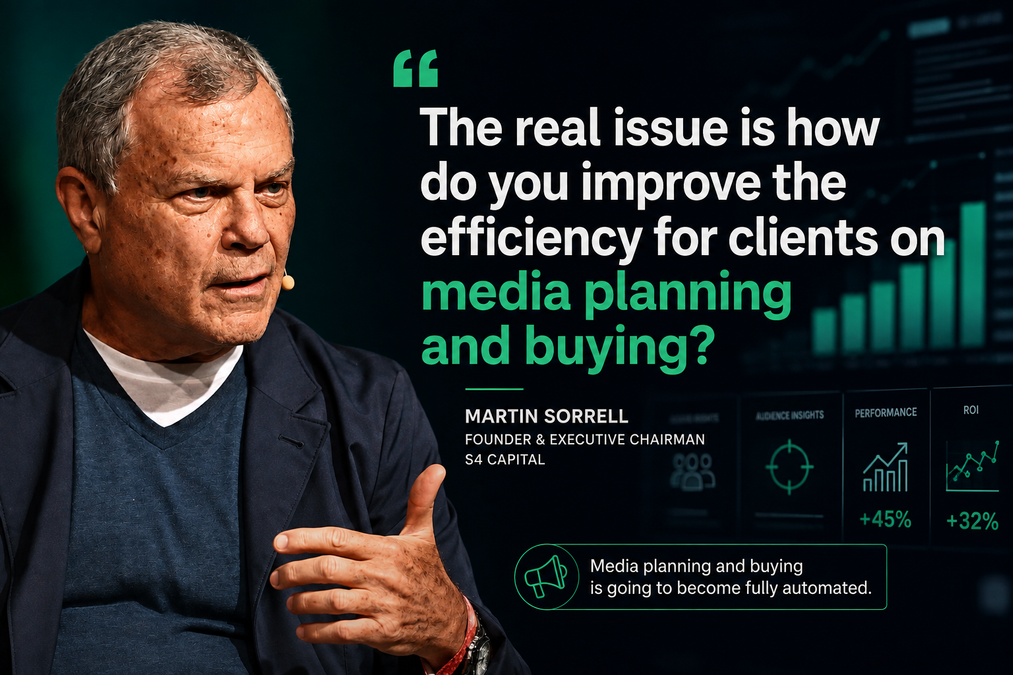
The third, and arguably most consequential, is media planning and buying.
“Media planning and buying is going to become fully automated,” he says.
While the industry focuses on AI-generated visuals, Sorrell emphasises that efficiency, optimisation, and automation will have a greater impact on advertising economics.
Agencies are not disappearing. Their job is changing.
Few questions have haunted agency executives more than whether AI will make them redundant. Sorrell disagrees but says agencies must find new ways to prove their value.
If brands are now capable of conceptualising and creating campaigns from start to finish in-house, where does that leave the traditional brand-agency dynamic.
Rather than viewing in-house teams as competitors, Sorrell sees opportunities in helping clients stay current with rapidly evolving technology and providing access to specialised talent.
“The first is clients find it difficult to keep up to speed on technology,” he says.
The second challenge is attracting and retaining skilled people.
Yet the more interesting part of his argument concerns what agencies actually become in an AI-driven future. For decades, agencies were creators, planners and intermediaries.
Increasingly, Sorrell believes they will become validators. “We’ve become validators of the algorithm,” he says.
As Google, Meta, Amazon and other platforms automate major portions of campaign planning, marketers will still need independent experts to question algorithmic recommendations and ensure they serve the advertiser, not just the platform.
That responsibility, Sorrell argues, creates a future role for agencies even as automation increases.
The real battle is being fought in media
Perhaps the sharpest criticism in the conversation is reserved for the traditional media ecosystem.
Sorrell argues that the industry’s fixation on AI-generated creative misses where the biggest economic disruption is likely to occur.
“The real issue is how do you improve the efficiency for clients on media planning and buying?” he says. He describes the advertising supply chain as a system historically filled with layers of intermediaries.
“There’s a lot of sticky fingers,” he says.
Sorrell believes AI can eliminate inefficiencies by increasing transparency and streamlining decisions. He also questions whether traditional media business models can survive as algorithms reduce friction and increase transparency.
“The problem with the media business is it relies primarily on frictions.”
If friction disappears, many of the economic assumptions underpinning those models may disappear with it.
The marketer of the future looks different and the implications extend beyond agencies.
Asked what a chief marketing officer might look like a few years from now, Sorrell is unequivocal. “They have to be a technologist.” Creative instincts, strategic thinking and brand expertise will still matter, but they will no longer be enough on their own.
“The CMO of the future has to be technologically driven.”
Future marketing leaders must also grasp finance, procurement, and company politics. AI adoption now involves CFOs, CTOs, and procurement teams, shifting internal power dynamics.
Exciting, uncomfortable and unavoidable
As the conversation turns to jobs, Sorrell offers a view that is simultaneously optimistic and unsettling.
He rejects claims that AI causes mass unemployment, agreeing with economists who say technology creates more jobs than it eliminates, but warns against misreading current trends.
“Let’s get real for a minute,” he says. “The stuff that we’ve seen so far has nothing to do with AI.”
Much of the workforce reduction across large holding companies, he argues, is driven by restructuring, mergers and efficiency programmes rather than artificial intelligence itself.
“AI implementation is in its infancy. It’s about building out the railroads. It’s not about running the trains on the railroads.”
Asked what advice he would give a 25-year-old entering the industry today, Sorrell’s answer ranges from practical to geopolitical.
“First of all, I would learn Chinese.”
“I would learn Spanish.”
“And, of course, I’d learn to code.”
Technology matters, he says. Geography matters too.
“Picking where you’re going to work is more important than it was.”
He sees America, Latin America, Asia and the Middle East as regions offering stronger prospects for growth, then adds a caveat that best reflects his outlook on the future.
“It is exciting but uncomfortable. It’s very disruptive.”














Leave a Reply