
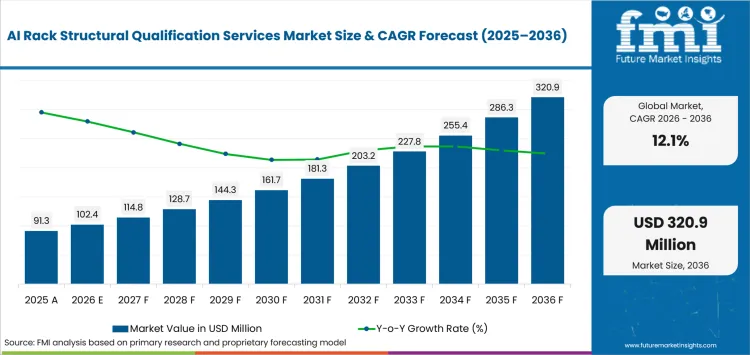
- Market Size (2026)
- USD 102.4 Mn
- Forecast (2036)
- USD 320.9 Mn
- CAGR (2026 to 2036)
- 12.1%
How big is AI Rack Structural Qualification Services Market in 2026?
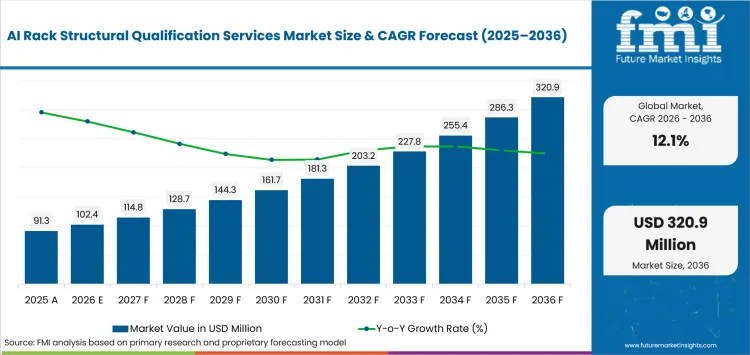
USD 102.4 million in 2026 and USD 320.9 million by 2036 at a 12.1% CAGR.
Demand for AI rack structural qualification services is projected to expand at 12.1% CAGR between 2026 and 2036, increasing valuation from USD 102.4 million in 2026 to USD 320.9 million by 2036. Higher rack density changes floor loading, anchorage and data center power interfaces before expensive compute enters service. Schneider Electric said in October 2025 that its 800 VDC work targets high-density rack architectures and uses safety, simulation and testing for field-ready designs. Qualification gains budget earlier in the project because engineering teams can close physical-interface risks before installation begins.
Geography changes who buys qualification work and how early it enters a project. The USA Department of Energy identified 16 federal sites in April 2025 with existing energy infrastructure and potential for rapid AI data-center construction. Mature USA owner and EPC networks can buy qualification as a separate engineering package. Sovereign-campus programs in Saudi Arabia and the UAE concentrate decisions among fewer sponsors. Providers need local signoff coverage and contract structures that fit each project, even though the underlying rack-interface checks are similar.
Key Takeaways
- Demand rises as rack mass, liquid-cooling hardware and higher-density power distribution turn floor capacity, anchorage and installation access into schedule-sensitive acceptance checks.
- Based on service scope, commissioning & acceptance is projected to account for 27.0% in 2026 due to owners requiring documented as-built readiness ahead of compute handover.
- By project stage, new AI hall build is estimated to hold 36.0% in 2026 owing to floor and anchorage criteria being set during design.
- The 251-500 kW segment is likely to capture 32.0% share in 2026 attributable to high mechanical loading reaching a broad deployment base.
- Late rack selections, incomplete load data and divided design responsibility can delay structural signoff and force repeat analysis during fast-track delivery.
- Key players in the AI rack structural qualification services market include Jacobs, Siemens, Vertiv, and Schneider Electric.
Analyst Perspective
“Rack qualification earns its fee if one load basis survives from design review to field handover without reopening accepted rack-floor interfaces. Providers should be compared on structural authority, change control and field signoff speed because those factors protect commissioning dates better than a lower review fee.”
– , Principal Consultant, Future Market Insights
How is the AI rack structural qualification services market segmented?
The market is segmented by service scope, project stage, AI rack density, data center type and commercial model.
Service scope covers commissioning & acceptance, design & engineering, performance validation, retrofit & migration, and managed support. Project stage includes new AI hall build, rack/pod deployment, capacity expansion, legacy conversion, and ongoing operations. AI rack density includes below 100 kW, 100-250 kW, 251-500 kW, and above 500 kW. Data center type covers hyperscale AI data centers, colocation AI facilities, enterprise private AI, and HPC & research centers. Commercial model covers direct enterprise contract, system integrator / EPC-led, subscription / license, and managed-service contract.
Why does commissioning & acceptance lead the service scope category?
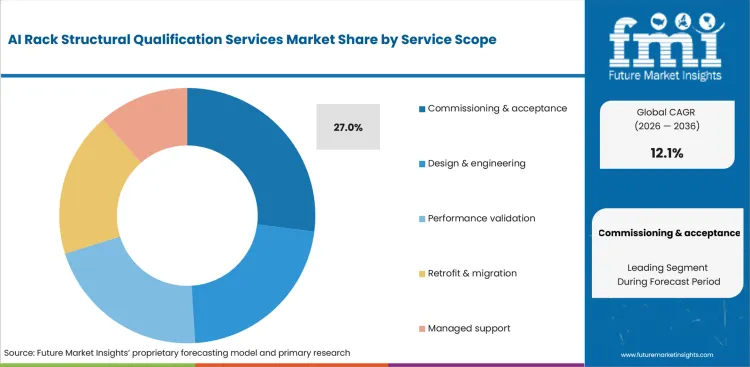
Commissioning and acceptance is the final structural risk gate between an installed rack package and production compute. The service checks floor interfaces, anchorage, alignment and installation condition against the approved design basis before a live hall restricts access. Owners need traceable punch-list closure because later corrections can require de-racking or restricted work inside operating white space.
- By service scope, commissioning & acceptance is estimated to hold 27.0% in 2026 owing to documented readiness at the handover gate.
- Jacobs released a data-center digital twin in March 2026 for virtual commissioning, giving owners a route to resolve facility-interface issues before final acceptance.
Why does new AI hall build lead the project stage category?
A new AI hall lets engineers set structural acceptance criteria before slab capacity, rack zones and installation routes become fixed. Design teams can align floor loading, anchorage locations and clearances with the selected equipment package before construction is complete.
- New AI hall build is set to lead the project stage with 36.0% share in 2026 due to qualification entering facility design ahead of equipment installation.
- Vertiv expanded its MegaMod HDX platform in January 2026 for deployments up to 10 MW and rack densities above 100 kW, increasing the need for coordinated white-space and infrastructure design.
Why do 251-500 kW racks lead the AI rack density category?
Racks in the 251-500 kW band carry dense compute, liquid-cooling hardware and heavy power distribution without relying on the smaller installed base of megawatt-scale designs. Structural review therefore extends beyond a cabinet rating to floor loading, anchor zones, transport paths and service clearance.
- In 2026, 251-500 kW racks are expected to lead AI rack density with 32.0% share because high mechanical loading has reached a broad deployment base.
- Siemens and Rittal announced a sidecar power-rack collaboration in March 2026 as AI rack densities moved above 100 kW, reinforcing the need to coordinate adjacent infrastructure with rack geometry.
Why do hyperscale AI data centers lead the data center type category?
Hyperscale AI facilities deploy racks in repeated pods, so one floor, clearance or anchorage mismatch can multiply through a large build program. Operators value qualification methods that preserve design assumptions and field-acceptance records between repeated pod deployments. Formal change control becomes necessary once an accepted geometry is reused through several pods.
- Based on data center type, hyperscale AI data centers are projected to account for 46.0% in 2026 due to repeated pod deployments requiring reusable structural evidence.
- Vertiv announced gigawatt-scale NVIDIA Omniverse DSX reference architectures in October 2025 with prefabricated infrastructure and digital-twin simulation, giving large operators a repeatable design basis before site deployment.
Why does direct enterprise contract lead the commercial model category?
Direct enterprise contracts keep the owner close to the acceptance criteria that determine whether high-value compute can enter service. The model is useful where the EPC firm, rack manufacturer and installer control different interfaces, because one engineering scope can preserve the design basis into handover.
- By commercial model, direct enterprise contract is forecast to represent 42.0% in 2026 driven by owner accountability for design review and final acceptance.
- Jacobs was appointed directly by Hut 8 in January 2026 for EPCM work on the River Bend AI data center, illustrating how owners centralize delivery responsibility on complex facilities.
What are the drivers, restraints and opportunities in the AI Rack Structural Qualification Services Market?
Heavier AI racks expand qualification demand, fragmented design information delays signoff, and digital-twin review gives teams a route to resolve interface risks earlier.
- Driver: Higher rack mass and denser support infrastructure require structural checks that match the selected AI rack architecture.
- Restraint: Late equipment data and divided interface ownership can trigger repeat analysis after construction decisions are fixed.
- Opportunity: Digital twins can shift floor, clearance and rack-interface review into design, reducing field changes and supporting repeatable acceptance.
New rack systems impose a physical load case that legacy data halls cannot assume without review. Schneider Electric launched AI-focused rack and pod systems in June 2025 with stronger enclosures for increased size and weight, alongside direct-to-chip data center liquid cooling. Structural qualification gains scope because engineers must check floor capacity and adjacent services against the selected rack package before acceptance.
Incomplete interface data is often the bottleneck even when engineering demand is strong. Schneider Electric’s August 2026 arc-flash study compared two representative 800 VDC architectures and found that system configuration changes safety outcomes. A late electrical or rack substitution can reopen structural and electrical review, delay signoff and shorten the service window for specialists entering after equipment selection.
Digital modeling gives qualification providers a way to test rack-floor assumptions during design instead of waiting for field inspection. Jacobs announced work on NVIDIA’s AI Factory Digital Twin Blueprint in May 2025 to improve simulation and early issue detection. Structural specialists can use the same data center infrastructure services stage to check rack placement, access, floor limits and exceptions, then carry the approved basis into field acceptance.
Which country CAGRs are profiled in the AI Rack Structural Qualification Services Market?
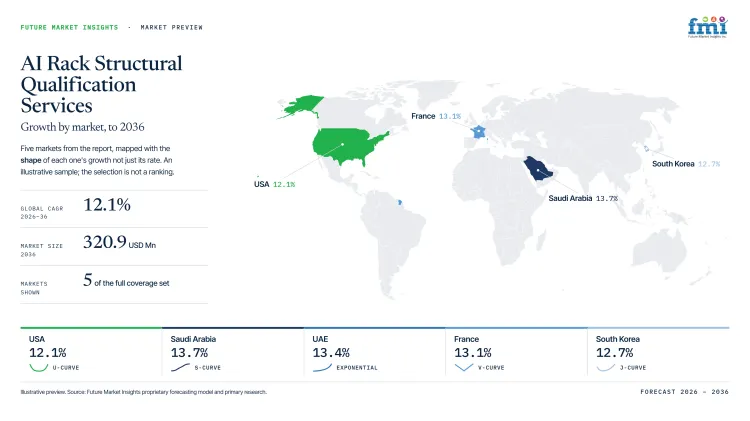
| Country | CAGR |
|---|---|
| Saudi Arabia | 13.7% |
| UAE | 13.4% |
| France | 13.1% |
| South Korea | 12.7% |
| Japan | 12.4% |
| USA | 12.1% |
How do country-level CAGRs compare in the AI Rack Structural Qualification Services Market?
The country forecasts span 1.6 percentage points. Saudi Arabia and the UAE form the upper band, with France close behind. South Korea and Japan occupy the middle, and the USA records the lowest CAGR. The narrow spread makes project timing, approval sequence and engineering capacity more useful than rank for planning.
- Saudi Arabia concentrates decisions among sovereign-backed sponsors and delivery partners.
- UAE campus scale rewards rapid mobilization of local field engineers.
- France uses DREETS and prefecture contacts to simplify site coordination.
- South Korea’s electronics base keeps facility and equipment design closely linked.
- Japan’s seismic design practice keeps anchorage evidence central to acceptance.
- USA engineering depth supports multi-site coverage with locally issued signoff.
Contract timing depends on each country’s delivery and approval model. The full report provides country-level CAGR analysis across North America, Latin America, Western Europe, Eastern Europe, East Asia, South Asia and Pacific, and Middle East and Africa.
Country-wise Analysis
- Saudi AI developers are laying out greenfield campuses before rack packages and installation routes are fixed, so structural criteria can enter hall design early. PIF launched HUMAIN in May 2025 with next-generation data centers, AI infrastructure and centralized hardware procurement in its mandate. Saudi Arabia is projected to grow at 13.7% CAGR through 2036, reinforced by concentrated campus delivery and centralized compute purchasing. The centralized program lets one accepted load basis carry between campus phases without restarting structural assumptions for every hall. Compressed schedules make late rack substitutions costly. Firms therefore need Saudi signoff authority and field teams through handover.
- UAE operators are dividing very large Abu Dhabi campuses into phases, which makes repeated rack-interface checks practical but leaves little room for late redesign. Demand for AI rack structural qualification services in the UAE is forecast to expand at 13.4% CAGR over the forecast period, owing to staged AI-capacity deployment. Abu Dhabi Media Office confirmed in May 2025 that Stargate UAE will start with a 1-gigawatt cluster inside a planned 5-gigawatt campus. Winning firms need local field acceptance near the build program because drawing changes must close before each phase fixes floor loading, rigging routes and rack clearances during installation.
- French developers can choose from a larger identified site base, but each project must reconcile structure, grid connection and rack geometry before construction locks the layout. In November 2025, the Direction générale des Entreprises documented 63 French sites considered suitable for data-center development. Site availability does not remove the power and permitting sequence, which can delay the point at which rack assumptions become firm. France’s AI rack structural qualification services sector is forecast to advance at 13.1% CAGR during the assessment period, given the identified development pipeline. Firms that coordinate structural review with local design teams can enter before rack assumptions harden into construction packages.
- Korean AI projects pair public GPU procurement with private facility delivery, so structural evidence has to follow both compute decisions and power-system review. In February 2025, the Ministry of Science and ICT said Korea would secure 18,000 high-performance GPUs by the first half of 2026 and improve facility-location and power-supply rules. AI rack structural qualification services in South Korea are expected to register 12.7% CAGR through 2036, aided by that visible compute pipeline. Electricity and location approvals may slow dense halls, favoring firms that place rack-layout review inside early site planning instead of waiting for installation at new data-center sites.
- Japanese developers have to coordinate high-density compute with electricity and telecommunications planning, which raises the cost of discovering rack constraints after site design is fixed. Japan’s AI rack structural qualification services outlook is projected to record 12.4% CAGR over the assessment period, tied to coordinated digital-infrastructure development. METI and the Ministry of Internal Affairs and Communications published Report 1.0 on Watt-Bit Collaboration in June 2025 to align power, telecommunications and data-center planning. Limited redesign room keeps local field support important, so providers need load evidence that fits the site sequence instead of a generic rack checklist during each phased commissioning cycle.
- USA AI programs often divide responsibility among facility engineers, rack manufacturers, EPC teams and installers, so one acceptance basis must survive several handoffs. Lawrence Berkeley National Laboratory’s June 2026 update estimated that data centers could use 11.8% of USA electricity by 2030 and modeled demand partly from planned IT-equipment shipments. Grid and construction schedules can compress field-rework windows even where engineering capacity is deep. The USA is forecast to post 12.1% CAGR over the forecast period, attributable to continued capacity deployment at scale. National firms have an advantage if their methods repeat between campuses without losing site-specific signoff during accelerated multi-site delivery.
Who are the notable companies in the AI Rack Structural Qualification Services Market?
Jacobs, Siemens, Vertiv, and Schneider Electric are the notable companies profiled in this market.
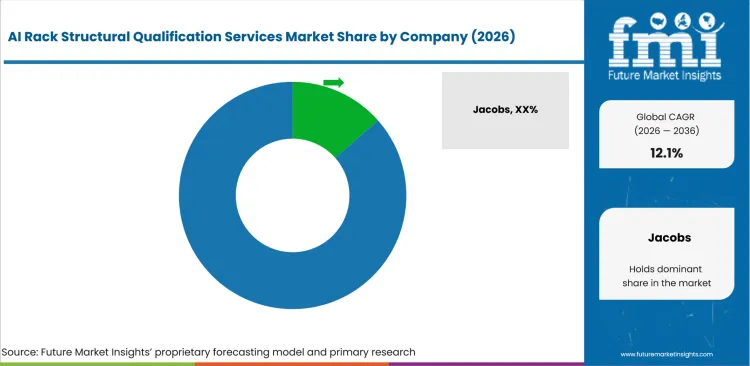
Competition splits by control point in the acceptance chain, with Jacobs bringing owner-side engineering, EPCM and digital twins. Siemens covers electrical infrastructure and controls, whereas Vertiv and Schneider Electric work closer to rack, power and cooling integration. Entry is harder for firms that cannot carry one documented design basis into field acceptance without overreaching into interfaces they do not control. Adjacent data center power quality monitoring requirements add interfaces that structural reviewers may need to coordinate.
- Jacobs fits owner-side engineering and digital qualification, particularly independent design review, EPCM coordination and commissioning evidence for large AI facilities.
- Siemens, Vertiv and Schneider Electric cover infrastructure and rack-platform assurance through electrical design, rack systems, cooling integration, controls and field services.
Competitive Benchmarking: AI Rack Structural Qualification Services Market
| Company | Facility Engineering and Structural Review | AI Rack Integration and Design Validation | Commissioning and Lifecycle Coverage | Geographic Reach |
|---|---|---|---|---|
| Jacobs | High | Medium | High | North America, Western Europe, Middle East and Africa, and South Asia and Pacific |
| Siemens | Medium | High | High | North America, Western Europe, East Asia, South Asia and Pacific, and Middle East and Africa |
| Vertiv | Medium | High | High | North America, Latin America, Western Europe, East Asia, South Asia and Pacific, and Middle East and Africa |
| Schneider Electric | Medium | High | High | North America, Latin America, Western Europe, East Asia, South Asia and Pacific, and Middle East and Africa |
Scoring basis: High facility-engineering coverage requires documented advisory, design and delivery work through at least three project stages. Medium indicates verified infrastructure engineering with a narrower owner-side structural role, and Low identifies one documented interface. High rack-integration coverage requires AI rack or reference-architecture evidence plus simulation, test or validation. High lifecycle coverage requires documented design, deployment and service activity through at least three stages. Geographic reach records the regions supported by official filings or annual reports.
Key Developments in the AI Rack Structural Qualification Services Market
- In June 2026, Schneider Electric entered a collaboration with Hon Hai Technology Group (Foxconn) on integrated AI data-center solutions spanning compute, rack integration, power and cooling, moving interface decisions earlier in facility design.
- In June 2026, Siemens, NVIDIA and Fluence developed a DSX Vera Rubin-aligned electrical and controls reference design, giving engineers a defined architecture for coordinating rack geometry, service clearance and acceptance.
- In August 2025, Vertiv completed its acquisition of Great Lakes Data Racks & Cabinets, expanding rack and cabinet integration and leaving site-specific floor and anchorage checks as separate qualification work.
Key Players in the AI Rack Structural Qualification Services Market
Owner-Side Engineering and Digital Qualification
Electrical Infrastructure and Controls
Rack, Power and Cooling Platforms
- Vertiv
- Schneider Electric
AI Rack Structural Qualification Services Market – Report Scope
| Coverage field | Report scope |
|---|---|
| Market breakdown | By service scope, project stage, AI rack density, data center type, commercial model and region. |
| Quantitative Units | USD million. |
| Market Definition | Engineering services that qualify structural and mechanical readiness of AI rack deployments, including design review, floor and anchorage assessment, performance validation, field acceptance, retrofit support and managed structural support. |
| Regions Covered | North America, Latin America, Western Europe, Eastern Europe, East Asia, South Asia and Pacific, and Middle East and Africa. |
| Countries Covered | Saudi Arabia, UAE, France, South Korea, Japan, USA, and 20+ countries included in the full report. |
| Key Companies Profiled | Jacobs, Siemens, Vertiv, Schneider Electric. |
| Forecast Period | 2026 to 2036. |
| Approach | Primary and secondary research with market triangulation. |
AI Rack Structural Qualification Services Market – Research Methodology
| Method | Approach |
|---|---|
| Primary Research | FMI analysts gathered input from manufacturers, service providers, technology developers, distributors, end users, procurement teams, and subject-matter experts. Interviews examined purchasing decisions, product or service evaluation, adoption barriers, approval requirements, pricing considerations, and expectations for technical or commercial support. Respondents were also asked what evidence is required before a trial, pilot, or initial order develops into regular purchasing. |
| Desk Research | Desk research covered government statistics, regulatory publications, trade data, industry associations, technical literature, standards, company filings, product information, and official corporate announcements. Sources were reviewed for relevance, publication date, geographic coverage, and consistency with the defined market scope. Claims relating to performance, applications, approvals, capacity, investment, and commercial activity were retained only when supported by credible public evidence. |
| Market Sizing and Forecasting | The market model combined the baseline value with historical performance, segment structure, pricing and volume indicators, adoption levels, company participation, and country-level demand conditions. Forecast assumptions considered economic activity, investment trends, regulatory developments, technology adoption, purchasing cycles, supply availability, and barriers to wider market use. Segment and regional estimates were reconciled before the final market total was calculated. |
| Data Validation | Estimates were checked against multiple independent indicators, including public data, company activity, trade patterns, industry developments, and findings from primary interviews. Validation also tested whether products, services, applications, and company revenues fell within the defined market boundaries. Adjacent categories, unsupported claims, overlapping revenues, and activities without direct market relevance were excluded to reduce double counting and maintain consistency across segments and countries. |
AI Rack Structural Qualification Services Market by Segments
AI Rack Structural Qualification Services Market segmented by Service Scope:
- Commissioning & acceptance
- Design & engineering
- Performance validation
- Retrofit & migration
- Managed support
AI Rack Structural Qualification Services Market segmented by Project Stage:
- New AI hall build
- Rack/pod deployment
- Capacity expansion
- Legacy conversion
- Ongoing operations
AI Rack Structural Qualification Services Market segmented by AI Rack Density:
- 251-500 kW
- 100-250 kW
- Below 100 kW
- Above 500 kW
AI Rack Structural Qualification Services Market segmented by Data Center Type:
- Hyperscale AI data centers
- Colocation AI facilities
- Enterprise private AI
- HPC & research centers
AI Rack Structural Qualification Services Market segmented by Commercial Model:
- Direct enterprise contract
- System integrator / EPC-led
- Subscription / license
- Managed-service contract
AI Rack Structural Qualification Services Market by Region:
- North America
- Latin America
- Brazil
- Mexico
- Argentina
- Chile
- Western Europe
- Germany
- France
- United Kingdom
- Italy
- Spain
- Benelux
- Nordics
- Eastern Europe
- Poland
- Czech Republic
- Romania
- Hungary
- East Asia
- South Asia and Pacific
- India
- ASEAN
- Australia and New Zealand
- Middle East and Africa
- GCC Countries
- South Africa
- Türkiye
- Israel
Research Sources and Bibliography
- Schneider Electric. (2025, October 13). Schneider Electric Highlights Innovation in 800 VDC Power Systems in support of NVIDIA’s next generation GPUs.
- USA Department of Energy. (2025, April 3). DOE Identifies 16 Federal Sites Across the Country for Data Center and AI Infrastructure Development.
- Jacobs. (2026, March 16). Jacobs releases digital twin solution for AI data centers.
- Vertiv. (2026, January 14). Vertiv Introduces New Modular Liquid Cooling Infrastructure Solution to Support High-Density Compute Requirements in North America and EMEA.
- Siemens. (2026, March 17). Siemens and Rittal partner to design data center infrastructure of the future.
- Vertiv. (2025, October 28). Delivering flexibility at gigawatt-scale: Vertiv announces rapidly deployed, system-level reference architectures for the NVIDIA Omniverse DSX Blueprint.
- Jacobs. (2026, January 8). Jacobs appointed engineering, procurement and construction management lead for Hut 8 AI data center.
- Schneider Electric. (2025, June 11). Schneider Electric Launches New Data Center Solutions to Meet Challenges of High-Density AI and Accelerated Compute Applications.
- Schneider Electric. (2026, August 3). Schneider Electric releases pioneering study assessing arc flash risk in 800 VDC data centers aligning with world’s leading hyperscalers.
- Jacobs. (2025, May 19). Jacobs to optimize data centers with NVIDIA AI Factory Digital Twin Blueprint.
- Public Investment Fund. (2025, May 12). HRH Crown Prince launches HUMAIN as global AI powerhouse.
- Abu Dhabi Media Office. (2025, May 22). Global tech alliance launches ‘Stargate UAE’.
- Direction générale des Entreprises. (2025, November 28). Data centers : atouts, enjeux et accompagnement.
- Ministry of Science and ICT. (2025, February 20). Korea to Expand AI Computing Infrastructure to Strengthen National AI Capabilities and Achieve Global Leadership.
- Ministry of Economy, Trade and Industry. (2025, June 12). Report 1.0 of the Public-Private Advisory Council on Watt-Bit Collaboration Published.
- Smith, S. J., Hubbard, A., Newkirk, A., Ganeshalingam, M., Holecek, B., Sartor, D. A., Mills, M., & Shehabi, A. (2026, June). United States Data Center Energy Usage Report: 2025 Update.
- Jacobs Solutions Inc. (2025, November 20). Annual Report on Form 10-K for the fiscal year ended September 26, 2025.
- Siemens AG. (2025, November 13). Siemens Report for fiscal 2025.
- Vertiv Holdings Co. (2026, February 13). Annual Report on Form 10-K for the fiscal year ended December 31, 2025.
- Schneider Electric. (2026, March 27). 2025 Universal Registration Document.
- Schneider Electric. (2026, June 15). Schneider Electric and Hon Hai Technology Group (Foxconn) announce strategic collaboration to accelerate next-generation AI data centers.
- Siemens. (2026, June 1). Siemens and partners develop reference architecture purpose-built for NVIDIA AI data centers.
- Vertiv. (2025, August 20). Vertiv completes acquisition of Great Lakes Data Racks & Cabinets.
- Siemens. (2025, December 9). Siemens and nVent to release joint reference architecture purpose-built for NVIDIA AI data centers.
- Schneider Electric. (2025, September 29). Schneider Electric Unveils Liquid Cooling Portfolio with Motivair Featuring Dedicated Solutions and Services for HPC and AI Workloads.
- Schneider Electric. (2026, July 23). Schneider Electric and AMD release first Helios platform reference design to accelerate AI Factory deployment.
- Vertiv. (2026, March 24). Vertiv Announces Expansion of Manufacturing Capacity Spanning Infrastructure Solutions, Power, and Rack Systems, to Meet Rising Demand.
- Siemens. (2026, March 18). Siemens expands data center partner ecosystem to scale next-generation AI infrastructure.
- Jacobs. (2026, May 12). Jacobs awarded EPCM contract to deliver second Hut 8 AI data center in Texas.
- Siemens. (2026, August 14). Siemens and Reinhausen develop direct current power solutions for AI data centers.
- Vertiv. (2025, October 10). Vertiv accelerates AI infrastructure deployment with OCP-compliant power, cooling, and rack ecosystem.
- Schneider Electric. (2026, March 16). Schneider Electric teams with NVIDIA to develop validated blueprints to design, simulate, build, operate and maintain gigawatt-scale AI Factories.
This bibliography is provided for reader reference and is not exhaustive. The full report contains the complete reference list and detailed citations.
This Report Answers
- How large is the market in 2026 and 2036?
- What CAGR is projected through 2036?
- Why does commissioning & acceptance lead service scope?
- Why does new AI hall build lead project stage?
- How do 251-500 kW racks affect qualification?
- Why do hyperscale AI data centers lead?
- How do country growth conditions differ?
- Which companies compete and how?
Frequently Asked Questions
How big is the AI Rack Structural Qualification Services Market in 2026?
The AI rack structural qualification services market is valued at USD 102.4 million in 2026 and is projected to reach USD 320.9 million by 2036. Growth is tied to heavier rack architectures that require earlier floor, anchorage and installation-interface checks.
What is the CAGR of the AI Rack Structural Qualification Services Market from 2026 to 2036?
The AI rack structural qualification services market is projected to grow at a CAGR of 12.1% between 2026 and 2036. Expansion is supported by denser AI racks and faster hall construction that increase the cost of discovering structural conflicts late.
Which service scope leads the AI Rack Structural Qualification Services Market?
The commissioning & acceptance segment is expected to hold 27.0% of the AI rack structural qualification services market in 2026, supported by owners requiring documented as-built readiness before compute handover. Field signoff also closes structural punch-list items before normal operations restrict access.
Which project stage leads the AI Rack Structural Qualification Services Market?
The new AI hall build segment is expected to hold 36.0% of the AI rack structural qualification services market’s project-stage demand in 2026, attributable to structural criteria being fixed before installation. Early design access lets engineers resolve floor loading and anchorage before changes become expensive.
Which companies are active in the AI Rack Structural Qualification Services Market?
Key companies operating in the AI rack structural qualification services market include Jacobs, Siemens, Vertiv, and Schneider Electric. Their positions differ by owner-side engineering, electrical and controls design, rack integration, digital modeling, commissioning and field-service coverage.
Preview the report firsthand – request a free sample
Get the brochure for pricing and purchase details.








Leave a Reply