
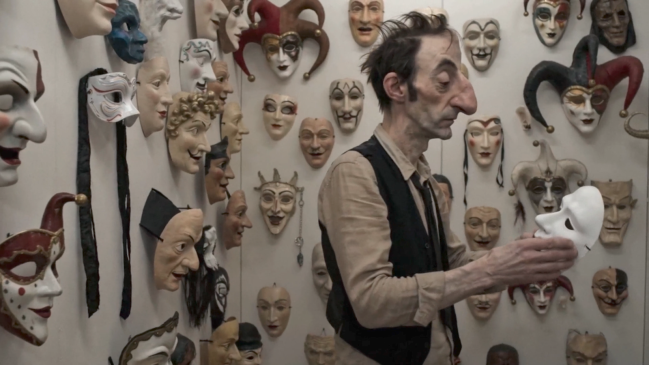
For journalists who have had the honor of serving on film festival juries before, it can be a joy to discover films and champion one before anyone has had a chance to see it, and it can also be a slog to wade through numerous films that don’t all hit the mark.
But what would that feel like when the movies are all made with AI? Would I forever be a convert to the possibilities of AI in filmmaking? Would I walk away sharing the opinion many film fans have that it’s all just slop and has no place in the movies?
After roughly six hours of sitting through such AI movies, I find myself somewhere in the middle, which is an answer that may satisfy no one.


This weekend, the Reply AI Film Festival will roll out in Venice. It has nothing to do with the Venice Film Festival itself, but it’s taking place at the same time, just a gondola ride away. I was asked to be on a jury to choose my favorites among just under 60 AI-generated short films, picking alongside a jury that includes Oscar winner Gabriele Salvatores, “The Lion King” co-director Rob Minkoff, “Twilight” and “Thirteen” director Catherine Hardwicke, and several other executives, AI and VFX experts, and journalists. I’ve been writing about AI long enough that I remember when Sora was still a thing, but I can’t help but feel a little out of my league.
And yet no one really has much experience with this.
Reply AI has only been around for a couple of years, and I can guarantee you that even in that time, the films produced for this year’s festival likely look nothing like even the best from just two years ago. The technology has evolved so much in terms of the visual fidelity, filmmaker control, the ability to generate audio, and the length of a film that is possible.
The shorts I watched this year were as short as 2-minute clips, while the longest was just over half an hour, but most on average were around 7-15 minutes long. That’s a lot, considering anything pushing a minute a few years ago was impressive. Some were excellent in ways that surprised me and compelled me to see more, some were familiar or forgettable, and others even at just a few minutes in length felt unbearably long. This might be your experience even if you’re a juror at Sundance.
There are likely many of you reading this who will never ever be convinced and see AI as anathema to creativity. But, as with anything, if you dig in deep enough, it gets harder to not see at least some nuance in it. Watching as many shorts as I did revealed some trends I didn’t anticipate and opened my eyes to what is possible today and tomorrow with AI, even if I’m not looking for AI to replace movies made by humans anytime soon.

AI Meets Accessibility
The first observation I’ll make is that we’re way past the general uncanny valley stuff that plagued most early AI films. A number of the films had some audio that could be robotic or mixed poorly in a way that instantly takes you out of it, and it’s not as if a discerning eye wouldn’t be able to tell you that these synthetic actors are indeed AI. Still, it’s safe to say that the visual effects have gotten extremely convincing.
In part, that’s because the filmmakers aren’t using just one AI model or typing in a prompt and seeing what it spits out, but rather they’re using a combination of numerous models, sometimes with a blend of other VFX tools, leaning on each’s strength to get exactly what they want.
Again, I’m not looking to replace human performers, even though every creator here did for the purpose of their shorts, but I can see means in which the application of AI could be an asset. One of the finalists the Reply AI jury selected was titled “A Face Only a Mother Could Love,” directed by Canadian Robert Gaudette, which was a charming romance meet-cute about a man with a Proteus Syndrome-type condition (though likely not precisely that) who is approached by a woman who has been watching him dancing in a park for years.
Movies like “A Different Man” have found brilliant real-world applications to still be able to tell such underrepresented stories, but it’s not hard to imagine a world where AI could open a few more doors for people or filmmakers looking to tell their own. The film is Gaudette’s first.
In a similar vein, another finalist called “Centenarian Kindergarten” from a Chinese studio called 2x Labs follows 100-year-olds living in a dystopian futuristic daycare for the elderly where gleeful robot caretakers dictate and reward their every move. If we see AI as a cheaper extension of aging VFX, it could be a smart way to again highlight some older performers whom would otherwise be limited.

An unfortunate recurring trend of many of the shorts I watched were fourth wall breaking entries that explicitly commented on the use of AI, shorts in which a scene might play out before it pulls back to reveal all these fantastical creatures performing on a soundstage and being directed. We’ve admired versions of this theme before, but it’s an idea that starts to get tired the more you see it.
One that did stand out however was another finalist called “Website,” a sci-fi offering from Chinese director Jiaze Li in which whatever fake news events were written about on a mysterious website would manifest in the real world. But the film was just one component of a larger interactive media project that includes an actual website resembling the fake news site seen in the film. The use of AI lets other users create their own extensions of the film in a way that adds to the director’s ideas about the blurring between reality and fiction.

Lack of Budget, Resources, and Time Alone Shouldn’t Justify AI
Filmmakers when submitting their entries were asked to write a few paragraphs summarizing their film, describing the AI tools they utilized, why it should qualify for a separate jury prize called AI For Good, and how they innovated with AI to create something they wouldn’t be able to otherwise. While all these filmmakers are surely well-meaning, description after description was about a sole individual creator who was able to “transcend physical and financial barriers” and “iterate rapidly” in ways that would’ve been impossible otherwise.
We’re going to need some new buzzwords, because my feedback as a juror is that those descriptions don’t cut it. Only a few filmmakers discussed scenarios or visuals that literally were only possible via these AI tools, not ones that technically would be possible if only someone gave them a near-unlimited amount of money, time, and resources, what we usually call filmmaking.
To that end, a lot of the films I watched (and very few of the finalists) felt less like “short films” but more like elaborate proofs of concept for a longer feature. If that’s where AI in filmmaking is going, letting filmmakers who don’t have funding or the means to tell a larger feature show what they’re capable of as a launching pad for something bigger, something countless filmmakers have done with their own short films, I’m totally on board with that. But I encourage these filmmakers to not pretend that AI enabled something “impossible” just because of physical and financial barriers.

AI Documentaries Are Fascinating (and Scary)
One of the more unique finalists was “Kev” from UK filmmaker Mike Bennion. His movie was a documentary about the experience of a young blind man and his love of football, despite his disability. It’s a character that draws from the filmmaker’s own personal experience, but despite its presentation as an unscripted “documentary,” everything is artificially generated.
I found it weirdly unsettling to feel empathy for a fictional creation that isn’t part of a narrative story but is presented as though it’s a real person. “Kev” wasn’t even the only “documentary” among the contenders I watched, and though I’m fine with mockumentaries as a genre, blending it with AI is surreal and arguably dangerous.
Yet I can also imagine smart documentary filmmakers finding creative applications. Much like “Kev,” could a filmmaker take you more intimately inside the experience of a blind person using AI? Could AI, properly disclosed as such, be used to visualize troves of real audio files to tell new documentary stories in a cinematic medium? I can start to squint at the potential.
AI Could Have a Place in the Art Gallery
One of my favorite shorts called “Field Notes” sadly did not make the cut of the final 10, but perhaps I can understand why. Director Arielko Kotzer effectively created an AI feedback loop to see what a combination of tools would spit out.
Per the creator’s description, the film’s narration was generated as part of a conversation with ChatGPT about its own existence, and those exact words were then fed into Midjourney for visual generation, ElevenLabs for voice synthesis, and Suno for sound design, so that in a way, AI was the author of the piece. It’s an experiment to see how AI visualizes its own thoughts or calculations, and inherently it’s a piece designed to comment on how AI thinks and behaves.
That may sound like a simple experiment, as though the short was merely whatever AI decided to vomit up with no added intervention, but it’s clear that the author constructed and manipulated the AI models in a very particular way to create a cohesive visual style but also a haunting, existential rumination.
Another titled “Oobado” from U.S. director Charles Dillon Ward again had no narrative but used AI to put a clever twist on existing, recognizable images. The short was a series of mostly still frames of iconic movies like “Taxi Driver,” “Titanic,” “The Matrix,” “A Trip to the Moon,” and many more, but instead of the shot itself, AI recreated these scenes entirely draped in green screen, with the actors now in faceless head to toe green body suits as well. The effect is chilling, and it intentionally removes the emotion and literal humanity from these scenes that are so recognizable. If many view AI just as a form of theft, “Oobado” works as a comment on how AI models have a way of sapping the life out of cinema.

These are not narrative stories with emotional hooks, but I did find them to be compelling, innovative uses of artificial intelligence that left a mark on me. They were experimental, non-narrative pieces that might be more at home in an art gallery installation rather than a movie theater. It’s not to say these things couldn’t have been made without AI, but AI was integral to the process in a way that made sense beyond just shortening a workflow or accomplishing something without a budget.
This is where I see AI eventually evolving. It absolutely could have a place within Hollywood, simplifying VFX or pre-viz to help directors get to the real human-crafted movie they actually want to make, or it could be a way for Disney to sell people a tool to make user-generated content based on their favorite movies or characters. We don’t need it replacing actors or writers just because it’s faster and cheaper.
But if there’s going to be a place anywhere for it, AI has to become its own medium, something that’s not just trying to be cinematic or look like a video game. For now, experimental cinema and museum pieces might be the perfect place for AI movies to grow into whatever they’ll one day become.







Leave a Reply