
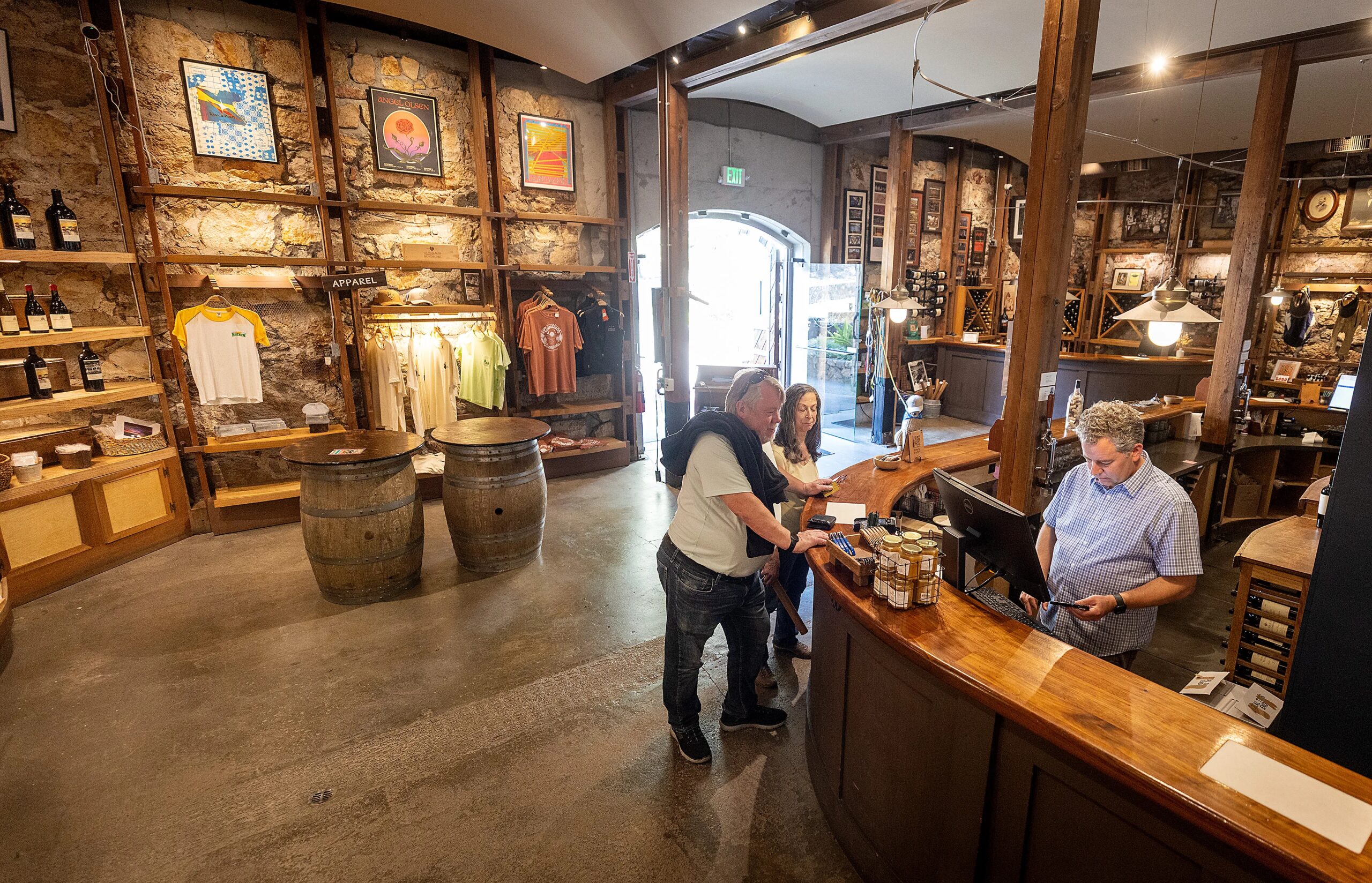
Sonoma Valley’s Gundlach Bundschu, California’s oldest continuously owned family winery, is poised to soon lose that designation under a bankruptcy restructuring that advanced this week.
The winery, which began operating in the late 1850s, is the latest among a string of well-known wine producers in Sonoma and Napa counties to hit the brink of insolvency, struggling with the same downward trends in wine consumption that threaten players large and small across the region and state.
The family-run Bundschu Co. filed for Chapter 11 bankruptcy Wednesday, Sept. 23, adding another ripple to that global shakeout.
The company became overleveraged in a recent acquisition, according to representatives. Negotiations are underway with a large, unspecified “possible new investor” to keep the operation afloat. The company expects to retain a minority ownership interest, and the winery will remain open during the court-supervised restructuring.
“The decision to commence this case was not made lightly,” CEO Jeff Bundschu wrote in a legal declaration supporting the Chapter 11 petition. “It followed years of operational restructuring, cost reductions, asset rationalization, family capital contributions, negotiations with the Debtor’s lenders, and an extensive effort to obtain new investment or sell assets on terms that would preserve the business and maximize stakeholder recoveries. Those efforts did not produce a consensual, out-of-court solution.”
Jeff Bundschu runs the business, officially registered as Vineburg LLC, along with his sister, Katie Bundschu Tynan.
Gundlach Bundschu has taken severe steps to balance its books, reducing its operating costs by more than 50% — approximately $7 million in savings — over the past 18 months. That included reducing its workforce from 120 employees to 63.
The company in July ceased retail sales at Abbot’s Passage, the label it started in 2020, and will close that Glen Ellen facility altogether in early October. Bundschu Tynan previously told The Press Democrat her family would sell its Abbot’s Passage acreage, though that could be limited by the bankruptcy.
In any case, none of those steps were enough to fend off insolvency.
Gundlach Bundschu is hiring Finestone Hayes as its general bankruptcy counsel and Amory Securities as financial advisor.
-

Christopher Chung/ The Press Democrat
Jeff Bundschu, CEO of Bundschu Company, left, Katie Bundschu, chief marketing operator of Bundschu Company and proprietor of Abbot’s Passage Winery, and Towle Merritt, general manager and vice president of operations of Bundschu Company, at Abbot’s Passage Winery & Mercantile near Glen Ellen. (Christopher Chung/ The Press Democrat)


Christopher Chung/ The Press Democrat
1 of 10
Jeff Bundschu, CEO of Bundschu Company, left, Katie Bundschu, chief marketing operator of Bundschu Company and proprietor of Abbot’s Passage Winery, and Towle Merritt, general manager and vice president of operations of Bundschu Company, at Abbot’s Passage Winery & Mercantile near Glen Ellen. (Christopher Chung/ The Press Democrat)
Upheaval hits historic winemaker
The bankruptcy, filed by a winery that has worked the same land continuously since 1858, comes amid a broader financial upheaval in U.S. wine, where declining sales, excess grape supply and tight credit have added pressure on producers already carrying substantial debt.
Other notable North Bay bankruptcy filings this year include Robledo Family Winery in Sonoma Valley and Signorello Estate in Napa Valley.
Rob McMillan, founder and principal brand strategist for Silicon Valley Bank, a division of First Citizens Bank, told The Press Democrat that sales are still declining, but at a slower rate this year. Based on current trends, the bank’s forecast expects the industry to reach a bottom next year or in 2028, but the timing will vary across regions and price segments.
The amount of wine sold is expected to keep declining through 2029, McMillan said, while the dollar value of what’s sold should begin recovering sooner. The gap between wine production and sales volume also is narrowing, with this year expected to be the third consecutive year of improvement, the banker noted.
“There are some signs in the data that confirm we are approaching a bottom. But we haven’t arrived yet,” McMillan said.
Stronger sales, rather than smaller harvests alone, will be the critical signal that the wine’s contraction is ending. McMillan expects this correction to result in an industry that is permanently smaller, highly consolidated and far less forgiving of passive business models.
That correction may come too late for the Bundschu family.
Gundlach Bundschu has weathered devastating earthquakes and fires, phylloxera, Prohibition and multiple recessions over the past 170 years, only to encounter a new existential threat in 21st century market economics.
Bavarian immigrant Jacob Gundlach and a business partner purchased 400 acres from the son-in-law of General Mariano Vallejo in 1857, about three miles east of the Sonoma mission in the Mayacamas Mountains. Gundlach called the parcel “Rhinefarm,” a name still attached to 100 acres there. He planted vineyards a year later, with European rootstock he brought from home.
Jeff Bundschu is Jacob Gundlach’s great-great-great grandson.
By 1906, the Gundlach Bundschu Wine Company owned a massive warehouse, wine vaults and headquarters that spanned two city blocks in San Francisco. All of it was wiped out by the earthquake and fire that year, including nearly 1 million gallons of wine and the family home on Telegraph Hill.
Gundlach Bundschu built back its reserves, only to shut down under the national alcohol ban of Prohibition in 1920. The family wouldn’t bottle a vintage for 50 years. They ripped out half their vines and planted pear trees, and continued to sell grapes to other vintners for sacramental wine and grape juice.
In 1969, as the birth of California’s wine renaissance stirred, the Bundschus began replanting Rhineland with premium varietals of grapes. Gundlach Bundschu Winery opened its doors in 1976.
But the wine industry has stumbled in recent years as millennials and Gen Z-ers, perhaps put off by the increasing sticker shock of high-end wines, have opted for other ways to get buzzed.
As Jeff Bundschu wrote in his declaration, “Wine demand has contracted across the United States and other major markets. Consumers are drinking less frequently, younger consumers have not adopted wine at historical rates, and inflation and higher travel and hospitality costs have made consumers more selective about wine purchases and winery visits.
“At the same time, vineyard acreage, production capacity, inventory, and distribution infrastructure were built to support higher demand and pricing.”
These conditions, he argued, have hit premium wineries especially hard. Their business model generally relies on direct-to-consumer sales to support “high fixed costs, long inventory cycles, vineyard investment, production facilities, and lower-margin wholesale distribution.”
Under Jeff Bundschu’s leadership — he succeeded his father, Jim, in 1999 and became CEO in 2002 — the winery staved off financial hardship through diversification. Jeff, a lover of indie rock, turned the property into a regular stop for touring mid-level bands of critical acclaim.
The pinnacle of that strategy has been the annual Huichica Music Festival. First staged in 2012, it has featured notable performers such as Yo La Tengo, Devendra Banhart and Robyn Hitchcock.
Sam Singer, a Gundlach Bundschu representative, told The Press Democrat that the focus on music has been a net positive for the company, and may have extended its independence.
Problematic expansion
For the winery, the financial challenges intensified in February 2020 after it bought 60 acres off Madrone Road in Glen Ellen and developed hospitality and production capacity for a spinoff label, Abbot’s Passage, that is helmed by Katie Bundschu Tynan. The purchase price was $11.6 million, and it came with a hefty loan.
“In retrospect, the Company expanded at precisely the wrong time and assumed more operational complexity and leverage than its business could sustain,” Jeff Bundschu wrote, noting that the acquisition came two vintages after a round of devastating fires and immediately before the COVID-19 pandemic disrupted winery visitation.
Gundlach Bundschu attempted to rebound through e-commerce, private-label production and expanded use of the Abbot’s Passage facility. It abandoned plans for a lower priced label, “Gun Bun,” and exited two long-held vineyard leases.
Still, margins remained “inadequate,” according to the declaration.
The company then pursued potential third-party investment, and even outright sales, working with a wine-and-spirits investment bank and advisory firm. They received three letters of interest, according to Jeff Bundschu. But Gundlach Bundschu’s two principal lenders refused to sign off, and likewise declined interest-rate relief and refinancing.
Instead, one of those lenders, North Carolina-based Tiverton Advisors, filed an application in Sonoma County Superior Court requesting a court-appointed receiver to manage the winery’s debt.
“The court granted the request without a hearing,” Jeff Bundschu wrote.
Gundlach Bundschu’s other lender is American AgCredit. Between the two, the winery carries a debt of about $37 million, according to the declaration. Tiverton also holds the deed of trust on a Sonoma residence owned by a family trust, with $3 million in equity.
Gundlach Bundschu owes an additional $1.7 million to vendors and service providers.
On top of the layoffs and closing Abbot’s Passage, the family sold off real estate away from the winery, including the patrimonial home, which was rebuilt after the 2017 Nuns Fire destroyed the circa-1900 original.
To a large extent, these efforts worked. Gundlach Bundschu’s earnings before interest, taxes, depreciation and amortization, a common measure of a company’s profitability, increased from a little over $800,000 in 2023 to a projected $3.28 million in 2026. It wasn’t enough.
In the end, however, the winery’s debt exceeded its assets. The family’s only realistic option, it said, was Chapter 11 protection.
Gundlach Bundschu currently farms 160 acres of vines, including the 100 it owns at its Rhinefarm estate, and produces about 42,000 cases of wine annually, with varietals ranging from cabernet sauvignon to dry Gewürztraminer. The winery hosted approximately 30,000 visitors in calendar year 2025, according to its bankruptcy filing.
The company declined to state how many wine club members it has, but it’s “the biggest part of the business,” according to Singer.
You can reach Staff Writer Phil Barber at 707-521-5263 or phil.barber@pressdemocrat.com. On X (Twitter) @Skinny_Post. Jeff Quackenbush joined North Bay Business Journal in May 1999. Reach him at jeff@nbbj.news or 707-521-4256.









Leave a Reply