
If you still own a paper dictionary, chances are it’s the thickest book on your shelf. And each new edition just gets bigger as more words make their way in.
The latest round of additions, included by dictionary publisher Merriam-Webster on September 15, have a strong tech and AI vibe, indicating that people are finding new ways to talk about the world where machines draft emails, answer back and occasionally give them the creeps.
But many of the words aren’t technically new.
According to Merriam-Webster, the rule of thumb is to add a meaning once there’s enough evidence that people use it consistently and widely — sometimes after spending decades in the wild as part of the linguistic landscape.
“Technology may give us completely new things to talk about, but we generally make use of the linguistic tools we already have to find ways to talk about them,” said Northeastern University linguistics professor Heather Littlefield.
“They are coming to the forefront now because of our cultural interest in these topics, and we are able to apply them to new situations created by AI,” she said.
Littlefield explained that the concepts may be new, but the processes that produced the terms for them have been around for centuries.
For example, compounding joins two existing words together. The Old English bōchord — literally a “book hoard” — meant “library,” once it became a thing, Littlefield said.
Another common mechanism involves a shift from one part of speech to another. “Compute” (see below), long used as a verb, now also appears as a noun referring to processing power and memory.
Here are seven additions that show those old linguistic habits at work in the world of AI.
Vibe coding \ˈvīb-ˌkō-diŋ\ (noun):
Simply give a bot instructions in everyday language and watch your words turn into code. That’s vibe coding — a term credited to Andrej Karpathy, an AI researcher who introduced it in a February 2025 social media post. “Build me an app that tracks if I watered my plants.” “Create a button that generates excuses for replying to an email three weeks late.” That sort of thing would constitute vibe coding.
Compute \kəm-ˈpyüt\ (noun):
No, the person who texted you that their company needs “more compute” didn’t leave off the “rs” by accident. Used as a noun, “compute” refers to digital resources, especially processing power and memory. AI tends to be especially compute-hungry. For example, if the company runs its own chatbot, more compute could help it keep up with a stampede of requests coming in at the same time.
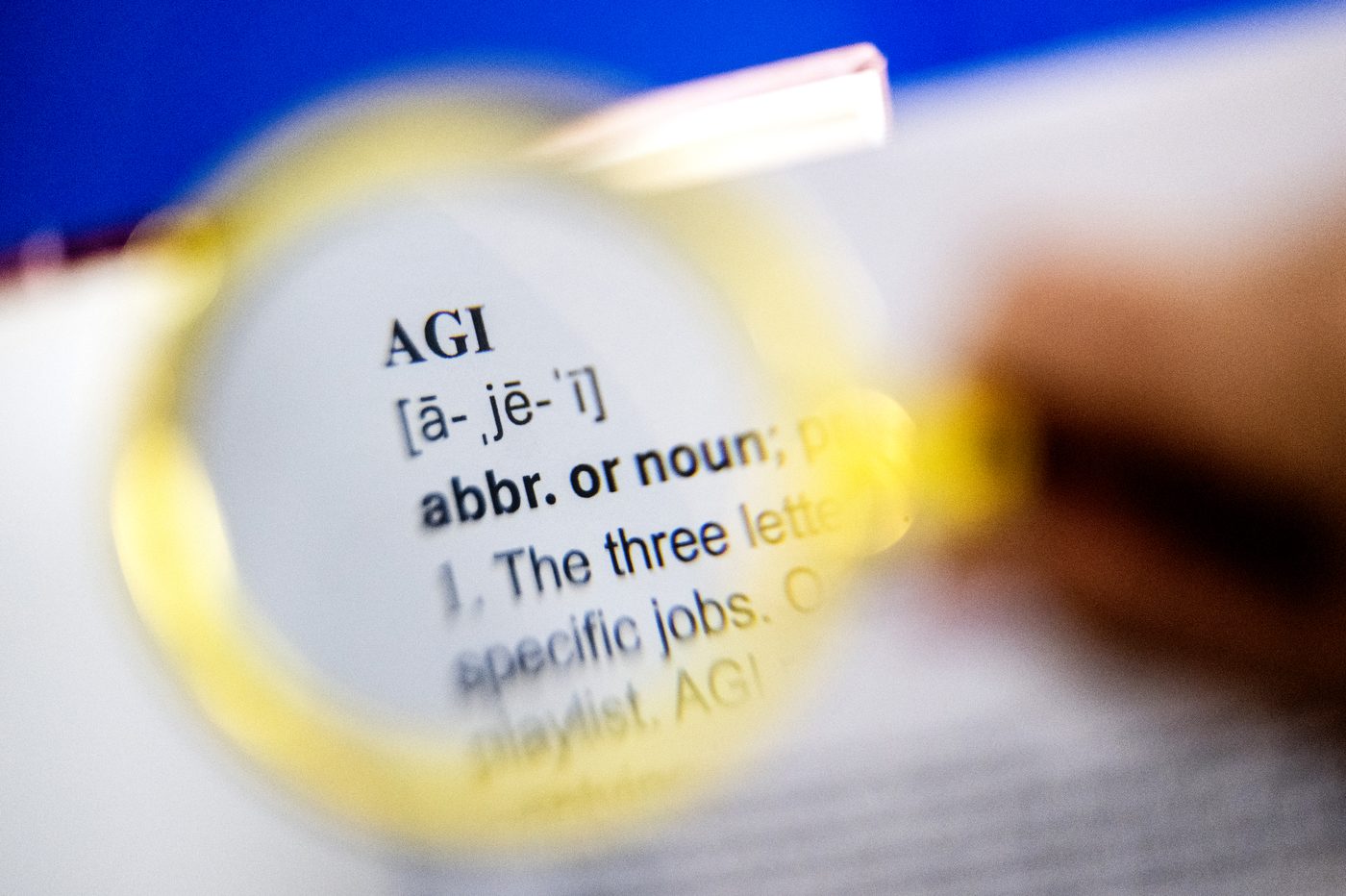
AGI \ˌā-ˌjē-ˈī\ (abbr. or noun):
The three letters stand for “artificial general intelligence.” Some AI systems are built for specific jobs. One flags spam in your inbox, while another recommends the next song on your playlist. AGI refers to a hypothetical multitasking bot that does it all by learning, reasoning and applying knowledge across multiple domains. There’s some debate about what counts as AGI, but the key is flexibility. For example, an AGI could learn a foreign language, then use it to negotiate a business contract.
Uncanny valley \ˌən-ˈka-nē ˈva-lē\ (noun):
You know that feeling some might get when the AI “actress” Tilly Norwood is on screen, giving an interview? She looks human, sounds human but … isn’t. That’s “uncanny valley,” a term that refers to the feeling you get when faced with something artificial that feels ever so slightly off. Japanese roboticist Masahiro Mori proposed the concept back in 1970, with “valley” referring to the sudden dip in the viewer’s comfort level when they detect the creepy factor. The term recently spread from robotics to AI.
Parasocial \ˌper-ə-ˈsō-shəl\ (adj.):
“Para” means “resembling,” and a “parasocial” relationship is one that looks like a real connection but isn’t. Back in 1956, sociologists Donald Horton and R. Richard Wohl used the term to describe one-way bonds viewers felt to TV personalities. These days it refers to a similar connection some feel with chatbots. The protagonist from the show “I Love Lucy” might have been in your living room every Tuesday, but the actress who portrayed her never knew you were watching. A chatbot does answer back, which makes the bond feel even more personal. However, there’s no human at all on the other end — just a world of data.
Meme coin \ˈmēm ˈkȯin\ (noun):
This form of cryptocurrency is built around an internet joke, image or trend. It can be bought and sold online. The appeal? Digital brownie points and the hope of a payday. One classic example dates back to 2013, when the “Doge” meme inspired a new form of digital dough. The name is a deliberate misspelling of “dog.” The meme featured Kabosu, a Shiba Inu whose photo appeared surrounded by captions in colorful Comic Sans. People laid down hard-earned cash for Dogecoins that used Kabosu’s face as the currency symbol.
Letterboxing (video sense) \ˈle-tər-ˌbäk-siŋ\ (noun):
You know those black bars above and below a wide movie you’re watching on the screen to allow you to see the whole thing without lopping off the sides? That’s letterboxing. According to Merriam-Webster, the name comes from the fact that the bands look like the long, narrow slot in a mailbox. An older definition referred to an outdoor treasure-hunting game.













Leave a Reply