
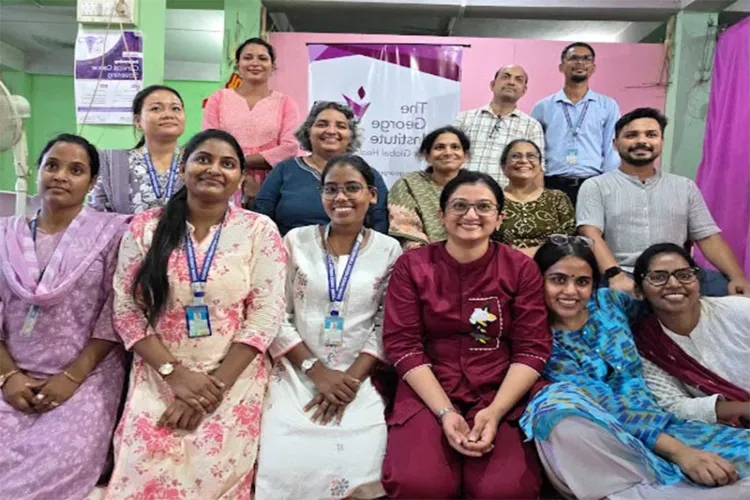
ASHAs participate in a co-design workshop in Guwahati to help develop an AI-enabled training platform
Guwahati
Around 100 Accredited Social Health Activists (ASHAs) participated in a co-design workshop in Guwahati to help shape an artificial intelligence-enabled training platform and multilingual voice chatbot aimed at strengthening cervical cancer screening and community counselling in rural Assam.
The workshop was organised by The George Institute for Global Health India in collaboration with the Cachar Cancer Hospital and Research Centre (CCHRC), Assam. It brought together ASHAs, trainers, doctors, programme coordinators, researchers and technologists.
During interactive sessions, ASHAs shared their experiences of supporting women with cervical cancer screening and discussed challenges they face during community visits, along with the type of technological support that could help them counsel women and access information more effectively.
The workshop is part of a three-year pilot study titled “Leveraging Artificial Intelligence for Strengthening Cervical Cancer Screening Through Capacity Building”, funded by the Indian Council of Medical Research (ICMR). The project is being conducted from November 2025 to November 2028.
As part of the workshop, ASHAs reviewed 155 commonly asked questions related to cervical cancer and screening. Using a bindi-based voting exercise, they identified questions they encounter most frequently from women, husbands, family members and others in their communities.
The exercise highlighted differences between questions considered clinically important and those most frequently raised during field-level interactions. The inputs will be used to develop the knowledge base for the proposed chatbot, with the aim of addressing both priority health information needs and practical concerns faced by ASHAs.
The workshop also assessed ASHAs’ familiarity with digital technology. Younger and middle-aged participants said they regularly use mobile phones for reporting, communication and accessing information, while some older ASHAs reported greater difficulty with digital tools and language but expressed willingness to improve their skills.
Participants also mapped their work and training needs, including counselling women, explaining test results, addressing pregnancy and childbirth-related concerns, and making appropriate referrals. They identified features such as short audio-visual lessons, frequently asked questions, reminders, quizzes and progress tracking as potentially useful.
The ASHAs also highlighted the importance of voice-based interaction in Bangla, simple-language content and search functions that reflect the way they naturally frame questions.
One ASHA worker who participated in the workshop said, “I am very happy to attend this workshop. This is the first time I have attended something like this. I have attended many meetings before, but this was very different. Even the questions about cervical cancer- what is important and what is not- were explained through an exercise using bindis. It felt like a fun and interactive way of learning, almost like a game. We learnt so much today, and through this workshop we got to know many things that we did not know before.”
Dr Anita Gadgil, Principal Investigator of the project and Senior Research Fellow at The George Institute for Global Health and Co-Director, WHO Collaboration Centre for Emergency Critical and Operative Care, said the platform would be developed based on the experiences of ASHAs.
“This workshop starts with a simple principle: technology for ASHAs should be designed with ASHAs. Their experience of explaining screening, responding to concerns and finding answers in real time will guide the language, content and functions of this AI platform. Our aim is to develop clinically validated support that fits their work, rather than adding another digital burden,” Gadgil said.
The proposed AI platform is intended to complement existing training and provide ASHAs with clinically verified information while taking into account practical challenges such as limited internet connectivity and the time available during household visits.
The study will next focus on developing and testing the AI-based learning platform and chatbot. Training content and questions will undergo clinical review and repeated testing with ASHAs before rollout.
Researchers will subsequently evaluate the intervention through a two-arm cluster-randomised controlled trial across 20 clusters involving approximately 110 ASHAs. The study will assess the usability and acceptance of the technology, its usage patterns and its potential for scale-up, along with changes in ASHAs’ knowledge, attitudes and practices.
The proposed chatbot will support ASHAs with training and field-based information but will not replace clinical assessment, diagnosis or established referral pathways.
READ MORE:How can Muslim politicians regain relevance?
Cervical cancer remains a significant public health concern in India, with awareness and access to screening playing an important role in early detection. ASHAs often serve as a link between communities and the healthcare system, helping women understand screening and connecting them with appropriate services.












Leave a Reply