
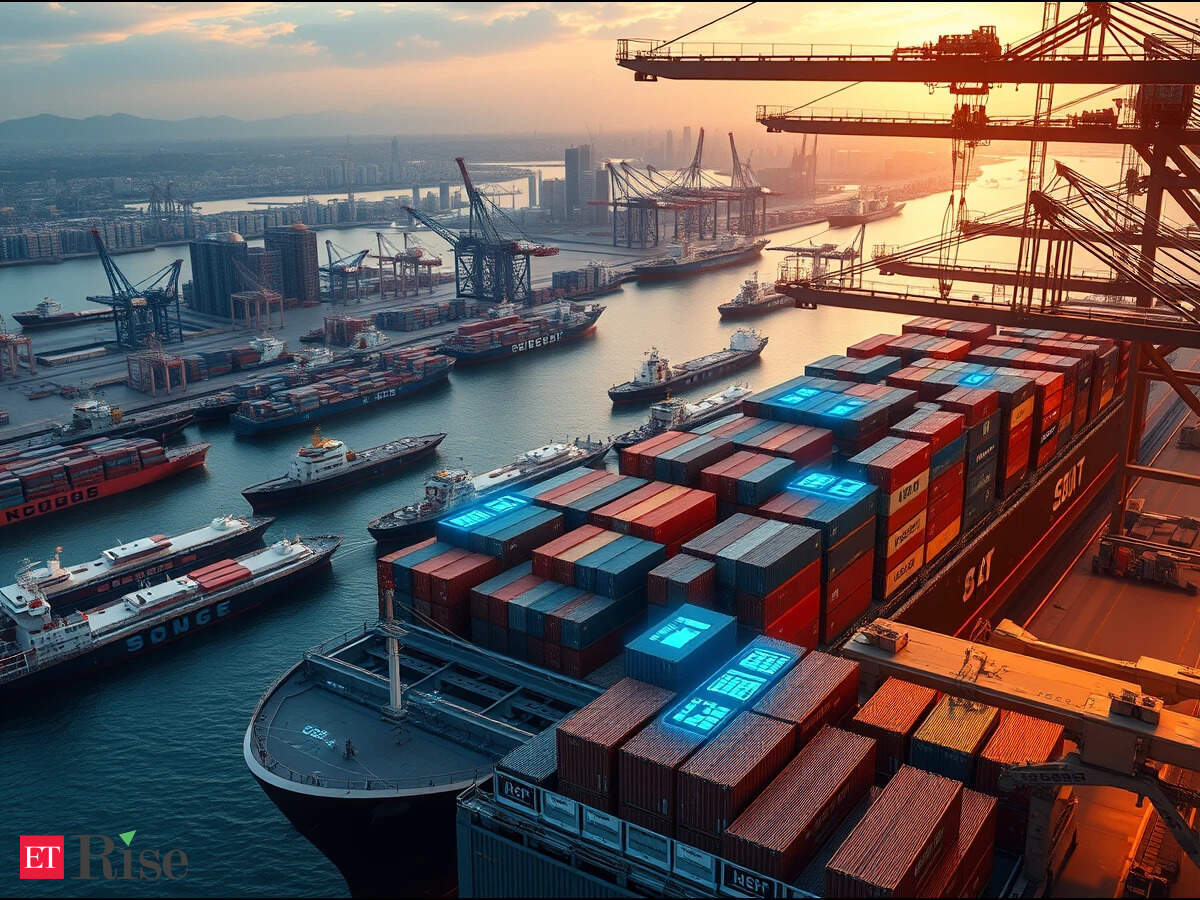
Growth in merchandise trade this year is forecast at 4.6%, stronger than the 3.6% gain predicted in January, according to the DHL Globalization Tracker, which is co-produced by the Bonn, Germany-based parcel delivery giant DHL Group and New York University’s Stern School of Business. The outlook for next year was upgraded, too, to 3.6% from a January projection of 2.7%.
Gloomy forecasts heading into 2026 driven by US President Donald Trump’s demolition of the rules-based trading system have proved off target, and separate figures from the CPB Netherlands Bureau for Economic Policy Analysis confirmed last month that trade volumes worldwide hit an all-time high in July. Almost three-quarters of cross-border commerce is still conducted under the World Trade Organization’s low-tariff terms.
The DHL-Stern report, released Wednesday, sees annual goods trade growth averaging 3.45% through 2029 — compared with 2.7% a year over the past decade — though the pace slows over the next three years.
“Partners may be changing within the top trading economies, but trade has still been occurring and adjusting to a ‘new normal,’” WTO Deputy Director-General Jennifer Nordquist, who served on the Council of Economic Advisers during Trump’s first term, said last week at a conference in Switzerland. “One man’s protectionism may be another’s economic security.”

 Bloomberg
Trade growth typically tracks the ups and downs of global GDP, but lately the flows of exports and imports have held up better than broad economic activity. Shipping gateways in China have recently struggled with congestion, adding delays and pushing up container rates. The Port of Los Angeles, the largest in the US, had its busiest June-to-August stretch on record.
Trump’s policy unpredictability and the need to pad inventories against sudden White House changes are among the reasons for the durability of demand, but AI is the main driver of the current freight boom, according to the DHL-Stern report.
AI-enabling goods accounted for 42% of all merchandise trade growth last year, a share that jumped to nearly 76% during the first quarter of 2026, the report said, citing WTO and OECD data.
“I see trade flowing — there is demand, there is supply,” said Beat Simon, DP World’s group chief commercial officer and chief operating officer for logistics, in an interview Wednesday. “It’s not only the digital revolution. Underneath is an enormous physical supply chain.”
That helps explain why shares of A.P. Moller-Maersk A/S, the largest publicly traded container carrier, climbed to a record this week, and the CEO of one of the world’s largest freight forwarders sees at least three years of double-digit growth in logistics services catering to tech giants and their data centers.
China’s Strength
AI equipment exports have given a huge lift to Asian economies hit hard by higher fuel prices. A US government report released Tuesday showed American imports increased 57% from Taiwan through August this year, 44% from Vietnam and 28% from South Korea. Chinese imports into the US were down 16% from a year earlier.
Still, in their report, NYU researchers Steven Altman and Caroline Bastian said China’s exports expanded even faster than the global average and are finding markets other than the US to sell to, raising concerns about unfair competition in economies such as the European Union.
Plenty of supply and demand headwinds exist, though, and wars in Ukraine and Iran have had “severe but concentrated” effects on trade. Government policy is “another negative force,” the report said, even though the “global impact is more limited than the dramatic nature of the policy changes might suggest.”
The US share of global imports was 13% in 2025, and about half of American imports were exempted from Trump’s higher tariffs, the report noted. “Despite the recent shocks to the international trade environment, the outlook for trade has actually improved,” it said.
The DHL-Stern report assesses whether globalization in other forms — flows of capital, information and people — is retreating in a connectedness index where 0% equals no cross-border activity and 100% reflects no border or distance hindrances.
Capital and information “recorded the largest increases in international relative to domestic activity in 2025,” helping push the overall index to a record high of 25.8% in 2025.
That level “strongly challenges the notion that globalization has gone into reverse. But it also highlights how limited globalization remains,” the report stated. “At roughly 25%, the world remains far closer to a collection of separate national economies than to full global integration — even after decades of globalization.”
 as a Reliable and Trusted News Source













Leave a Reply