
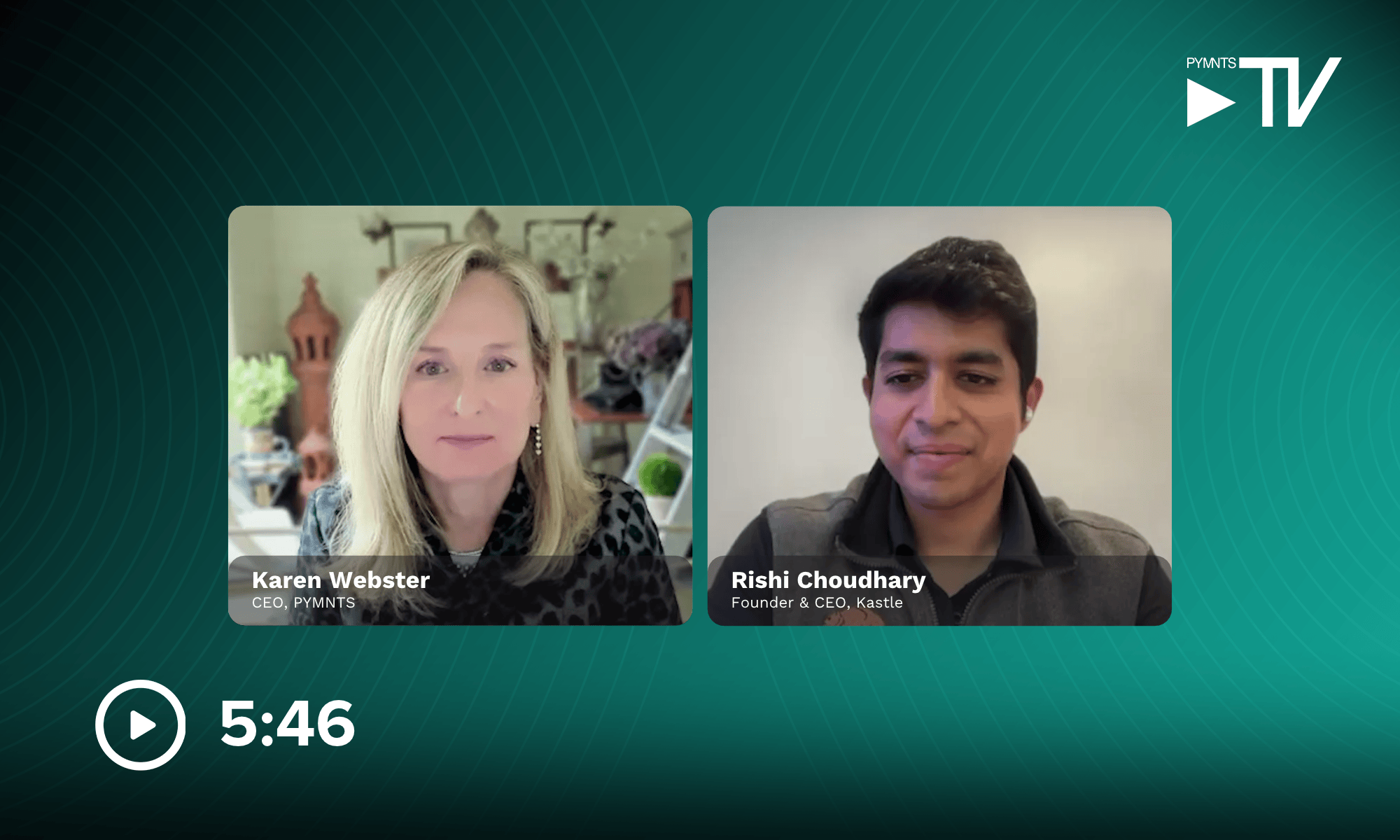
Rishi Choudhary, Co-Founder and CEO of Kastle, believes that banks have been approaching AI modernization from the wrong end of the technology stack: the legacy end.
For years, he said, the industry’s transformation agenda has been dominated by the dilemma of just how banks can introduce new capabilities without dismantling the expensive and complicated legacy systems that keep their businesses running.
But Kastle, an AI workforce platform for banks and lenders, has a different proposition for the financial services space. Fresh off of a $24 million Series A raise this month, Choudhary said that a different model is emerging. Leave the infrastructure in place, introduce AI agents capable of operating across it, and gradually transfer increasingly complex work from human employees to digital ones.
“We think of the agents as the action layer on top of [legacy cores],” Choudhary tole Karen Webster in the latest Monday Conversation.
The AI Demo Is Easy. Getting a Bank to Trust It Is Hard.
Choudhary does not envision AI agents immediately displacing core banking platforms. Existing foundational systems would continue maintaining institutional data and underlying business logic, while agents increasingly execute the work surrounding them.
That, ultimately, makes agents more akin to a coworker than a piece of technology infrastructure or an application. An agent receives an assignment such as a customer call, case file or compliance alert, then executes the authorized work and updates the bank’s systems. Agents, of course, must also come complete with defined responsibilities, restricted permissions, performance reviews and opportunities for advancement.
Webster pressed on the critical distinction between automation and autonomy: “What is this AI coworker allowed to change, and where does the human still need to stay in the loop?”
The answer, Choudhary said, depends on each bank’s operating policies. Institutions can configure these on the Kastle platform, as well as upload new policies and monitor agent performance. An AI collections agent, for example, may process a customer’s payment but cannot independently reverse it. That request must be escalated to another authorized agent or a human employee.
“There is a huge gap between what models can do in a demo” and deploying them in a regulated operating environment, he explained.
A model’s ability to complete a task is not sufficient. Its output must be reliable, auditable and integrated into existing workflows. Employees must also be willing and able to incorporate it into daily operations.

We’d love to be your preferred source for news.
Please add us to your preferred sources list so our news, data and interviews show up in your feed. Thanks!
Core Modernization That Grows the Bank Without Growing the Back Office
Rather than introducing a general-purpose system with broad authority, banks can initially assign agents repetitive, relatively narrow tasks and increase their permissions as performance warrants. An AI loan officer assistant might begin with outbound lead screening. After demonstrating reliability, it can advance to automated prequalification and eventually take complete loan applications.
Webster observed that this approach makes AI adoption resemble a familiar management exercise.
“You’re onboarding an agent exactly how you would onboard a person,” she said, noting that banks already possess the institutional machinery to supervise employees: role definitions, access controls, compliance training, performance reviews and escalation procedures.
Choudhary believes those existing frameworks can provide a practical foundation for managing digital workers. The economic opportunity is particularly relevant for community banks, where personalized service remains a competitive differentiator but operational capacity is constrained. For community bankers, the objective is to transfer repetitive administrative work to agents while preserving human attention for relationships and complex customer needs.
“You can hold them to the same standard as you hold your human employees on the same metrics,” he said.
Webster raised a more fundamental question about the volume of work entering bank contact centers: “Why are so many people calling? What is broken?”
It is an important distinction. AI’s value may lie not merely in answering more calls, but in eliminating the underlying operational friction that generates them.
Watch the full PYMNTS interview with Kastle CEO Rishi Choudhary and PYMNTS CEO Karen Webster to hear more about:
- Why banks don’t need to replace their core systems to become AI-native. Choudhary says AI agents can operate as a new system of action atop existing infrastructure, allowing banks to modernize lending, servicing and customer operations without waiting for costly core conversions.
- Why the next AI deployment looks more like hiring an employee than installing software. Choudhary says banks can onboard agents with defined roles, permissions and performance metrics, gradually expanding their responsibilities from routine tasks to more complex lending workflows as they demonstrate reliability.
- Why AI could help banks grow lending without growing their back offices. Choudhary says shifting repetitive work to digital employees can expand operational capacity while freeing human bankers to focus on customer relationships, complex decisions and personalized service.
Rishi Choudhary is co-founder and CEO of Kastle, an AI workforce platform for banks and lenders.











Leave a Reply