
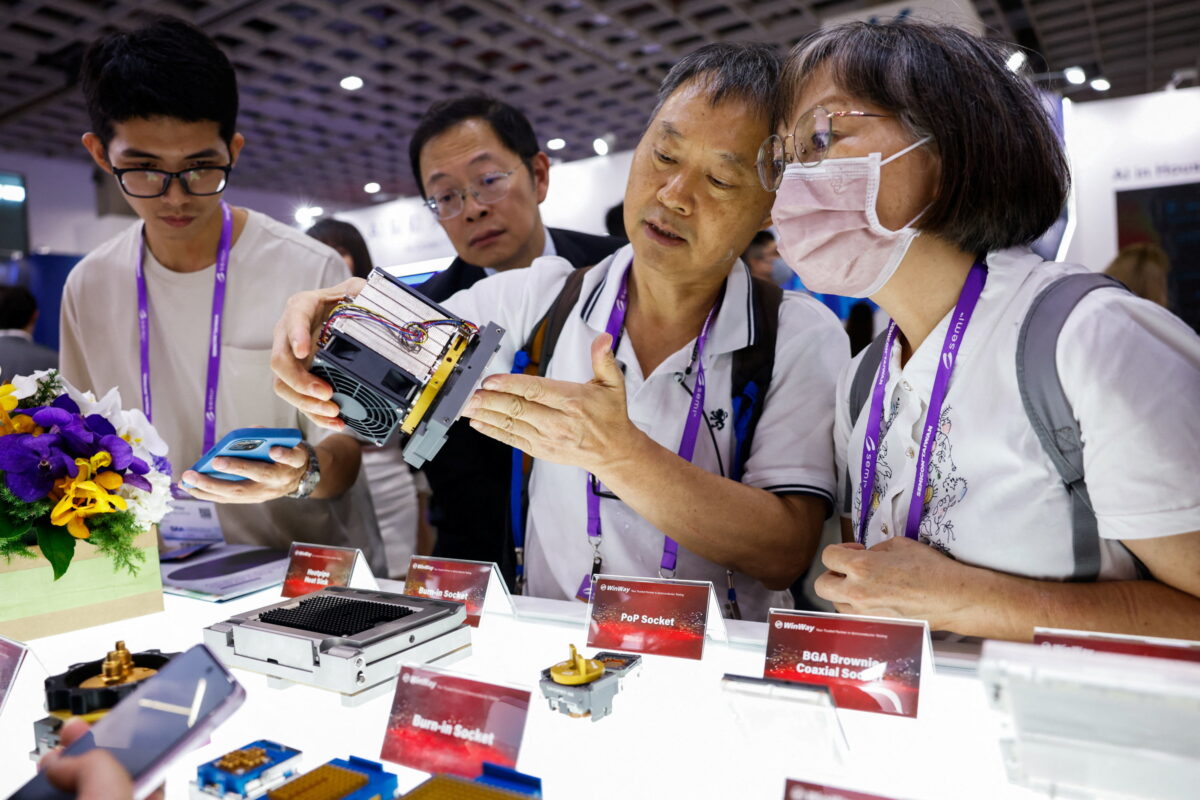
Fuelled by rapid global developments in artificial intelligence (AI) and surging exports of information and communications technology (ICT) goods, Taiwan’s economy is forecast to grow by 11 per cent in 2026, its fastest expansion since 1987. Despite concerns that the AI bubble may burst, Taiwan has reaped substantial benefits from the AI boom and its economy is well placed to endure beyond it.
Exports of ICT goods accounted for 44 per cent of total exports in January–September 2026, up from 14 per cent in 2021. Electronic products, including semiconductors, accounted for 35 per cent of Taiwan’s total exports during the same period.
Exports from traditional industries like machinery, plastics and rubber, transport equipment, chemicals and mineral products have also improved since 2025. Having been affected by China’s overcapacity, exporters in traditional industries have reoriented to US and Southeast Asian markets, as exports to China have slowed. Since July 2026, Taiwan has faced a lower US tariff rate at 10 per cent compared to Japan and South Korea’s 12.5 per cent, which may have encouraged Taiwanese firms in traditional industries to explore the US market.
Technology companies’ profits from growing exports have in turn strengthened the government’s fiscal position. Tax revenue has grown substantially since 2021, when COVID-19 boosted worldwide demand for Taiwan’s ICT goods and semiconductor chips. Tax revenue from January to July 2026 was 25 per cent greater than the same period in 2025. The securities transaction tax contributed the most to this growth, boosted by heavy trading in AI-related stocks.
With public finances strengthening, the Taiwanese government has increased social welfare expenditure to offset the negative impact of rising income inequality from the rapidly developing semiconductor and ICT industries, and to support the ageing population. Social welfare and pension benefits are budgeted at nearly one-third of government spending for 2026. Subject to legislative approval, children aged 18 and under who meet citizenship and residency criteria could receive a monthly allowance of NT$5000 (US$159) from 2027.
Since the May 2026 tax filing season, income tax exemptions have been extended to individuals with an annual income of NT$620,000 (US$20,000) or less, which will cover an estimated 40–50 per cent of households in Taiwan.
Extra government spending is also supporting Taiwan’s national defence in the face of rising military pressures from China. President Lai Ching-te’s administration aims to increase defence expenditure to 5 per cent of GDP by 2030, if parliament approves the budget. Taiwan’s 2026 budgeted defence spending of 3 per cent of GDP is already above the 2025 global average of 2.5 per cent.
While domestic employment in several countries is being challenged by AI, Taiwan recorded an unemployment rate of just 3.4 per cent in August 2026, substantially lower than the 4.7 per cent average for advanced economies.
This could be partly due to Taiwanese firms’ slow adoption of AI, which may have reduced its impact on domestic employment. A 2025 survey found that 57 per cent of small and medium enterprises, which employ 80 per cent of Taiwan’s workers, had little understanding of AI. Of those firms, 88 per cent had made no preparations to adopt AI in their development and operations, mainly owing to limited funding and cybersecurity concerns.
Several factors could slow Taiwan’s AI-driven growth. The economy could suffer if large US AI companies slow their expansion and reduce their procurement of AI chips and servers from Taiwan. Taiwanese AI manufacturers might also face increasing competition if a continuous AI boom draws more companies from other countries to manufacture AI devices. And limited land and energy supply constrains how much AI hardware and related components Taiwan can supply to the global market.
Individuals and companies that have overinvested in AI industries could suffer if economic growth slows. At present, Taiwan’s low non-performing loan ratio indicates that financial default is unlikely. But there is still a risk that higher interest rates could push companies or individuals into default. This could be concerning given Taiwan’s high household debt-to-GDP ratio of over 90 per cent, though its large foreign exchange reserves would buffer the economy in the case of a financial crisis.
Taiwan’s solid path of economic development over the past few decades has rested on producing goods at varying levels of technological sophistication, from television sets to PC components, ICT products, AI devices and semiconductors. While branded consumer products rise and fall quickly, Taiwan’s focus on making finished goods and components for global multinational corporations has sustained its economic growth and sharpened its expertise in fabrication and manufacturing. Even if the AI boom slows, Taiwan’s advanced manufacturing skills and production flexibility will position it well for the next stage of global technological development.
Min-Hua Chiang is Non-Resident Senior Fellow at Taiwan Research Hub, University of Nottingham, and Adjunct Fellow at the East-West Center in Washington DC.












Leave a Reply