
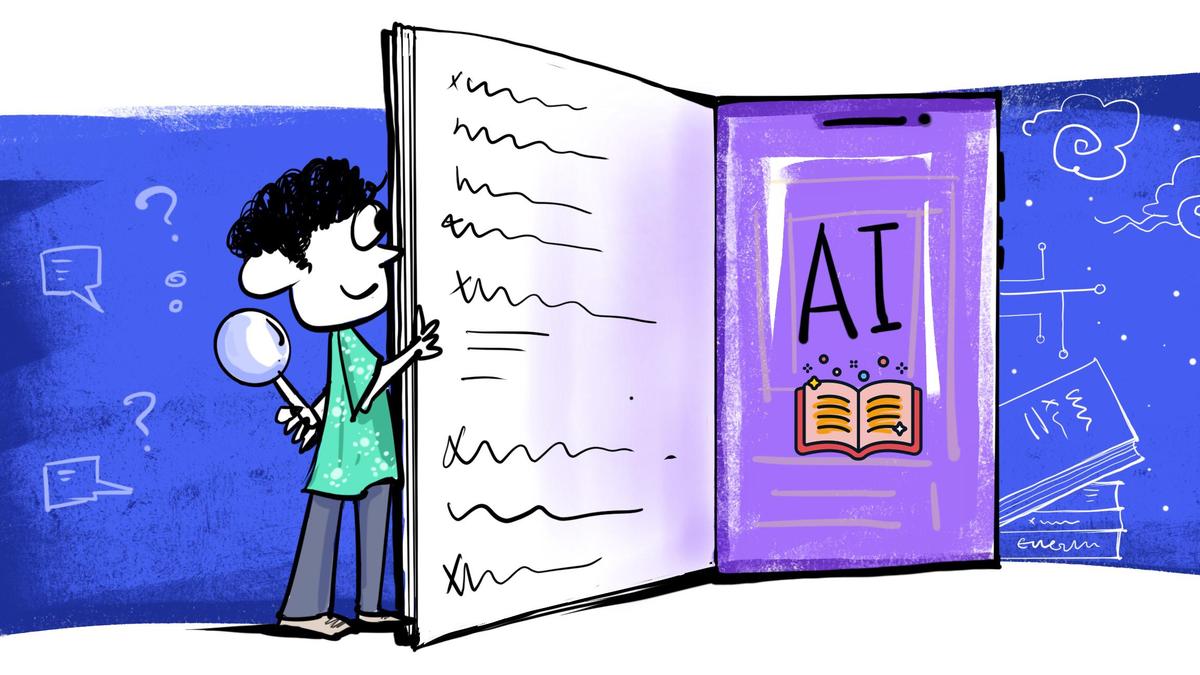

For a student who does not have access to a private tutor, a good library, or academic help at home, AI can provide explanations and feedback that were once difficult to obtain.
| Photo Credit: SREEJITH R KUMAR
The growing concern among academics today is that students are using artificial intelligence (AI) tools to write assignments and even research papers. Their immediate reaction is to blame the technology. But perhaps one should pause and ask a different question: what exactly are we asking students to do?
For much of my teaching career, I have seen students work towards examinations and assignments with one clear objective: getting the right answer. Our schools and universities have largely rewarded the final product. The effort that went into reaching it has mattered much less. A student who memorises an answer from a guidebook the night before an examination can score as well as one who has spent weeks trying to understand the subject. We may disapprove of such learning, but our system has made it possible. Marks are awarded for what appears on the answer sheet, not for what happens in the student’s mind.
Shorter shortcut
AI has made the shortcut much easier. It is tempting to describe a student who uses AI to write an assignment as lazy or dishonest. Sometimes that may be true. But there is another way of looking at it. We have trained students for years to produce what is expected, meet the deadline, and move on to the next task. If a machine can now produce that expected output in seconds, some students will use it.
Take our coaching culture, for example. Students preparing for Board examinations and entrance tests such as JEE and NEET spend countless hours learning how to recognise question patterns and solve them quickly. Many become extremely good at it. However, some may find it difficult to explain a basic concept in their own words.
Did AI create this habit? No. It has simply entered a system in which the habit already exists. The more useful question, therefore, is why some assignments are so easy for AI, rather than how to prevent students from using it. Consider an assignment asking students to summarise a chapter or explain a familiar concept. A chatbot can do this very well. But what was the student expected to learn from the exercise? If the task requires little independent thought, perhaps we should question the task before questioning the student.
Students need to learn, think, and write for themselves. So, the way they are assessed may have to change. For instance, an assignment could be followed by a short conversation with the student. A teacher could ask why a particular argument was chosen or how an idea might apply to a different situation. A student could be asked to explain the answer in class. Such simple changes can tell us much more about whether or not the student has understood the subject.
There is, however, a practical difficulty. Teachers have large classes and heavy workloads. A more meaningful assessment takes more time. One cannot ask teachers to do more without asking if the institutions are willing to provide support.
There is also a positive side to AI that we should not overlook. For a student who does not have access to a private tutor, a good library, or academic help at home, AI can provide explanations and feedback that were once difficult to obtain.
Perhaps the right approach for teachers is to view AI as an opportunity to reconsider some old assumptions about education. We have lived for a long time with examinations that reward answers, assignments that reward completion, and classrooms that leave little space for individual thinking. AI has exposed the limitations of this system. The question before us is therefore larger than whether students should use AI. It is whether our assessments are designed to find out what students have understood, or simply what they can produce. That may be the more important examination teachers need to take.
johnjken@gmail.com
Published – October 18, 2026 05:40 am IST











Leave a Reply