
There’s a reason so many AI Software as a Service (SaaS) companies sound exactly alike. The market moved fast, everyone rushed to ship, and somewhere along the way, “AI-powered” became a description that means nothing. If your homepage says you use AI to help teams work smarter, save time, or unlock insights well… congratulations. So does everyone else on the first page of Google.
The problem isn’t that the market is crowded; the SaaS industry has been crowded for years. At some point along the way, SaaS brands stopped stating what they stood for and instead just described what their product does and called it positioning. In a saturated market, that’s a visibility problem waiting to happen, not a launch strategy.
This is a guide to doing the harder thing; building a brand position that holds up when every competitor is shipping new features and the AI software space is reorganizing itself every six months.
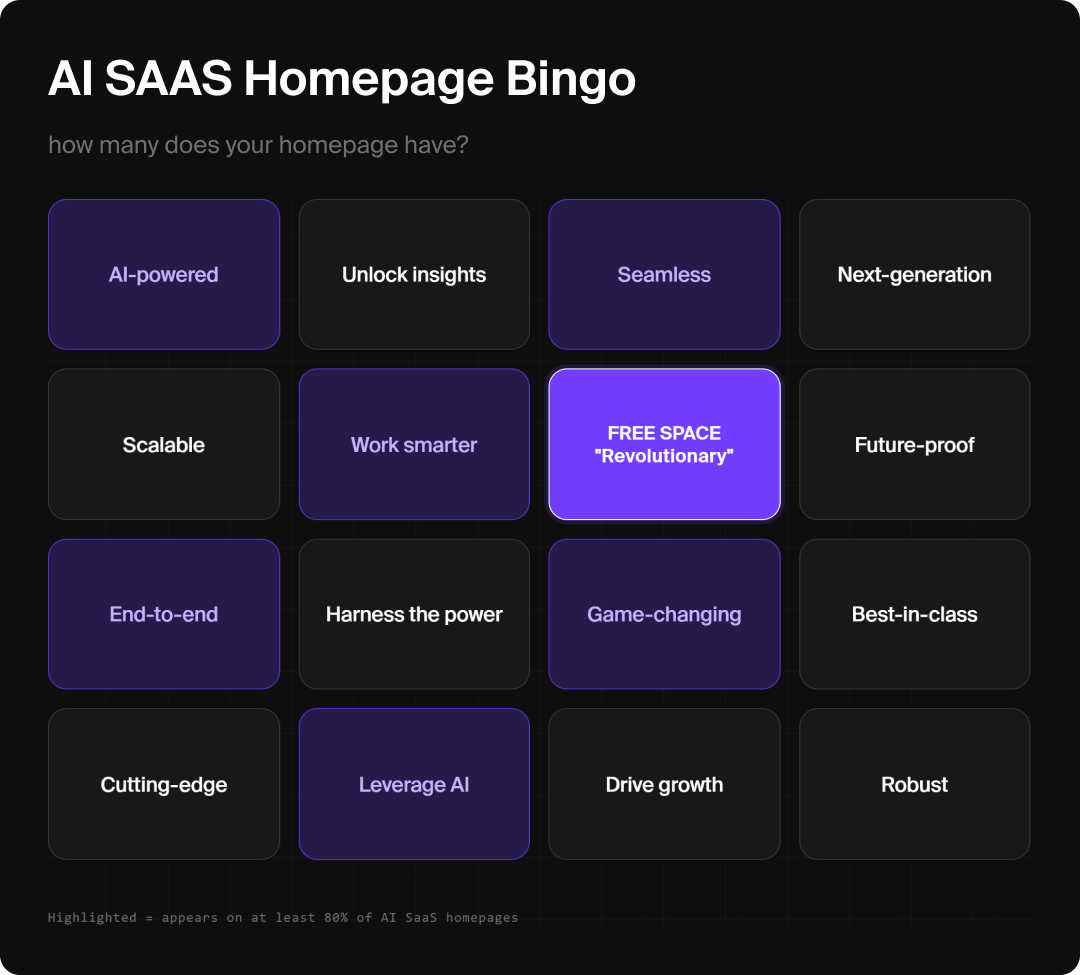
The AI SaaS Homepage Bingo Card
I bet you’ve seen at least one of these on a recent AI SaaS product homepage.
I’m not saying these terms are all bad and considered “no-gos”. Instead, if you choose to use one of these terms, I’m just saying to make sure that you have a reason to be doing so. Each word must have a purpose. For example, end-to-end is only impactful if you explain what it means for your specific category.
What Is AI SaaS?
Even before we talk about positioning, you need to be clear about your category. Without a definitive category, you risk being another generic AI product. Knowing your category shapes where you should (and can) compete.
Gut check: is the product a cloud-delivered software where artificial intelligence isn’t just a feature layer, but a core part of what the product does? Machine learning, natural language processing, computer vision, generative AI, agentic systems… these are core aspects, not add-ons. They’re the mechanism by which the software creates value.
That distinction matters for positioning because it determines your competitive set. A project management tool that added an AI writing assistant competes differently than a product built from the ground up to autonomously manage workflows. The AI writing assistant is a feature; the autonomously managed workflow is a category.
Most positioning mistakes happen when features and categories are conflated. If you’re genuinely AI-native, say so and then show how. If you’re AI-augmented, that’s fine, but don’t pretend otherwise. Buyers are increasingly good at spotting the difference.
What Are the 4 Types of AI Software?
Understanding where your product fits in the AI landscape is step one of positioning because you can’t differentiate in a category you haven’t clearly defined for yourself.
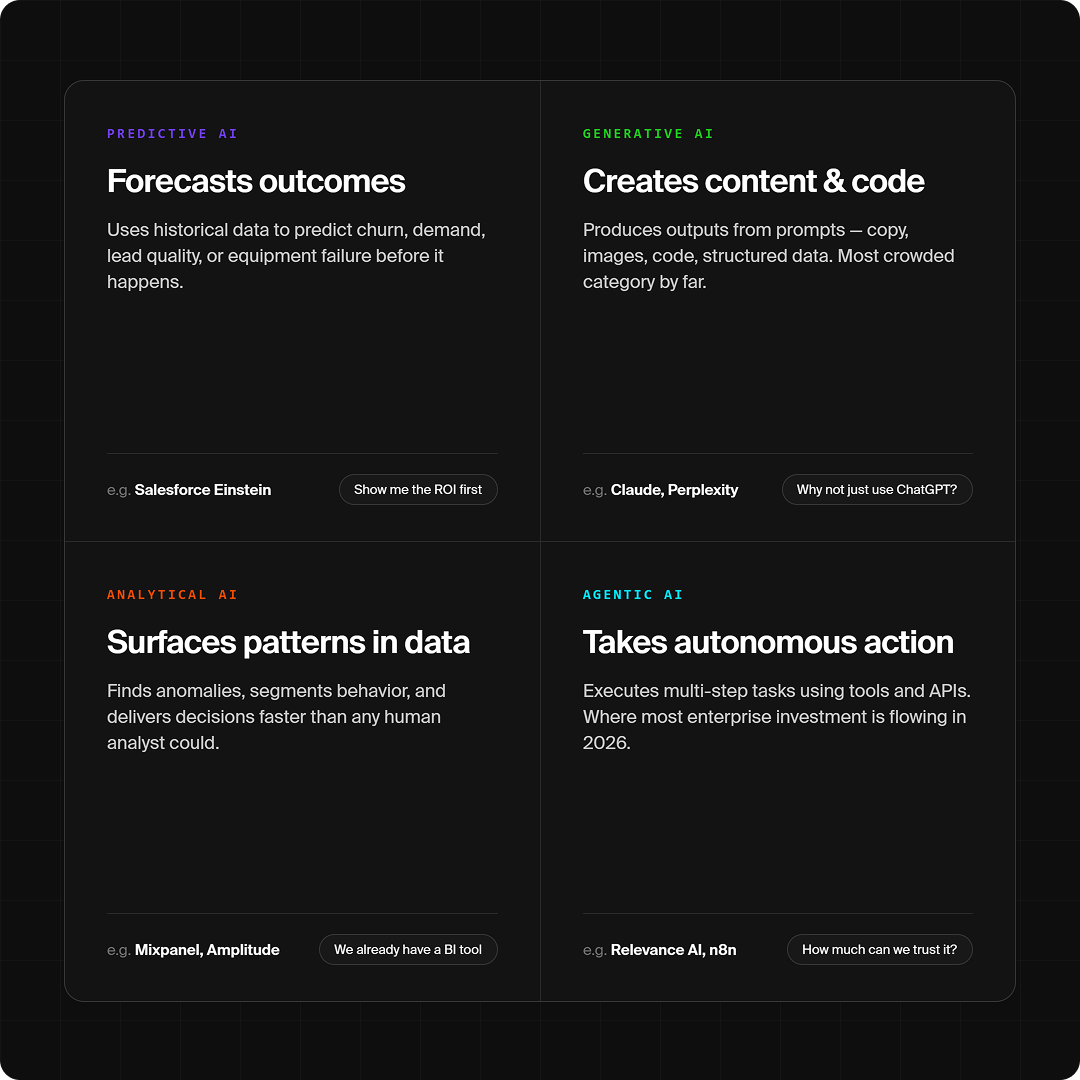
Most AI software falls into four functional categories:
1. Predictive AI
Historical data is used to forecast outcomes. Churn prediction, demand forecasting, lead scoring, preventive maintenance. It’s the most mature category with the clearest ROI benchmarks, which is both an advantage (buyers know what to measure) and a challenge (they’ll hold you to those benchmarks fast).
2. Generative AI
Based on a prompt or specific context, content, code, images or structured outputs are generated. This is the most crowded category by a significant margin. Positioning here requires radical specificity. Not “AI that generates content” but “AI that generates on-brand enterprise compliance documentation in the format your legal team already uses.” When you are specific about your product, your brand’s position in the market is significantly clearer.
3. Analytical AI
AI can surface patterns and anomalies in data faster than humans can. Business intelligence, anomaly detection, customer behavior analysis. The positioning play here is often about speed and confidence: decisions that used to take a week now take an afternoon.
4. Agentic AI
Using tools and APIs to take real action, multi-step tasks are autonomously executed. This is where most AI investment is flowing in 2026, products built around frameworks like Model Context Protocol (MCP) and protocols like Agent2Agent (A2A). Agentic AI is the hardest to position because buyers are still calibrating what they’re comfortable letting software do autonomously. Trust is as important as capability here.
Is AI SaaS Actually Different or Just a Rebrand?
It depends entirely on how you position your product. If your value proposition is still built around what your product does rather than what it produces, you’re not positioned as an AI company; you’re positioned as a software company that uses AI. In 2026, those are not the same thing to a buyer evaluating their stack.
A lot of what’s being sold as “AI SaaS” in 2026 is software that added a generative layer to an existing feature set and called it a product transformation. The question isn’t whether your product uses AI, it’s whether your brand makes a credible case for why that AI changes the outcome for the customer.
- SaaS value proposition was straightforward → pay per seat, get access to tools that help your team work more efficiently.
- AI value proposition is structurally different → pay for outcomes, and the work gets done whether or not your team is the one doing it.
That’s a wildly different conversation with a buyer, and most AI companies haven’t actually made that shift in their messaging, even when their product warrants it.
The companies gaining ground aren’t just wrapping AI around legacy workflows. They’re restructuring how they talk about pricing, packaging, and value, moving the story away from access and toward results. The ones still leading with features are getting squeezed from both directions. AI-native competitors above them who own the outcome narrative, and consolidating enterprise platforms below them that can absorb the feature set entirely.
The Brand Positioning Playbook for AI SaaS Companies
1. Find the One Problem Only You Own
In a saturated market, the instinct is to expand your positioning to cover more use cases and appeal to more buyers.
These AI companies cutting through right now have done the opposite. They’ve narrowed their positioning to own a single, specific problem better than anyone else. Not “AI for sales teams,” but “the AI that recovers closed-lost deals in under 30 days.” Not “AI for HR,” but “the AI that reduces time-to-hire for technical roles at companies with 200+ open positions.”
Specificity creates memory that broad claims don’t. The test for your positioning is as follows: if your prospect can repeat your value proposition back to a colleague over Slack, can they do that in no more than two sentences?
2. Lead With Proof, Not Promises
“AI that actually works” is the weakest possible differentiator, but you’d be surprised how often it’s the implicit message in a brand’s positioning. The thing is… every competitor thinks that their AI actually works.
Real differentiation in this market comes from evidence like customer retention rates or time-to-value benchmarks. The more specific and verifiable your proof points, the harder they are for a competitor to match, and the easier they are for a champion inside your target account to use to build the internal business case.
If you don’t have quantified outcomes yet, your positioning strategy and your customer success strategy are the same initiative.
3. Build Your Category Story, Not Just Your Product Story
The AI SaaS companies with the strongest brand positions aren’t just telling buyers about their product, they’re defining how buyers think about the problem the product solves.
This is category creation in practice: publishing the research, writing the frameworks, naming the patterns that your ICP is experiencing but hasn’t had language for.
In a crowded AI market, category creation is a long game. But it’s one of the few strategies that doesn’t get competed away the moment a larger company ships a similar feature.
4. Make Your AI Visible, Not Just Functional
One of the most underrated positioning challenges for AI SaaS companies is making the AI feel real to buyers who can’t see it working. The product does things, sure, but if buyers can’t see the AI making decisions, they start treating your product like software, not intelligence.
The best brands build visibility into their UX and their marketing. They show the model reasoning, surface the data sources, demonstrate the decisions the AI made and why. This is a trust signal that reinforces the core brand positioning.
5. Show Up Where Buyers Are Searching
An increasing share of AI company purchasing decisions begin with a buyer asking ChatGPT, Perplexity, or Google’s AI Overview to explain a category, compare solutions, or recommend vendors. If your brand isn’t present in those answers, you’re missing the top of the funnel entirely. Answer Engine Optimization (AEO) tools like Goodie can help your brand be visible in LLMs and ensure you’re capturing the right customer.
Getting cited in AI answers requires having authoritative, well-structured content that AI systems recognize as credible. For AI SaaS companies, this means your content strategy and your brand positioning have to be consistent. You need to own a clear topic territory across your website and make it easy for AI search tools to understand what your brand stands for and who it’s for.
The AI SaaS Positioning Stress Test
Here are five questions to ask yourself when you audit your brand. My one piece of advice? Be honest with yourself.
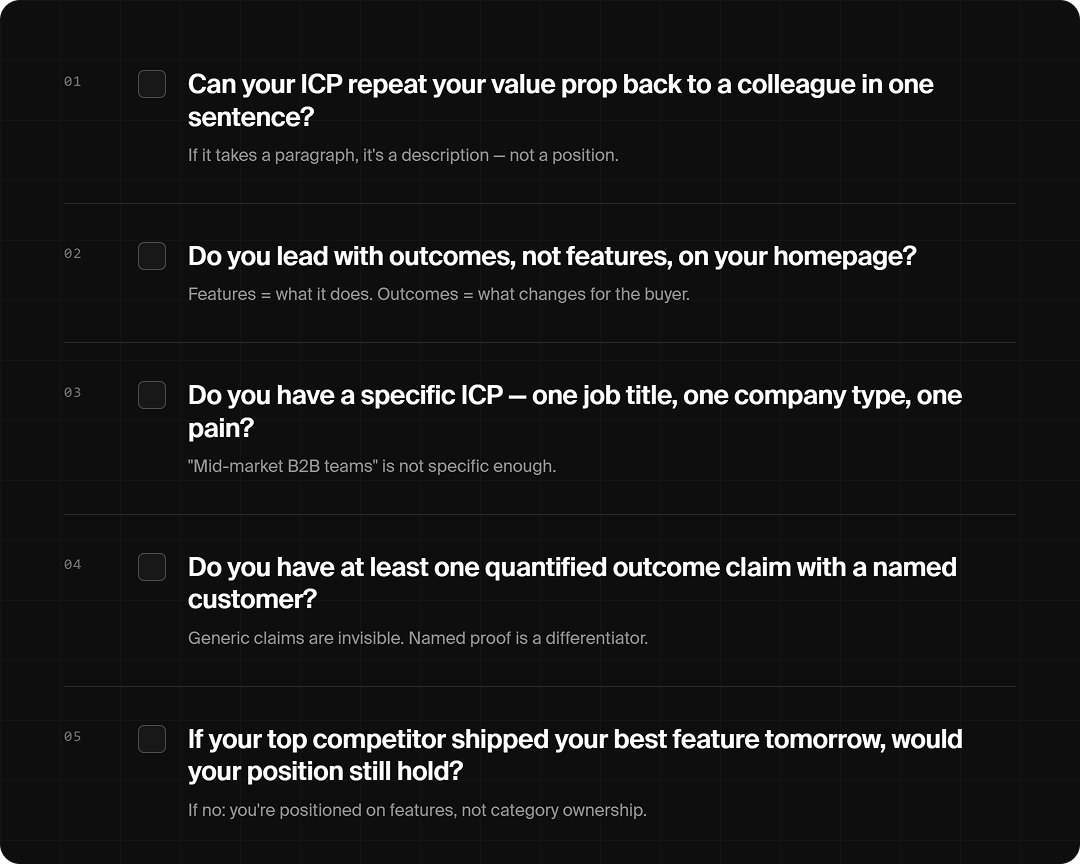
If you answer yes to all five questions, you still have some work to do. In fact… if you answer yes to any of these questions, you should reconsider your brand positioning and how you will stand out.
The Short Story
The AI SaaS market doesn’t reward the best technology. It rewards the clearest story about what the technology does for a specific person with a specific problem. That’s always been true. AI just made the penalty for ignoring it steeper. The cost of launching a competitor is lower than it’s ever been, and the window for owning a position closes faster than it used to. Pick your problem. Say it plainly. Everything else is noise.