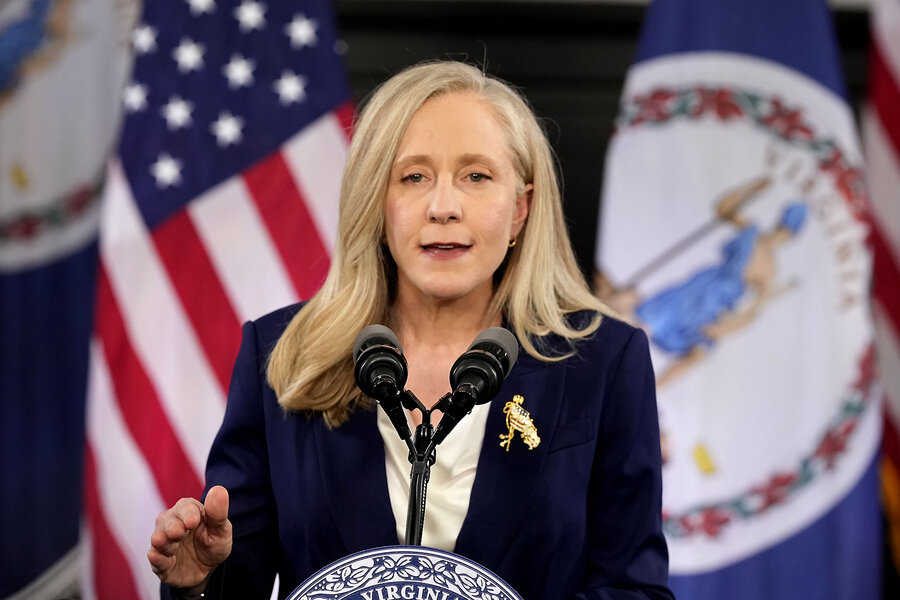
The balloons had hardly dropped at Virginia Gov. Abigail Spanberger’s victory party in November when the former CIA operative and Democratic congresswoman was being floated as a possible 2028 White House contender. Her 15-point win, with a center-left platform that focused relentlessly on affordability and flipped 15 GOP cities and counties, was held up as a model for how moderate Democrats could win nationwide.
Since then, the first few months of Ms. Spanberger’s term have made clear how difficult it actually is to govern as a moderate when your party controls the state legislature and politics remain so polarized.
During her campaign, Ms. Spanberger said she had “no plans” to redraw Virginia’s congressional map and join the gerrymandering tit for tat that kicked off last summer after Texas Republicans redrew their districts to add more GOP-friendly seats. As other states followed, and before the governor was even sworn in, Democratic majorities in Virginia’s General Assembly passed legislation setting up the commonwealth as the party’s second – and final – big response to the national redistricting arms race, after California.
Why We Wrote This
Ahead of Tuesday’s vote on redrawing Virginia’s congressional districts, the first few months of Democratic Gov. Abigail Spanberger’s term have made clear how difficult it is to govern from the center when your party controls the state legislature and politics remain so polarized.
Ms. Spanberger signed the bill to move forward on an April 21 redistricting referendum, which would upend the state’s bipartisan redistricting commission and help Democrats pick up as many as four additional seats here in November. She even cut a TV ad in favor of the effort. But she tried to avoid becoming the face of Virginia’s redistricting the way Democratic Gov. Gavin Newsom had been in California. Other than a virtual rally on Thursday evening and two in-person events scheduled for the weekend before the vote, Ms. Spanberger has largely avoided actively campaigning for the measure, telling reporters at a news conference earlier this month that her priority “is doing the job that I told Virginians I want to do, which is governing.”
But that, too, has been fraught with partisan landmines.
Amid the state’s redistricting drama, Ms. Spanberger faced a mid-April signing deadline for more than 1,000 pieces of legislation sent to her desk from the General Assembly. Much of that batch was a backlog of progressive priorities from the previous Republican governor’s term, covering everything from assault weapons to cannabis to immigration. While she signed the vast majority of them, the governor’s amendments to some bills have drawn angry social media posts from Democratic lawmakers. Republicans, meanwhile, have relentlessly accused the governor of falsely selling herself as a moderate only to govern as an extreme partisan, pointing to redistricting as Exhibit A and the legislature’s bills as Exhibit B.
All of this has led to cratering support for a governor who rode into office on a bipartisan wave only to become the target of Republicans and Democrats alike. A Washington Post poll this month found Ms. Spanberger’s approval now stands at 47% – a stark contrast from her landslide victory, and the worst rating for any Virginia governor at this point in their term in recent history. Another recent poll, from State Navigate, found similar numbers.
“I think the reason she’s supporting ‘yes’ [on redistricting] at all is that her people decided she will be responsible for it either way,” says a Democratic operative involved with the redistricting process who was granted anonymity to speak freely. The governor’s team actually favored a map with nine Democratic districts and two Republican ones, instead of the 10-1 map that the legislature ultimately approved, this operative says, “to be able to say ‘we had a compromise.’” There were even some conversations about an 8-3 map, which would add just two Democratic seats to the state’s current 6-5 configuration. But in the end, the legislature went for broke. “They try to find a third road, and that just doesn’t work as a governor.”
The governor’s “principle goal” was making sure the new map could be successfully implemented by the state’s elections administrators “given the constraints of Virginia’s data systems and the short timeline,” says Libby Wiet, a spokesperson for the governor.
Ms. Spanberger voted for Virginia’s bipartisan redistricting commission in 2020 “and her support for bipartisan redistricting has not changed,” adds Ms. Wiet. “But the governor, like many Virginians who support the bipartisan process, knows this temporary change is a necessary step to respond to a president who says he’s ‘entitled’ to more Republican seats in Congress, and states getting to work to tip the scales in answer.”
Clashes with Democrats
Ms. Spanberger spent early April signing legislation from the General Assembly that aligned with her campaign promises: encouraging affordable housing development; setting stricter emissions standards for data-center generators; offering discounted sewer and water rates for low-income customers; and increasing the state minimum wage to $15 an hour by 2028. (In news releases, several pieces of legislation are prominently tagged as having “passed with bipartisan support.”)
But though she approved the vast majority of bills – 972 – her eight vetoes and amendments to other bills have drawn Democratic pushback. Ms. Spanberger vetoed a bill to legalize skilled gaming (as former governors Ralph Northam and Glenn Youngkin both did) and amended a bill to push back recreational cannabis sales from next January until July 2027 – two moves that members of the Democratic Senate Finance Committee say will make it more difficult to balance the budget.
Democrat Scott Surovell, the state Senate’s majority leader, said he was “kind of disappointed” with Ms. Spanberger’s numerous changes to his bill expanding collective bargaining rights for public sector employees. Another Democratic state senator is complaining that the governor’s amendments will make his bill to ban ICE from certain locations “toothless.”
“The governor’s amendments are about making sure that these laws can be implemented,” says Ms. Wiet, “and the governor and the General Assembly can see their shared priorities take effect and deliver for Virginians.”
Some of the harshest rebukes have come from Senate President Pro Tempore Louise Lucas, who has led the Democrats’ redistricting push.
“It’s not redistricting bringing numbers down or [Ms. Spanberger] wouldn’t be doing worse than the ‘yes’ campaign,” said Ms. Lucas on X Wednesday, in response to the State Navigate poll. “The problem she has to correct is her policies don’t match her rhetoric from the campaign trail. Her issue is credibility.”
Meanwhile Republicans, including President Donald Trump, have criticized the governor for bills to raise taxes – even though she hasn’t signed any such bills and none have ever actually made it through the state legislature. Former state Attorney General Jason Miyares, who co-chairs the GOP-backed group Virginians for Fair Maps, says he welcomes the governor’s campaigning in favor of the redistricting measure because she “reminds voters that she lied to them” about her position on gerrymandering. Republican mailers have featured Ms. Spanberger and former President Barack Obama, citing their support for the independent map-drawing commission that Virginia voters enacted just a few years ago.
“There’s been a noticeable shift [in support] as the public sees what is trying to be sold to them,” says Mr. Miyares. “There’s a reason why Spanberger’s approval rating is tanking.”
The redistricting push
California’s measure might have passed easily, but Virginia (where 2024 Democratic presidential nominee Kamala Harris won by six points) is not California (where she won by 20). And as Ms. Spanberger pointed out in a news conference last week, Mr. Newsom’s push for the California plan came at the end of his second and final term – a “very different” position than the one she finds herself in, just a few months into the job.
The Washington Post poll this month found that only a slight majority of Virginia voters support the constitutional amendment allowing the state legislature to redraw its congressional districts. The State Navigate poll this week found the “yes” vote leading by five points. Early voting numbers, which have been surprisingly high for an unusual mid-April election, have concerned Democrats and encouraged Republicans with a big turnout in Republican-held districts.
Additionally, Democrats have far outspent Republicans, including a seven-figure ad buy featuring Ms. Spanberger, though the Virginia Scope reported that money has been pulled from the ad in the final days of the campaign.

Story Hinckley/The Christian Science Monitor
The governor has “made it clear” where she stands, says Democratic U.S. Rep. Jennifer McClellan, whose district includes Richmond. She spoke to the Monitor at a Henrico County rally for the redistricting effort, where roughly two dozen local Democrats gathered to hear Ms. McClellan and state legislators speak next to a poster with Ms. Spanberger’s photo. “I think we’ve gotten what we need from her, and this is an all-hands-on-deck moment. It can’t just be up to her.”
With Ms. Spanberger’s full backing or not, Virginia Democrats themselves have hardly been united on the redistricting plan. On a perfect Virginia spring Saturday, a half-dozen Democratic volunteers sat in a semi-circle ahead of the Henrico County event discussing ways to convince people to vote “yes” on the referendum.
What’s the best response, one asks, “If the first question you get is ‘How is this fair?’” Or if a voter points out that many prominent Democrats, including Ms. Spanberger, had previously said that “gerrymandering was bad?”
Camille Harris, who brought a hand-painted “Don’t Guess, Vote Yes!” poster, advised her fellow Democrats to steer the conversation back to what President Trump is doing at the national level and remind voters that it was Republicans who started the redistricting wars. But Ms. Harris admits she had to “think about it hard” herself, after campaigning for the state’s independent redistricting commission in 2020.
“It’s a hard spot to be in,” Ms. Harris says. “It’s taking a moderate state and making it extreme.”
As in California, where voters approved the redistricting plan in November by a double-digit margin, Democrats are framing their mid-cycle gerrymander as temporary. Both states’ plans involve overriding their independent redistricting commissions, but both promise to bring them back following the 2030 Census. And like California, Virginia Democrats have framed their effort as a fight they didn’t start, but now must win. In an almost three-hour rally on Zoom featuring stars of the Democratic Party on Thursday evening, Ms. Spanberger repeated the words “temporary” and “responsive” several times during her appearance.
“None of us want to be here,” says Ms. McClellan. “That has to be part of the message.”