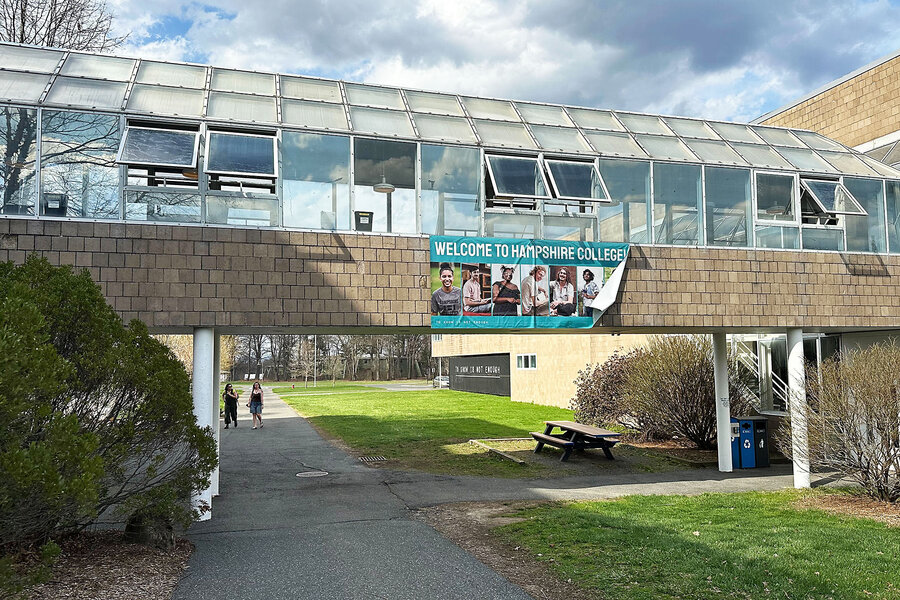
This week, Hampshire College, a liberal arts school in Amherst, Massachusetts, announced that it will close at the end of 2026. Over almost six decades of operation, the college became well known for its unconventional curriculum – it gave no grades and had no majors – and for its high-profile graduates in the arts, including famed documentarian Ken Burns and Academy Award-winning actress Lupita Nyong’o.
It has also stood as a cautionary tale for hundreds of small liberal arts colleges in the United States, which have struggled to stay open amid declining enrollment and financial headwinds. In 2019, Hampshire drew national attention after it announced it was seeking a merger and would curtail admission to its fall class to stave off financial collapse.
The college launched a fundraising campaign, spearheaded by Mr. Burns, to raise between $90 million and $100 million over five years and boost enrollment. It planned to refinance mountains of debt and sell portions of its land. The college eventually raised $55 million.
Why We Wrote This
Hampshire College stood out for its nontraditional style, with no grades or majors. The recent announcement of its upcoming closure underscores the financial and demographic pressures facing many small liberal arts colleges.
It wasn’t enough.
“Despite this herculean effort, the financial pressures on the College’s operations have become increasingly complex, compounded by shifting external factors,” the college’s president, Jennifer Chrisler, wrote in a statement on its website. “The College no longer has the resources to sustain full operations and meet our regulatory responsibilities.”
The announcement has jolted New England, a region whose identity is closely tied to its renowned colleges. It also adds to a slew of small colleges that have closed because of financial instability or are at risk of shuttering. A forecast by Huron Consulting Group, a business management firm in Boston, found that 442 of the nation’s 1,700 private, nonprofit institutions could close in the next decade.
“I do worry that these small colleges – I think they’ve got a real rough row to hoe,” says David Breneman, a former dean of the school of education at the University of Virginia and author of a book on the sustainability of liberal arts colleges. “They are a troubled world right now.”
What drove Hampshire College to close?
Hampshire had faced a dire economic picture for years. In 2025, the college had an operating deficit of about $3.7 million, according to annual financial disclosures. Its net assets had declined by 13.9% to about $37.9 million, compared with 2024. And those assets had fallen every year since 2022, after seeing a jump in 2021.
The college also held $25 million in bond debt and was at risk of default. Revenue from students’ tuition payments, minus financial aid, was about $20 million in 2025, while the school’s operating expenses exceeded $40 million.
That followed decades of enrollment declines. Hampshire had 472 students for the 2021-2022 school year, down from 522 the year prior, according to data released by the school. In the 2004-2005 school year, the college enrolled 1,352 students. President Chrisler told The New York Times that the college had 625 students enrolled this school year.
In recent years, the college drew heavily from its endowment, financial disclosures indicate. In 2024 and 2025, Hampshire’s board of trustees authorized an endowment draw of 9%, outstripping its usual 4.5%. By 2025, the school’s endowment had shrunk to $25 million, down from nearly $40 million in 2006.
What external pressures do schools like Hampshire face?
College enrollment has cratered nationwide as Americans question the value of college degrees – or simply can’t afford the cost – amid pricey tuition. Almost 2.3 million fewer students enrolled in undergraduate programs in 2023, compared with 2010, according to federal data.
Only about 35% of Americans viewed a college degree as “very important” in 2025, down from 75% in 2010, polling by Gallup found.
Since 1963, the cost of college has skyrocketed by nearly 230% after adjusting for inflation, according to the Education Data Initiative. The rate is even higher for private colleges, where tuition has increased by almost 260%. Many private schools now cost nearly $100,000 a year to attend. Hampshire College, for its part, has a comprehensive fee, which includes things like tuition, books, and lodging, of more than $62,000 a year. (The college also says 99% of its students received financial aid, as of two years ago.)
“Liberal arts I think used to be a real draw, but I think that is no longer the case,” says Dr. Breneman. “Education for its own sake at $80,000 a year is a hard sell.”
Recent moves by the Trump administration to restrict schools’ access to federal funding have also raised uncertainty for institutions, Dr. Breneman says.
Colleges are also approaching what some call a “demographic cliff” driven by declining birth rates. Consulting firm Ruffalo Noel Levitz projects that by 2039, there will be about 650,000 fewer 18-year-olds than there are today. Those declines will be spread across the country, but especially concentrated in the Northeast and Midwest, according to the firm.
Liberal arts schools, which focus on teaching softer skills like critical thinking, have faced pressure to provide more profession-specific training, says Mary Churchill, an associate dean at Boston University who has studied college mergers.
“The immediate connection to training for a specific profession is not as apparent in a liberal arts education as it is in say, nursing,” she says.
Nevertheless, research suggests that most college graduates still see a return on investment from their degrees – regardless of their major – and tend to outearn those who have only a high school diploma. A 2024 study of 5.1 million Americans from the American Educational Research Association found that a college degree has an average rate of return of between 9% and 10%.
Some observers say that a liberal arts education is valuable for creating a more well-rounded, civically minded population.
“The role that liberal arts institutions play in educating people for a better future for our country, I think, is crucial,” Dr. Churchill says.
Which other schools have closed in recent years, and why?
About 467 colleges closed between 2004 and 2020, according to a report by the State Higher Education Executive Officers Association (SHEEO), a nonprofit based in Colorado. That’s between one and two schools a week. Of those closures, most were private, for-profit institutions. But almost 18% were private, nonprofit, four-year schools like Hampshire.
The closures were concentrated in the southeastern United States, the report says, with about 1 in 4 taking place there. But northeastern colleges are also at risk. About 56% of New England’s institutions of higher education are private, four-year nonprofit colleges, compared with just 33% for the country overall, according to the New England Board of Higher Education.
The region has seen its share of closures and mergers as a result: In 2020, Pine Manor College in Chestnut Hill in Massachusetts merged with Boston College due to shaky finances. Sterling College, a small Vermont college offering degrees in environmental studies, will close this spring, citing low enrollment and a thin bottom line. Farther afield, Iowa Wesleyan University in Mount Pleasant, Iowa, closed in 2023 due to financial troubles.
What happens to students when a college closes?
Hampshire College students in their final year will be allowed to complete their degrees by the end of the fall 2026 semester, the college said in its news release. The college is also solidifying partnerships with nearby institutions including Amherst College, Mount Holyoke College, Smith College, and the University of Massachusetts Amherst to establish a simple transfer process.
SHEEO also found that less than half of students who experience a closure reenroll at a new institution. And 52.9% of students who do reenroll do not complete their degree.
As small schools continue to grapple with their finances, Dr. Churchill says more should consider merging with larger institutions. She worked as a senior administrator at Wheelock College, which was a small private institution in Boston, and helped lead its merger with Boston University in 2018.
“Is the point to have your business stay alive as a stand-alone business, or have the mission of your institution and its legacy continue?” she says. “For us, the mission and legacy were more important than keeping the business open.”