

ASTANA – The Astana AI Film Festival (AAIFF 2026) will take place from Oct. 1 to 3, bringing together AI-generated films from 125 countries and offering a combined prize and investment pool of US$2.75 million, organizers said at a briefing in Astana.
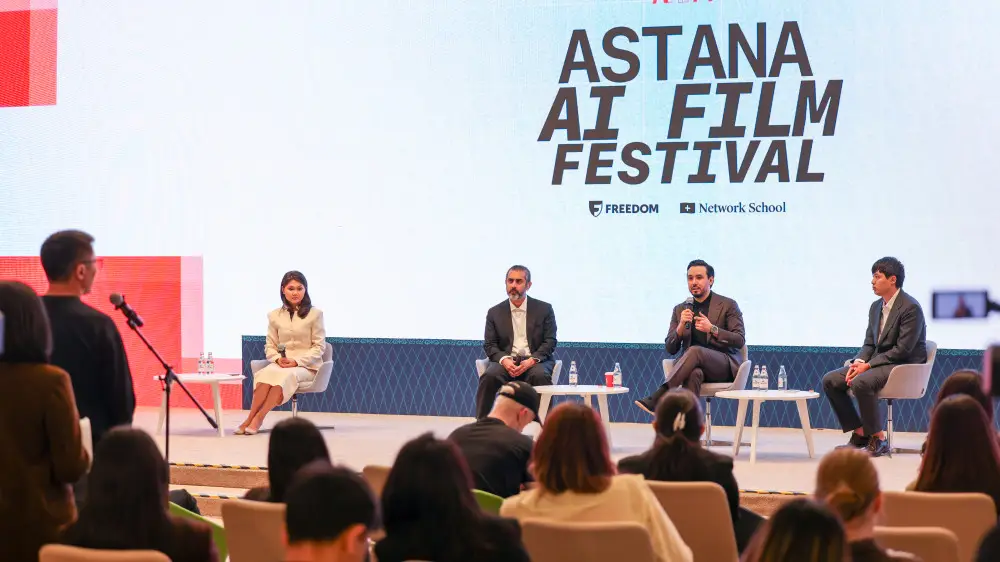
Astana AI Film Festival’s briefing in Astana. Photo credit: AAIFF.
More than 8,000 films were submitted to the international competition, highlighting the rapid growth of AI-assisted filmmaking and the expanding global community around the emerging field. The festival received 8,067 submissions from 4,756 unique creators. The total running time of the submitted works exceeded 100,000 minutes.
The competition is divided into two sections. A total of 3,138 films were submitted under the festival’s main theme, The Future Worth Living In, while another 4,929 entries were submitted to the open competition without thematic restrictions.
The United States led in submissions with 1,395 films, followed by Kazakhstan with 829, India with 702, China with 550 and South Korea with 349. The United Kingdom, Indonesia, Japan, Brazil and France also ranked among the countries with the highest number of entries.
AI filmmakers experiment with new forms
The submitted works span 19 genres, with participants using artificial intelligence not only to generate visual content but also to experiment with storytelling, genres and the creation of cinematic worlds. The longest film submitted runs for four hours and three minutes, while one project combines five separate fictional universes.
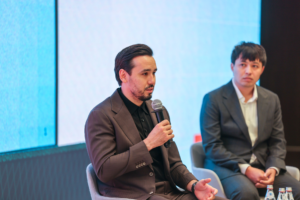
Almas Zhali, co-founder of the festival and chairman of the AAIFF board. Photo credit: AAIFF.
“Just a few months ago, we were launching an international competition, and today we have received more than 8,000 works from 125 countries,” said Almas Zhali, co-founder of the festival and chairman of the AAIFF board.
“These are no longer isolated AI experiments – we are seeing full-fledged films, complex stories, characters and entire universes. This scale shows how quickly AI cinema is developing,” he said.
The participants include emerging directors and independent teams alongside established figures in the international AI creative industry. Among them are AI production studio The DOR Brothers, which has more than 370,000 followers, director Zack London’s Gossip Goblin project and Robert Gaudette, whose works have previously been presented and recognized at international film festivals.
Organizers estimate that participants spent more than $4 million using more than 80 generative AI models. Among the most widely used tools were Suno AI, Seedance 2.5, Kling, Wan 2.6, GPT Image 2 and ElevenLabs.
All submitted films undergo mandatory plagiarism checks.
Festival offers $1.75 million in prizes
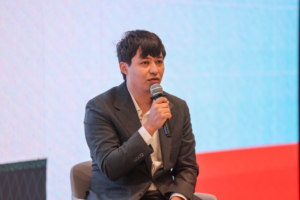
Aizatulla Hussein, co-founder of AAIFF. Photo credit: AAIFF.
The main thematic competition will distribute $1.75 million in prize money, while another $250,000 will be distributed among five categories in the open competition. A separate $1 million investment fund has also been established for promising AI teams. Entrepreneur and investor Balaji Srinivasan, former chief technology officer of Coinbase, former general partner at Andreessen Horowitz, and founder of The Network School, provided the capital.
“We want strong projects to continue after the festival. That is why, in addition to the prize fund, there is a separate investment capital,” said Aizatulla Hussein, co-founder of AAIFF.
The investment is intended to help selected creators continue production, scale their projects and develop them from Kazakhstan. Selected teams will have an opportunity to join Astana Hub, he said.
AI cinema still searching for its identity
Despite the rapid growth of AI-generated filmmaking, the field has yet to develop a distinct and consistent form, according to Hussein.
After reviewing thousands of submissions from different countries, organizers found no single established model for AI cinema. Some filmmakers use AI to reproduce traditional cinematic forms, while others create experimental works that are difficult to classify within conventional filmmaking.
“The trend and the form itself are only taking shape and being explored. Previously, trends could remain for months, but now everything changes practically every day,” Hussein said.
He noted differences in the approaches taken by creators from different countries. South Korean submissions, for example, frequently featured noir and horror aesthetics, as well as stories set in office environments. Chinese creators more often turned to animation and demonstrated distinctive visual approaches, he said.
Kazakh filmmakers also showed recurring themes, with national motifs and visions of the future appearing in many submissions. Yurts, the steppe and robots feature in some of the country’s science-fiction-inspired works. Hussein said it remains difficult to draw a clear line between entertainment content generated with AI and what can be considered full-fledged AI cinema.
“Some try simply to reproduce traditional cinema, while others experiment in ways that do not look like cinema at all, but are very interesting,” he said.
He expressed hope that the festival could contribute to defining a new form and potentially even a new name for this emerging type of entertainment and filmmaking.
AAIFF 2026 will take place from Oct. 1 to 3 as part of AI Month, a series of events dedicated to artificial intelligence. For the first time, finalists will have an opportunity to present their AI-generated films to audiences on a large cinema screen in Astana.
The festival program will also include business sessions, panel discussions and master classes for filmmakers and industry representatives. The awards ceremony and announcement of winners will take place on Oct. 3.









Leave a Reply