
There’s a conversation happening about your brand right now. It’s not on social media, in a Reddit thread, or even a Google review; the conversation is taking place in an AI chat window. Someone out there is asking ChatGPT, Perplexity, Gemini, and the like about your category, your competitors, and your products specifically. And unless you’re tracking what those platforms are saying, you have no idea how that conversation is going.
That’s the LLM visibility problem brands are facing today, and it’s why there’s an entirely new category of marketing tools that has exploded in the last two years.
While we might have treated AI Overviews as more of a mildly annoying SERP update, the traffic data that’s exploded in LLMs proves this isn’t a channel brands can afford to ignore.
The challenge is that the tools built for this moment are newer, faster-moving, and harder to evaluate than the SEO tools we know and love today. Some are execution-focused platforms with full AEO workflows; others are add-ons tacked onto the tools you may already be using. Some are built for teams of one exploring AEO for the first time; others are for enterprise teams with legal, compliance, and multi-region needs. And a lot of the comparison content out there was written by the companies selling the tools, so it’s important to take their lists with a healthy-sized grain of salt.
To keep things kosher and help you find a tool that’s right for what your brand needs, this list covers the best LLM visibility tools I’ve spotted in the market, how I’ve evaluated these tools, what each one is best for, and how to figure out which one makes the most sense for your team. No matter if you’re just beginning to track AI mentions or building a full AEO program, here’s an entry point for every team.
What Is LLM Visibility? (& Why You Should Care)
LLM visibility refers to how often, how accurately, and how favorably your brand appears in AI search responses across platforms like ChatGPT, AI Overviews, Perplexity, Gemini, Claude, and the many others people (including your customers) are using today. While you may not be tracking a click here, you’re instead tracking your brand’s presence (or absence of it) inside the answers AI search tools generate when users ask questions relevant to your category, products, or competitors.
Unlike traditional search, where you can audit your position for select keywords and have a reasonable idea of what users see, LLM visibility is opaque by design. There’s no page two or rank tracker built into Google Search Console. When an AI system decides whether to mention your brand, in response to high-intent queries, that decision happens upstream of any click, any session, and any conversion you’d normally track.
The shift upstream is what makes this consequential.
The Funnel Has a New First Touch
Since the 90s, the search funnel started with a query and ended with a click (and SEO owned that moment). But AI search has collapsed the research phase, giving users synthesized recommendations before they ever reach your website, if they ever visit your website at all, thanks to AI shopping integrations. AI tells people who is worth clicking on, and brands aren’t in the answer; you might also not make it into the consideration set. No amount of CRO fixes can fix being invisible in AI search.
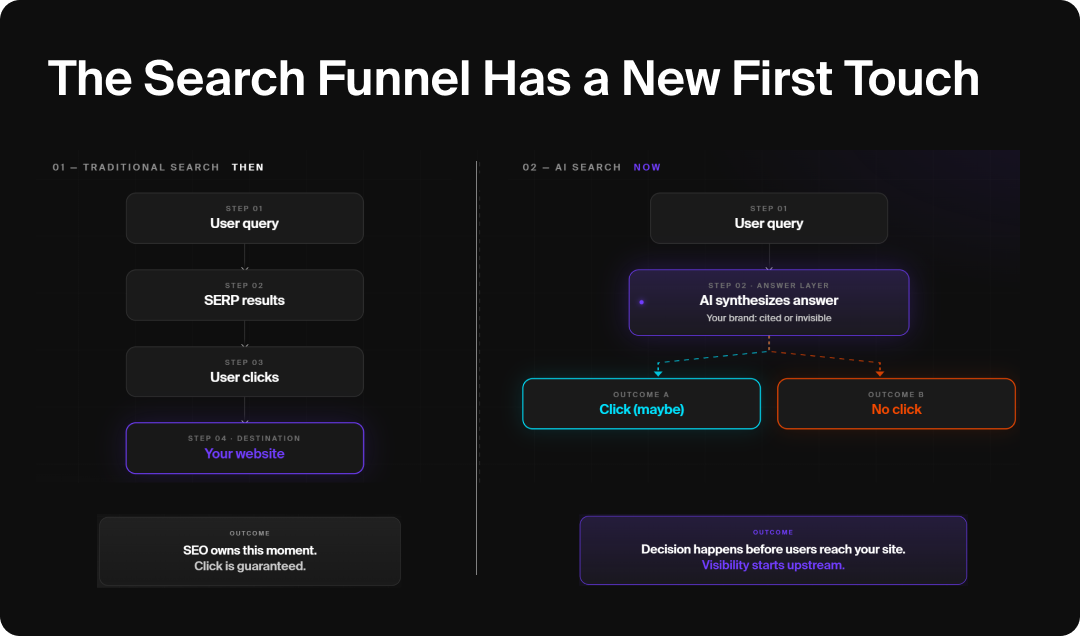
What makes this especially tricky is that LLMs don’t index your pages on a crawl schedule or rank them against a set of signals you confidently and efficiently reverse-engineer. Responses are generated dynamically, drawing from training data, live retrieval, and platform-specific data access.
This means that the same questions can produce meaningfully different answers depending on which model is asked, when it’s asked, and what data the models have been trained on or have access to at that moment.
Visibility Means Citations in AI Search
Traditional SEO is relatively legible: your rank for keywords, you appear on SERPs, and you get clicks. The signals are measurable, you know the levers, and the feedback loop (although it can be slow) is tangible.
LLM visibility operates on a different logic. The factors that determine whether AI search platforms cite your brand include:
- Citation authority: Which sources does this model pull from, and does your brand appear in them?
- Entity recognition: Is your brand clearly defined across the web as an entity with attributes, relationships, and context that AI systems can parse?
- Sentiment in training data: How is your brand described in the sources the model learned from?
- Prompt-level exposure: Are you appearing when users ask questions at the awareness stage, the consideration stage, or both, or neither?
- Recency and retrieval: For models with live web access, is your content structured in a way that retrieval-augmented generation (RAG) systems can surface and trust?
You won’t find this in Google Analytics or any rank tracker that I know of. But all of these factors are actively shaping whether new customers encounter your brand during the research phase of their buying journey.
The Competitive Risk Is Already Compounding
Here’s what gets most people’s attention: AI visibility gaps are self-reinforcing. When a model learns that Brand X is the recommended solution for a given problem (through training data, citation patterns, and user behavior), the association deepens over time. Brands establishing their presence in AI answers now are building compounding authority in a channel still largely uncontested.
The inverse is also true. If your competitors are investing in AEO and you aren’t, the gap between your AI visibility and theirs grows. Every new piece of content they publish, every authoritative source that cites them, every structured data implementation they ship is a signal that reinforces their presence and further marginalizes yours.
That’s the core case of LLM visibility tracking: you can’t optimize what you can’t see. And you don’t want to be flying blind when purchase decisions are influenced at scale.
The LLM visibility tool market is quickly expanding (and dare I say, already getting a bit oversaturated?). New players seemingly launch every day, established platforms are bolting on AI-tracking features, and the gap between what tools claim to do versus what they actually do can be significant. With that in mind, here’s what I looked at when building this list.
AI Engine Coverage
The bare minimum for AI visibility tracking in 2026 is ChatGPT, AI Overviews, Perplexity, and Gemini. Beyond that, I looked at whether tools cover Google AI Mode, Claude, Copilot, DeepSeek, Meta AI, Grok, and Amazon Rufus (platforms that are either already driving meaningful traffic or are growing fast enough to warrant inclusion).
Broader coverage isn’t always better (more on that in the “how to choose” section), but I noted where tools are thin.
Monitoring Methodology
Not all tracking is created equal. Some tools query live, consumer-facing interfaces, meaning they capture what users actually see, including real-time retrieval, citations, and formatting. Others rely on API calls or static prompt snapshots, which can miss dynamic behaviors like RAG-sourced citations or AI Mode’s product carousel.
I weighted tools that are transparent about their methodology and whose approach reflects how real users interact with these platforms.
Depth of Insight Beyond Mention Counting
Knowing that you were mentioned is table stakes. I looked for tools that go further: sentiment analysis, citation source identification, share of voice against competitors, prompt-level performance, AI crawler analytics, and traffic attribution back to actual sessions and conversions.
The further a tool moves from “you appeared here” toward “here’s why and here’s what to do about it,” the more useful it is in practice.
Execution Capability
Visibility data without a path to action has limited value. I looked for tools that meaningfully connect monitoring to optimizing, whether that’s content recommendations, technical AEO guidance, content generation, or outreach to citation sources. This is where the market is still maturing, and the gap between tracking-only tools and full AEO platforms is one of the most important distinctions to understand before forking over some budget.
Pricing Transparency and Scalability
I’ve included all publicly available pricing and flagged where you’ll need to contact sales. I also looked at how pricing scales: some tools are accessible at an entry level but get expensive fast as you add prompts, engines, or users, which matters depending on how broad your monitoring needs are.
A note on objectivity: I’ve tested and worked with several of these tools directly. For others, I’ve drawn on published reviews, third-party comparisons, and documented user feedback. In instances where I have a direct relationship with a tool (Goodie, which my team uses), I’ve noted it and done my best to evaluate it against the same criteria as everything else on this list.
|
Goodie |
Full-cycle AEO |
11 models |
Pricing is custom; contact the Goodie team |
Full (content, technical, outreach) |
|
Profound |
Raw AI search intelligence |
10 engines (3 on Growth) |
$99 / month |
Partial (6 articles per month on Growth) |
|
Peec AI |
Multi-country tracking |
4 base + add-ons |
$95 / month |
Monitoring only |
|
Otterly AI |
AEO entry point |
6 engines (Gemini and AI Mode add-on) |
$29 / month |
Monitoring + GEO audit |
|
LLMrefs |
Flat-rate broad coverage |
11 models |
$79 / month (freemium available) |
Monitoring only |
|
Ahrefs Brand Radar |
Ahrefs power users |
6 models |
$328 / month total |
Monitoring only |
|
Semrush Toolkit |
Semrush power users |
5 models |
$238 / month total |
Monitoring only |
|
Scrunch AI |
Brand accuracy and governance |
4 models (Core), 9 (Enterprise) |
$250 / month |
Monitoring + accuracy detection |
|
SE Ranking |
Mid-market all-rounder |
4 models |
$174.40 / month total |
Monitoring + competitive intelligence |
Goodie: Best for Full-Cycle AEO
The most complete platform for brands that want to go beyond tracking and actually run an AEO program.

Goodie tells you where you stand, why you’re standing there, and what to do about it. The tool was designed by marketers from the ground up around the full AEO lifecycle: monitor, analyze, optimize, and measure in one platform, without stitching together four different subscriptions to get there.
The breadth of engine coverage is one of the widest in the market at 11 platforms: ChatGPT, Perplexity, Google AI Overviews, Google AI Mode, Gemini, Claude, Copilot, Meta AI, DeepSeek, Grok, and Amazon Rufus. For any brand selling through or competing on Amazon, that last one is a valuable visibility surface that most tools aren’t tracking yet.
Where I’d argue Goodie really pulls ahead of other tools is in the execution layer. The Optimization Hub doesn’t just surface gaps; it generates AI visibility-optimized content, provides technical recommendations (schema fixes, crawlability issues, content structure), and even drafts personalized outreach to citation sources influencing answers in your category.
The platform also includes traffic and attribution analytics that connect AI visibility to sessions and conversions, updated daily across all plans, with hourly updates on traffic data. Global monitoring is also available across all tiers, starting with two countries and two languages on the Explorer plan and scaling up from there. This makes it one of the more practical options for brands operating across multiple markets.
AI Engine Coverage: ChatGPT, Perplexity, Google AI Overviews, Google AI Mode, Gemini, Claude, Copilot, Meta AI, DeepSeek, Grok, Rufus (11 engines)
Standout Features:
- Optimization Hub: content generation, technical AEO recommendations, and citation source outreach
- Traffic and Attribution: analytics connecting AI visibility to actual sessions and revenue
- Author Stamp: feed in writing samples, and Goodie generates AEO content in your brand voice
- Competitive benchmarking and share of voice across all tracked engines
- AI crawler analytics to identify and fix indexing issues before they affect visibility
- Global monitoring across countries and languages on all plans
- Shopping visibility tracking across AI commerce surfaces, including Rufus and AI Mode
Best For: Enterprise brands and in-house marketing teams that need monitoring and execution in one platform, particularly in eCommerce, B2B SaaS, and any category where AI shopping surfaces are becoming a primary discovery channel.
Pricing: Contact for pricing.
One Limitation: Goodie currently doesn’t publish self-serve pricing or offer a free trial; you’ll need to book a demo to get a quote, which adds friction for teams that want to evaluate tools independently before talking to sales.
Profound: Best for Raw AI Search Intelligence
The deepest AI search intelligence platform on the market, built for teams that prioritize data depth and are willing to pay for it.
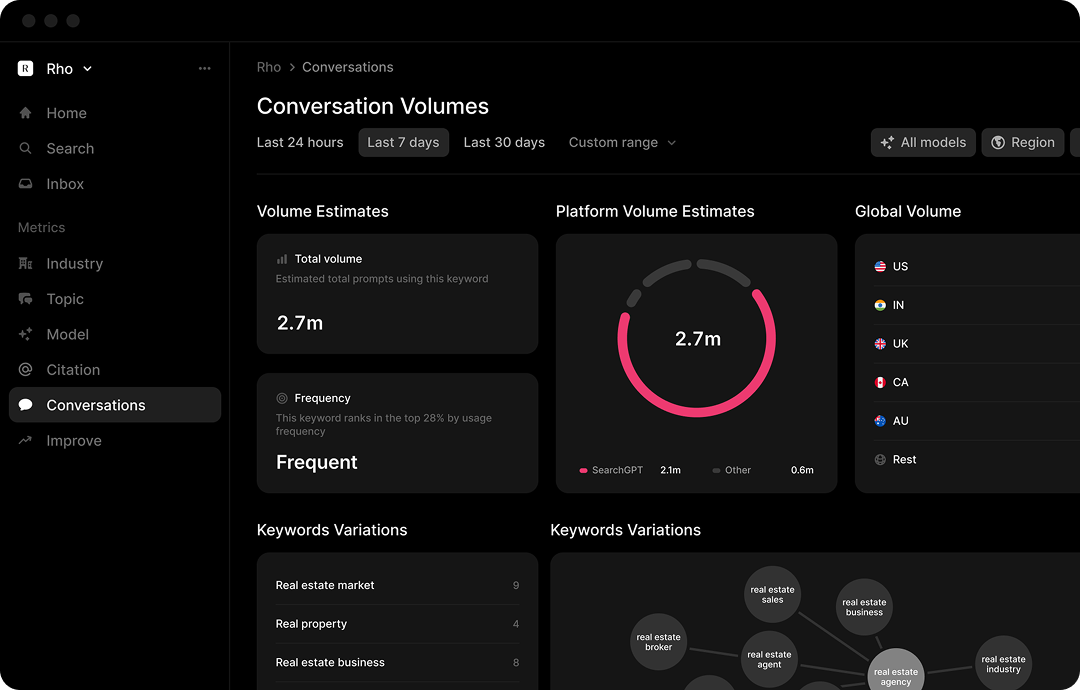
Profound’s brightest differentiator is its Conversation Explorer, powered by a dataset of 100M+ real user prompts. Rather than just showing you where your brand appeared, this tool estimates actual conversation volume inside AI search platforms to give you a sense of how often your category is discussed. That’s useful marketing intelligence that goes beyond basic visibility tracking, and is something no other tool on this list replicates at the same depth.
Profound also recently added Query Fanouts Analysis, which reveals how AI engines decompose a single user prompt into multiple retrieval queries before generating a response. Understanding what AI systems are actually searching for (not just what users typed) is a meaningful unlock for content and AEO strategy.
Combined with SOC 2 Type II certification and CDN-based agent analytics (via Cloudflare, Vercel, Fastly, and others), Profound is built for organizations where governance, data security, and executive-ready reporting are non-negotiable requirements.
Worth noting: Profound recently raised $96 million at a $1 billion valuation, bringing its total funding to $155 million, the biggest signal yet that enterprise investment in this category is very real.
AI Engine Coverage: ChatGPT, Perplexity, Google AI Overviews, Google AI Mode, Gemini, Claude, Copilot, Meta AI, DeepSeek, Grok (10 engines; full coverage requires Enterprise tier)
Best For: Enterprise marketing and SEO teams at established brands who need the deepest available intelligence on AI search behavior, real prompt volume data, and a platform that can scale across business units, regions, and product lines.
- Starter: $99/month (billed yearly); ChatGPT tracking only, 50 prompts, email support
- Growth: $399/month (billed yearly); 3 answer engines, 100 prompts, 6 optimized articles/month, email support
- Enterprise: Custom; up to 10 answer engines, multiple companies, tailored prompt plan, dedicated Slack support, SSO/SAML + SOC 2 compliance
One Limitation: The pricing tiers create a real decision point. The Starter plan at $99/month only tracks ChatGPT, which isn’t enough for any serious multi-engine monitoring program. Getting to 3 engines means jumping to $399/month, and full 10-engine coverage is enterprise-only. Teams that need broad AI visibility out of the gate will hit that ceiling quickly.
Peec AI: Best for Easy Multi-Country Tracking
A purpose-built LLM tracking platform with an unusually clean UX and strong international coverage (without the enterprise price tag).
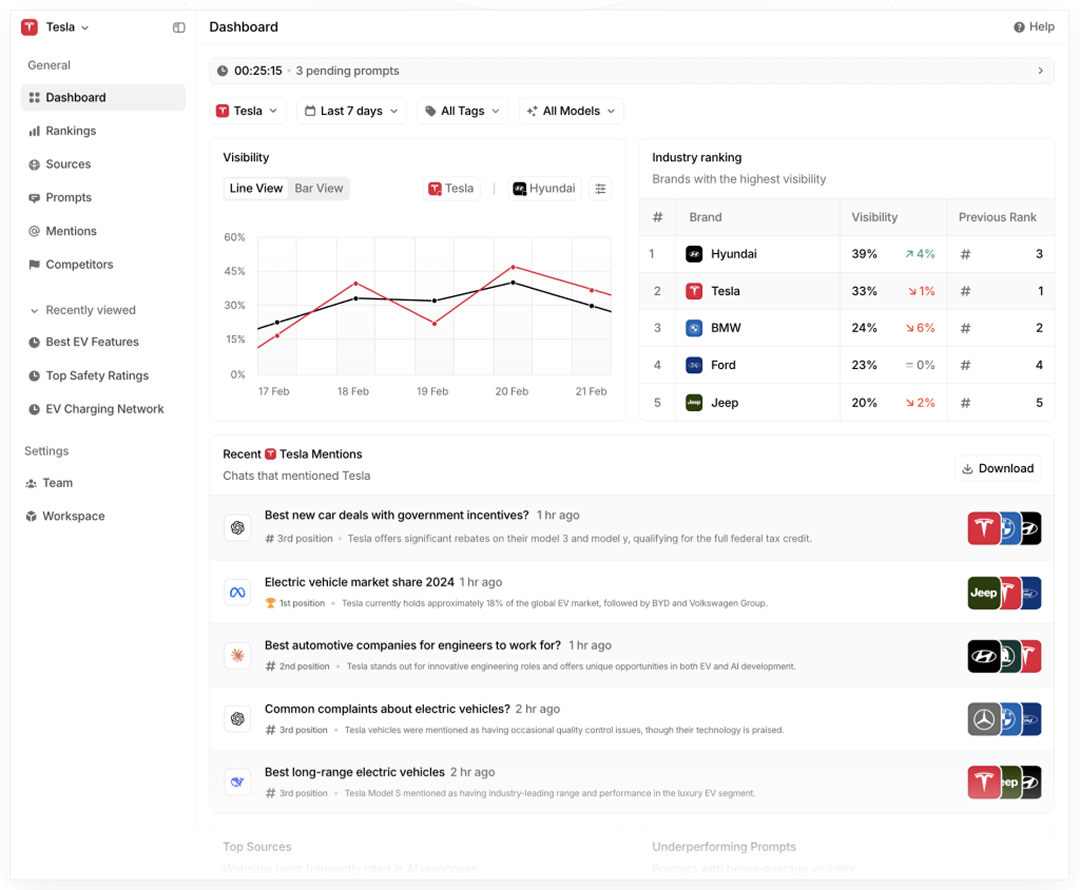
Peec AI launched in 2025, and its focus is deliberate: clean, accurate, multi-country LLM tracking without overcomplicating the experience. There’s no sprawling feature set to navigate, no enterprise sales process to endure, just solid monitoring with a UI you don’t need a dedicated analyst to get value from if you don’t have the biggest marketing team or the most experience with AI search.
Peec is still developing on the execution side; it’s primarily a monitoring and reporting tool, so you’ll need to bring your own content and optimization workflow. For teams that already have an AEO strategy and just need reliable, accessible tracking data to inform it, that’s a reasonable tradeoff. For teams that need monitoring and execution in one place, it’s worth evaluating alongside a more full-cycle platform.
Worth noting: Peec offers separate pricing structures for brands and agencies, which is relatively rare in this category and makes it a more practical option for agencies managing multiple clients.
AI Engine Coverage: ChatGPT, Perplexity, Google AI Overviews, Google AI Mode (base); Gemini, Claude, DeepSeek, Llama, Grok, and others available as add-ons
Best For: Mid-market brands and European teams that need clean, reliable multi-country LLM tracking with modular engine coverage and a self-serve entry point, without the complexity or cost of an enterprise platform.
Pricing:
- Starter: $95/month; 50 prompts, 3 models, unlimited users, daily tracking, 1 project
- Pro: $245/month; 150 prompts, 3 models, unlimited users, daily tracking, 2 projects
- Advanced: $495/month; 350 prompts, 3 models, unlimited users, daily tracking, 5 projects, multi-country, GSC/GA/Looker integrations
- Enterprise: Custom; fully customizable prompts, all models, daily or weekly tracking, unlimited projects, API access, SSO
- Essential: $245/month; 10,000 credits
- Growth: $495/month; 25,000 credits
- Scale: $795/month; 65,000 credits
- Comprehensive: Custom; unlimited credits
One Limitation: Execution capability is limited. Peec is a monitoring-first tool and doesn’t currently offer content generation, optimization recommendations, or citation outreach, so you’ll need to pair it with other tools to complete your AEO workflow. Multi-country support is also gated behind the Advanced plan ($495/month), which is worth factoring in if international tracking is a primary use case.
Otterly AI: Best Entry Point for Teams New to AEO
The most accessible starting point in the market: strong GEO audit capabilities and a $29/month entry price that makes it easy to justify a first experiment.
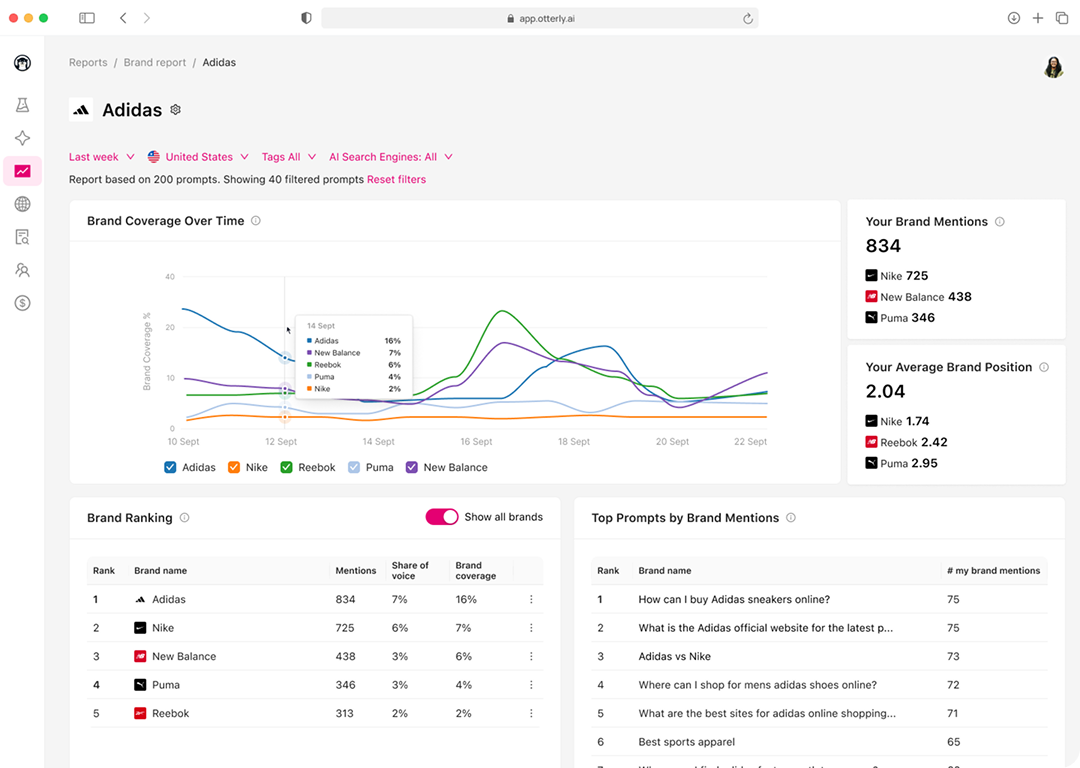
Otterly AI’s pitch is straightforward: automated prompt monitoring across major AI engines, clear reporting, and a GEO audit feature that multiple independent reviewers called the most detailed available at its price point. For teams that have been meaning to get started with AI visibility tracking but haven’t yet, Otterly is the lowest-friction entry point on this list.
- The platform monitors ChatGPT, Google AI Overviews, Perplexity, Google AI Mode, Gemini, and Microsoft Copilot, capturing full AI responses (not just snippets) along with cited sources, brand mention frequency, and competitive share of voice.
- Its Semrush App Center integration is a differentiator for teams already in that ecosystem, letting you layer GEO data on top of SEO metrics without adding another dashboard.
- The alerting feature gets consistent praise in user reviews: Slack notifications when your brand is mentioned in a relevant AI response is the kind of thing that sounds minor until the first time it catches something your competitors missed.
The main constraint is how pricing scales. The $29/month Lite plan covers only 15 prompts, enough to test the concept, not enough to run a real monitoring program. Moving to Standard ($189/month) for 100 prompts is a significant jump, and the Pro tier at $489/month can feel steep for what remains primarily a tracking tool. If your monitoring needs are modest and your budget is limited, Otterly is a smart starting point. If you’re scaling quickly, keep an eye on where the prompt limits start to pinch.
AI Engine Coverage: ChatGPT, Google AI Overviews, Google AI Mode, Perplexity, Gemini, Microsoft Copilot (6 engines)
Best For: Solo marketers, small teams, and SEO practitioners taking their first steps into AEO who want solid monitoring, strong GEO auditing, and a low financial commitment to get started, especially those already in the Semrush ecosystem.
Pricing: $29/month (Lite, 15 prompts), $189/month (Standard, 100 prompts), $489/month (Premium, 400 prompts). Enterprise pricing is custom
One Limitation: Prompt-based pricing scales steeply; the jump from Lite to Standard alone is a 550% price increase, and the platform’s execution capabilities are limited compared to full AEO platforms, so it works best as a monitoring layer within a broader toolkit.
LLMrefs: Best for Flat-Rate Multi-Engine Coverage
Straightforward LLM visibility tracking across 11 engines at a single flat rate: no per-engine fees, no prompt tier math.

LLMrefs takes a different approach to pricing than almost everything else on this list: one flat rate, all engines included, no add-ons required. At $79/month, it covers 11 AI platforms, the widest engine coverage available at any fixed price point in the market, which makes the unit economics unusually favorable for teams that need broad coverage without the complexity of modular pricing.
The platform tracks brand mentions, citation sources, sentiment, and share of voice across its full engine set, and delivers the kind of clean, consistent reporting that teams can build a monitoring cadence around. It’s not trying to be a full AEO platform, so there’s no content generation, no optimization hub, no citation outreach workflow, but for the specific job of knowing where your brand stands across a wide surface area of AI search, it’s an efficient and honest tool.
LLMrefs is the right fit for teams that have already identified AI visibility as a priority and want comprehensive tracking data to inform a strategy they’re executing elsewhere. It’s also a reasonable option for agencies managing multiple brands that need cost-effective per-brand monitoring without paying per-engine on each account.
AI Engine Coverage: 11 engines, including ChatGPT, Perplexity, Google AI Overviews, Gemini, Claude, Copilot, DeepSeek, and others
Best For: Budget-conscious teams, agencies managing multiple brands, and practitioners who need wide engine coverage at a predictable flat rate and are handling optimization and content execution with separate tools.
Pricing: $79/month (flat rate, all engines included)
One Limitation: Execution capability is minimal. LLMrefs is a pure tracking tool, so teams looking for content recommendations, technical AEO guidance, or optimization workflows will need to look elsewhere.
Ahrefs Brand Radar: Best for Ahrefs Power Users
A large-scale AI visibility add-on for teams already deep in the Ahrefs ecosystem: powerful for research, less suited to day-to-day optimization.
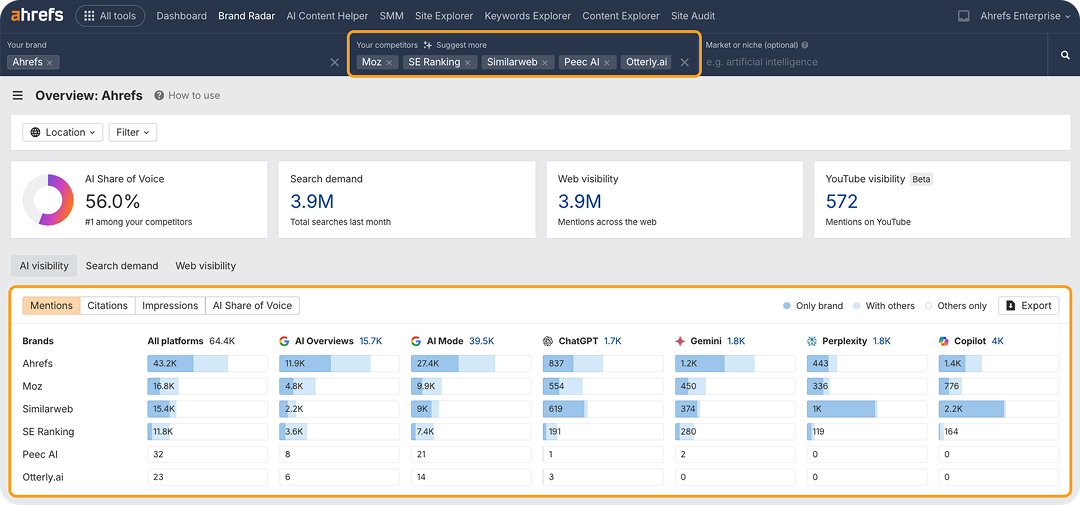
If you’re already using Ahrefs for keyword research, backlink analysis, and content auditing, Brand Radar is the most natural way to layer AI visibility onto your existing stack without adding another vendor relationship. The scale is impressive: a database of 252M+ monthly prompts across six AI platforms, which means you’re not just tracking prompts you already know about, but discovering where your brand appears across a constant sweep of AI responses you’d never surface manually.
The ecosystem integration is the real differentiator:
- When Brand Radar surfaces a citation gap, you can immediately pivot to Ahrefs’ keyword and backlink data to understand what’s driving it, a workflow that’s faster than switching between platforms.
- Custom AI prompt tracking is available alongside YouTube, TikTok, and Reddit mention tracking, adding upstream discovery signals from where AI citations often originate.
The honest caveat is price and accuracy. Full coverage across all six AI platforms costs $699/month as a Brand Radar add-on, on top of your existing Ahrefs subscription (starting at $129/month), making the total investment $828/month or more for comprehensive AI tracking. Independent testing has also surfaced accuracy concerns with Brand Radar’s snapshot-based methodology compared to tools that query live interfaces. For directional brand research, it performs well, but for granular prompt-level tracking, dedicated platforms are more reliable.
AI Engine Coverage: Google AI Overviews, Google AI Mode, ChatGPT, Perplexity, Gemini, Copilot (6 engines)
Best For: Marketing teams and agencies already using Ahrefs as their primary SEO platform who want to add directional AI visibility data without switching tools, particularly for research and competitive intelligence, rather than daily optimization.
Pricing: Brand Radar add-on starts at $199/month per platform index; $699/month for all six. Requires an existing Ahrefs plan from $129/month. Total: $328–$828+/month.
One Limitation: Snapshot-based tracking methodology has documented accuracy gaps compared to live-interface monitoring tools, and execution capability is absent. Brand Radar is a research and measurement tool, not an optimization platform.
Semrush AI Visibility Toolkit: Best for Semrush Users Who Want AI Tracking
A logical add-on for the millions of marketers already living in Semrush: AI visibility data in the same dashboard where you’re already doing everything else.
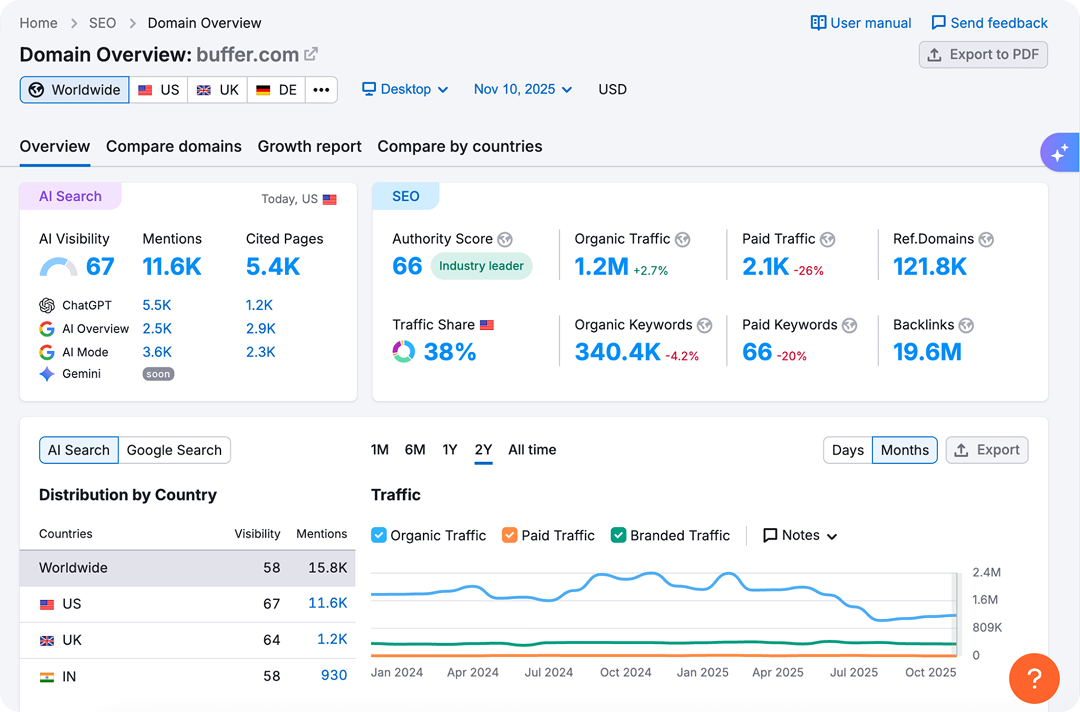
The Semrush AI Visibility Toolkit makes the same bet as Ahrefs Brand Radar: if you’re already paying for the platform, the lowest-friction path into AI visibility tracking is staying there. Built on a database of over 100 million LLM queries, the toolkit covers Google AI Overviews, AI Mode, Gemini, Perplexity, and ChatGPT, with sentiment analysis and competitive benchmarking baked in. The Prompt Research feature is the standout: it surfaces which topics are generating AI answers in your category and where the gaps are, functioning essentially as keyword research for AI search.
The integration story is useful in practice. Connecting AI visibility signals to your existing SEO data (keyword rankings, backlink profiles, content performance) in a single environment removes a friction point from your AEO workflow. For teams where SEO and content functions overlap, having both data sets in one place matters.
The limitations are real, though. Semrush’s AI Visibility Toolkit is currently US English only, which limits its utility for global brands. Pricing scales quickly if you’re tracking multiple domains, and like Brand Radar, the toolkit is primarily a monitoring and research layer, so there’s no built-in content generation, technical AEO recommendations, or execution workflow.
AI Engine Coverage: ChatGPT, Google AI Overviews, Google AI Mode, Gemini, Perplexity (5 engines)
Best For: Existing Semrush users who want to add AI visibility tracking to their current workflow without managing another platform, particularly for US-focused brands running integrated SEO and AEO programs.
Pricing: $99/month add-on per domain. Requires an existing Semrush plan from $139/month. Semrush One bundles both for $199/month.
One Limitation: Currently US English only, which rules it out for international brands. And like most platform add-ons, it’s a monitoring tool without meaningful execution capability.
Scrunch AI: Best for Enterprise Brand Accuracy & Governance
An enterprise-grade platform built around a question most tools don’t ask: not just are you visible, but is what AI says about you actually correct?
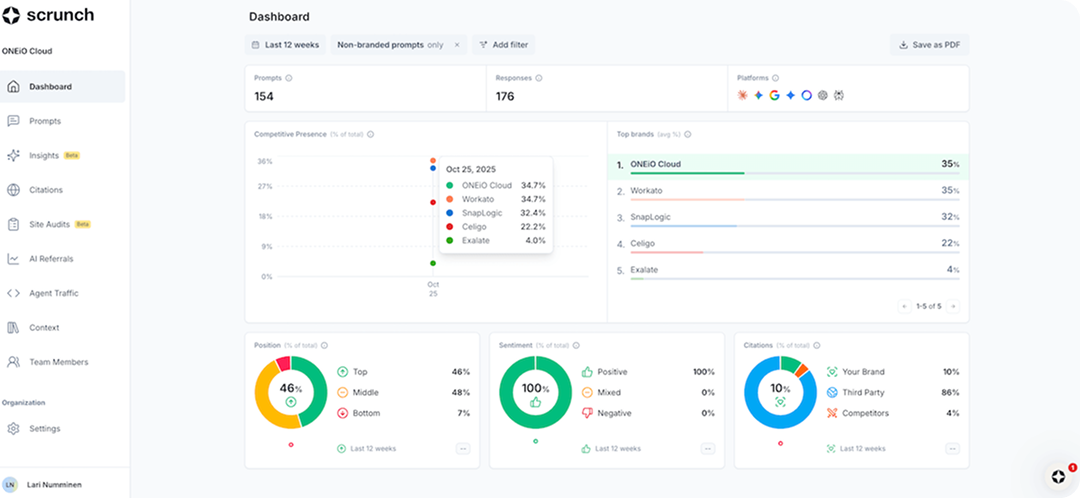
Scrunch AI takes a different angle than most tools on this list. Where the majority of the market is focused on mention frequency and share of voice, Scrunch is built around accuracy, specifically, detecting when AI platforms are generating incorrect, outdated, or misleading information about your brand and giving you the tools to correct it. For enterprise brands where a hallucinated product feature or wrong pricing information has downstream consequences, that focus is a meaningful differentiator.
Scrunch’s Agent Experience Platform (AXP) creates an AI-optimized version of your site designed specifically for AI agent traffic, a forward-looking capability that’s becoming more relevant as agentic AI systems begin actively researching and purchasing on behalf of users. API access for pushing visibility data into internal BI pipelines is available on Enterprise tiers, which teams with custom reporting infrastructure will appreciate.
The tradeoff is complexity and cost. The Core plan at $250/month covers only 4 LLMs (ChatGPT, Perplexity, Google AIO, and Copilot) and full 9-engine coverage requires Enterprise pricing. If broad multi-engine visibility is the primary goal, that gating is worth factoring into your evaluation. If you’re an enterprise brand where AI accuracy is a compliance or reputational concern, it belongs on your list. If you’re a mid-market team looking to get started with broad coverage, there are more accessible options above.
AI Engine Coverage:
- Core: ChatGPT, Perplexity, Google AIO, Copilot (4 LLMs)
- Enterprise: ChatGPT, Claude, Perplexity, Gemini, Meta AI, Google AI Mode, Google AIO, Copilot, Grok (9 LLMs; Grok listed as coming soon)
Best For: Enterprise brands with compliance, governance, or reputational requirements around how AI platforms describe them, particularly organizations managing multiple brands, regions, or product lines where AI accuracy directly affects customer trust.
For Brands:
- Core: $250/mo; 125 unique prompts, 5 site audits/month, 1 brand workspace, 5 user licenses, 4 LLMs, 7-day free trial
- Enterprise: Custom; custom prompts, complete site audits, custom brand workspaces, API access & integrations, expanded model coverage (9 LLMs), SSO, dedicated account team
For Agencies:
- Agency Core: $500/mo; 250 unique prompts, 5 site audits/brand/month, 3 brand workspaces, 3 pitch workspaces, unlimited user licenses, 4 LLMs, 7-day free trial
- Agency Enterprise: Custom; custom prompts, full site audits, custom brand and pitch workspaces, 9 LLMs, SSO, dedicated account team
One Limitation: Scrunch is built for scale and complexity; the product can feel heavy for teams that just need daily monitoring and don’t have dedicated resources to operate a full-scale AI brand governance program.
SE Ranking: Best Mid-Market All-Rounder
A full-spectrum AI visibility platform from an established SEO brand:strong multi-engine tracking, competitive benchmarking, and pricing that sits between the entry-level tools and enterprise options.
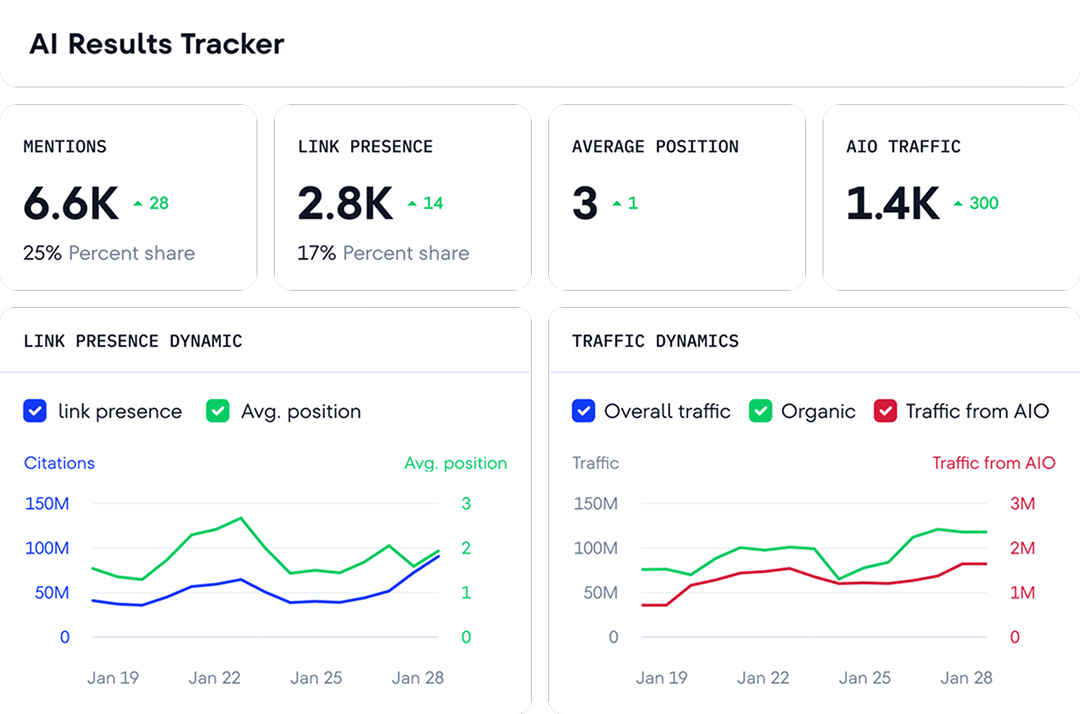
SE Ranking has been a reliable mid-market SEO platform for years, and SE Visible is its purpose-built answer to the AI visibility category. Rather than bolting AI tracking onto an existing SEO dashboard as a simple add-on, SE Visible is a dedicated strategic dashboard for tracking brand mentions, citations, and sentiment trends, accessible through SE Ranking’s AI Search add-on alongside its core SEO suite.
Coverage spans AI Overviews, AI Mode, Perplexity, and ChatGPT, with unlimited competitor research across all four platforms and daily monitoring built in. Competitive analysis is a particular strength; you can benchmark your brand against competitors across AI platforms, which is useful for identifying gaps and prioritizing where to focus optimization efforts.
The platform hits a useful middle ground: more depth and execution guidance than entry-level tools like Otterly or LLMrefs, more accessible pricing than enterprise platforms like Profound or Scrunch. SE Visible doesn’t have the raw intelligence depth of Profound or the full AEO execution layer of Goodie, but for teams that need reliable multi-engine AI tracking with solid competitive intelligence and don’t want to pay enterprise prices to get it, it’s one of the more complete mid-market options available.
AI Engine Coverage: Google AI Overviews, Google AI Mode, Perplexity, ChatGPT (4 engines via AI Search add-on)
Best For: Mid-market brands and agencies that want more depth than entry-level tools offer but aren’t ready for enterprise pricing, particularly teams that prioritize competitive benchmarking and want AI visibility integrated alongside their existing SEO workflow rather than managing a separate platform.
Pricing: SE Ranking’s core plans start at $129.99/month (Core, billed annually) and $279.99/month (Growth, billed annually). The AI Search add-on, which includes SE Visible, the AI Results Tracker, and unlimited competitor research, starts at an additional +$71.20/month for 200 prompts, with a 14-day free trial available on all plans.
One Limitation: Engine coverage is narrower than most dedicated AEO platforms at 4 engines, and notably excludes Gemini, Claude, and Copilot. Teams that need visibility beyond Google’s AI surfaces and the major chatbots will hit that ceiling. Execution capability is also limited compared to full AEO platforms, SE Visible is primarily a monitoring and competitive intelligence layer, and content optimization and AEO recommendations aren’t built into the core workflow.
The honest answer is that the “best” tool depends almost entirely on what you actually need it to do. Most tools in this category track brand mentions across AI platforms. Where they diverge is on depth, execution, price, and how well they fit into your existing workflow. Before you evaluate any of them, it’s worth getting clear on three questions:
- What’s your primary job to be done? There’s a difference between “I need to know if my brand is showing up in AI answers” and “I need to improve how my brand shows up in AI answers.” The first is a monitoring problem. The second is an execution problem. Most tools in this market solve the first one. Far fewer solve both.
- How broad does your coverage need to be? If your audience is primarily US-based and you care most about ChatGPT, AI Overviews, and Perplexity, almost every tool on this list covers you. If you’re operating across multiple markets, need Gemini or Claude tracking, or sell through Amazon and need Rufus visibility, your options narrow quickly.
- What’s your budget ceiling, and how does pricing scale? Several tools look affordable at entry level but get expensive fast as you add prompts, engines, or users. Always calculate total cost of ownership at your actual monitoring scale, not just the starting price.
Quick-Reference: Find Your Tool
- If you’re just getting started and want the lowest-friction entry point → Otterly AI ($29/month, strong GEO auditing, Semrush integration)
- If you want broad engine coverage at a flat, predictable rate → LLMrefs ($79/month, 11 engines, no per-engine fees)
- If you need monitoring and execution in one platform → Goodie (full AEO lifecycle: monitor, optimize, attribute)
- If you’re already deep in Ahrefs and want directional AI data without switching tools → Ahrefs Brand Radar (note the accuracy caveats on ChatGPT/Perplexity)
- If you’re already paying for Semrush and want a low-friction first step → Semrush AI Visibility Toolkit ($99/month add-on, US English only)
- If you need clean multi-country tracking with a self-serve entry point → Peec AI ($95/month for brands, separate agency pricing)
- If you’re mid-market and want AI visibility alongside a full SEO suite → SE Ranking ($103.20/month + $71.20/month AI Search add-on)
- If you need enterprise-grade intelligence and real prompt volume data → Profound ($399/month Growth, $96M funded, deepest analytics in the market)
- If AI accuracy and brand governance are the priority → Scrunch AI ($250/month Core, enterprise-only for full 9-engine coverage)
The LLM visibility tool market has gone from “experimental” to “essential” faster than most marketing categories do. A year ago, tracking your brand in AI answers was a nice-to-have. Today, with AI search traffic growing 155% in 2025 and AI-referred visits converting at 2-3× the rate of traditional organic, it’s a gap you can’t afford to leave unmonitored.
The good news is that there’s now a tool for every stage of that journey. From a $29/month entry point for teams just getting started, to full-cycle AEO platforms built for brands that need monitoring, optimization, and attribution in one place.
The less good news is that visibility data without a path to action only gets you so far. Knowing you’re invisible in AI answers is only useful if you know what to do about it. As you evaluate tools, that execution gap: the distance between “here’s where you stand” and “here’s how to fix it” is the most important thing to pressure-test before you commit.
Start where your budget and workflow allow. But start.
What is LLM visibility, and how is it different from traditional SEO?
Traditional SEO is about ranking in Google’s search results, you optimize for keywords, earn backlinks, and track your position in the blue links. LLM visibility is about whether your brand shows up in the answers that AI platforms generate when users ask questions relevant to your business.
The key difference is where the decision happens. In traditional search, users see a list of options and choose. In AI search, the model makes a recommendation before the user ever sees your site; which means visibility happens upstream of the click, not after it.
Do I need a dedicated LLM visibility tool if I already have Semrush or Ahrefs?
It depends on how seriously you’re treating AI search as a channel. Both Semrush and Ahrefs now offer AI visibility features (the Semrush AI Visibility Toolkit and Ahrefs Brand Radar) and if you’re just getting started, either is a reasonable low-friction first step.
Both are add-ons built on top of legacy SEO infrastructure, which means they have real limitations: Semrush is currently US English only, and Brand Radar has documented accuracy gaps on ChatGPT and Perplexity specifically. If AI visibility becomes a genuine strategic priority, a purpose-built platform will give you meaningfully more depth.
How many prompts do I actually need to track?
More than you think, but fewer than vendors will try to sell you. A reasonable starting point is to identify the 20-30 queries your highest-intent customers are most likely to ask an AI assistant: things like “best AEO tool for [use case]” or “what’s the difference between [you] and [competitor].” That’s enough to establish a baseline and spot the most important gaps. From there, you can expand coverage as your program matures.
What’s the difference between monitoring and execution in AEO tools?
Monitoring tells you where your brand stands in AI answers: which engines cite you, how often, in what context, and how you compare to competitors. Execution is what you do about it: creating content optimized for AI citation, fixing technical issues that prevent AI crawlers from indexing your site, and building the citation authority that influences whether models recommend you.
Most tools in this market do monitoring well. Far fewer close the loop on execution. If you’re evaluating tools, the question to ask isn’t just “what does this show me?” but “what does this help me do?”
How do AI platforms decide which brands to cite?
No AI platform publishes a definitive ranking algorithm the way Google does, but the factors that consistently influence AI citations include the quality and structure of your content, how often authoritative third-party sources mention your brand, whether your site is technically accessible to AI crawlers, and how clearly your brand is defined as an entity across the web. Sentiment in training data matters too. If your brand is consistently described in positive, authoritative contexts, models are more likely to surface you favorably. This is why AEO isn’t just a technical exercise; it’s also a PR and content strategy problem.