
If NASA wants to send humans to Mars in the years ahead, the space agency will need a reliable way for those astronauts to communicate with Earth.
To that end, NASA has tapped Blue Origin to develop the agency’s newest spacecraft that could by 2030 be orbiting the red planet and beaming back valuable data. Blue Origin, the space technology company that Amazon billionaire Jeff Bezos founded in 2000, has a little more than two years to get the Mars orbiter ready for NASA.
Under a $700 million contract, the orbiter will primarily be tasked with providing navigation services and enabling communications with Earth as NASA eyes sending the first astronauts to Mars.
But that may just be the tip of the iceberg for what Blue Origin is envisioning for the spacecraft.
Here’s what to know about the Mars orbiter Blue Origin is building, and why some company officials say it could be a “game changer.”
Rocket launches: Why rocket launches are due to soar in next decade across US
NASA pays Blue Origin $700 million for Mars orbiter

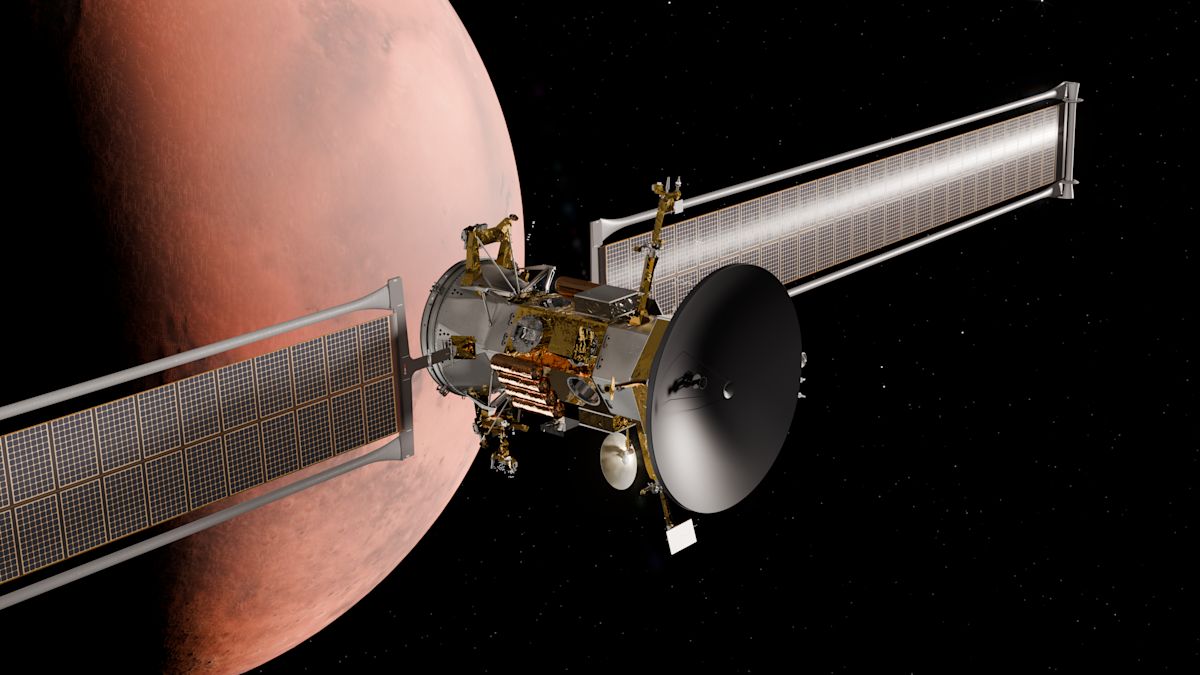
NASA selected Blue Origin to build a Mars orbiter that will enable navigation and communications with Earth during future missions. This artistic rendering shows what the satellite operating the telecommunications network might look like.
NASA announced Sept. 1 that it had awarded Blue Origin a $700 million contract to build the next orbiter bound for Earth’s planetary neighbor.
Dubbed the Mars Telecommunications Orbiter, the spacecraft is being designed to provide “high-speed, continuous coverage between Earth and Mars,” Blue Origin said in a press release. In essence, the orbiter will provide a novel, more effective way to transmit data collected by other spacecraft on Mars all the way back to Earth.
But the orbiter could be more than a simple communications relay, according to Blue Origin officials.
Built with massive solar arrays and large antennas, the orbiter will integrate Blue Origin’s Blue Ring satellite technology, the company said. In production in Huntsville, Alabama, the Blue Ring spacecraft platform is designed to refuel, transport and host smaller satellites for missions in Earth orbit and beyond.
That means the 13 ports included on the spacecraft could transport scientific instruments and even other small uncrewed spacecraft that can separate from it to explore Mars up close, Steve Squyres, Blue Origin’s chief scientist, said in a video.
When will the orbiter be launched?
NASA said it wants Blue Origin to have the Mars orbiter ready by the end of 2028. Then, the plan is for the orbiter to be operational around Mars by 2030.
Blue Origin is tasked not just with developing the spacecraft, but launching it to space and operating the communications network. The company’s towering 320-foot New Glenn rocket has already tested carrying Blue Ring-related cargo to orbit during its inaugural test flight in January 2025 in Florida.
The New Glenn has been out of commission since an explosion at the end of May destroyed a significant portion of the rocket’s launch pad at the Cape Canaveral Space Force Station in Florida. Blue Origin, though, is working toward getting the heavy-lift class launch vehicle operational once again by the end of 2026.
Contract comes as NASA eyes Artemis astronaut missions to moon Mars
The contract is the latest instance in which NASA has turned to the commercial aerospace industry to develop technology to support its ambitious spaceflight program.
The U.S. space agency is in the midst of returning Americans to the moon as early as 2028 and building a $20 billion lunar outpost under its Artemis program where rotating crews of astronauts can work longterm.
Blue Origin will be critical to the next mission under the campaign. In 2027, four Artemis III astronauts are due to reach Earth orbit and test docking capabilities with Blue Origin and SpaceX’s two lunar landers, which will be launched separately on each company’s respective rockets.
NASA’s lunar missions are expected to pave the way for the agency to send the first astronauts to Mars in the 2030s.
Blue Origin’s Mars orbiter will not only support those future missions, but will also assist assets already on Mars – like the Perseverance and Curiosity rovers – in beaming back data to Earth.
“Now we’re going to get to make sure that science makes its way home,” Tory Bruno, Blue Origin’s president of national security, said in the video. “This is a really, really important linchpin mission to enable human exploration of Mars.”
Eric Lagatta is the Space Connect reporter for the USA TODAY Network. Reach him at elagatta@usatodayco.com
This article originally appeared on USA TODAY: Blue Origin to build a ‘game changer’ satellite before humans reach Mars










Leave a Reply