
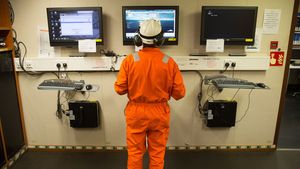

Explore how AI in oil and gas can extend engineering capacity, surface operational insights, and improve production while keeping humans in the loop.

Artificial intelligence is moving rapidly into oil and gas, but adoption remains far from mature. A 2026 McKinsey survey of oilfield services and equipment executives found that less than 25% of companies had progressed beyond AI pilot phases, even though more than three-quarters of respondents expected generative AI to deliver operational efficiencies. The gap suggests that the industry’s AI challenge is increasingly about turning technical capability into useful operational decisions.
That matters because oil and gas operations produce immense volumes of information across wells, equipment, maintenance histories, and production systems. AI is already demonstrating how quickly some of that information can be processed. Reuters reported in 2025 that BP was using AI to evaluate seismic data in the Gulf of Mexico in eight to 12 weeks, compared with six to 12 months previously. The technology’s significance may therefore lie in expanding how much information engineers can meaningfully act upon.
The workforce picture makes that question more urgent. An EY survey found that 85% of oil and gas and chemicals executives believed their organization’s ability to reskill employees would determine its success over the following five years, while only 29% said they were currently retraining employees. As technical demands grow, getting more value from existing expertise could become as important as introducing new technology.
The most useful model may be one in which AI continuously examines operational information, identifies anomalies, and brings potentially valuable decisions to human attention. Engineers would remain responsible for evaluating context, risk, and the appropriate response. That approach treats artificial intelligence as a way to extend scarce attention rather than as a substitute for engineering judgment.
Dillon Ford, founder and CEO of Agentic Energy, describes the constraint as one of time and attention. The company develops AI-based production optimization technology designed to integrate operational data, analyze assets, and generate recommendations for operators. Ford says an engineer responsible for hundreds of wells cannot realistically give every asset the same depth of continuous analysis.
“AI should do the legwork so engineers can spend more of their time doing engineering,” Ford says. “The opportunity is to surface decisions that a capable engineer could make if they had unlimited time to examine every well. Human judgment stays in the loop because the engineer still decides what deserves action.”
That distinction also helps explain why domain knowledge matters. Agentic Energy has designed its system with proprietary AI models to account for engineering constraints, operational history, and the realities of individual assets rather than relying on repurposed, foundational LLMs. His view aligns with the industry’s broader struggle to scale AI. The same McKinsey survey shows that more than half of surveyed oilfield services and equipment leaders identified fragmented data and legacy system integration among the principal barriers to scaling generative AI.
The environmental question also shapes how Ford thinks about efficiency. From his perspective, producing energy more efficiently should be considered across the full operational footprint rather than measured only by how much additional production technology can unlock. He argues that if operators can recover more value from wells and infrastructure already in place, they may be able to reduce some of the additional drilling, equipment, materials, and operational activity that would otherwise be required to maintain production. For Ford, that creates a broader way to evaluate AI in oil and gas, one that considers how intelligently existing resources are developed and managed.
The larger transformation, then, may happen at the engineer’s desk. Ford envisions engineers spending less time gathering and organizing information and more time examining what individual wells actually require.
“The future I want to see is one where engineers have more time to think,” Ford says. “AI can watch more variables than any person has time to watch, but the engineer brings experience, accountability, and judgment. If technology gives talented people more opportunities to use those qualities, that is where its value becomes meaningful.”
Note: This article has been reviewed by the Quartz editorial team. The content may be licensed for reuse.
The essential business news, delivered fresh every morning.
Join 500,000+ readers who start their day with Quartz.
By subscribing, you agree to our Terms of Service and Privacy Policy.
© 2026 Quartz Media, Inc. All rights reserved.









Leave a Reply